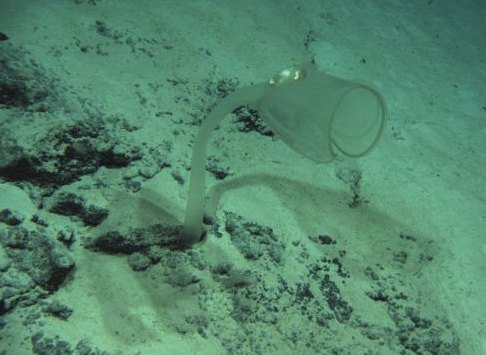
Until last December, no one had ever seen the bottom of the Tasman Fracture, a trench that drops more than four kilometers below the surface of the ocean. A group of Australian and American researchers recently spent a month hundreds of kilometers southwest of the Tasmanian coast, exploring the fracture's depths. Jess Adkins, a professor at Caltech and one of the project's lead scientists, remembers sitting in his control room and watching the underwater life on his monitors with a sense of awe. Once, he says, none of the scientists or pilots said a word for ten minutes straight as their submersible glided over an undiscovered coral reef full of urchins and sponges and sea stars.
The researchers explored the fracture with Jason, a remotely-operated submersible the size of a small car. On loan from the Woods Hole Oceanographic Institute, it carried a high-definition camera that weighed more than five hundred pounds and beamed underwater video up to the ship through a long fiber-optic tether. At 3,000 meters below sea level, the crew saw thousands of sea spiders. At 3,500, millions of specimens of a new, purple-spotted sea anemone. At 4,000 meters, a single never-before-seen carnivorous sea squirt with a funnel-shaped body that snapped shut like a Venus flytrap around any shrimp unfortunate enough to brush against it.
Back on land, the three new species (the anemone, the sea squirt, and a new kind of barnacle) have drawn the most attention, but it's the team's coral collection, some 10,000 pieces of it, that can tell us about the history of our climate and, perhaps, its future.
A coral skeleton acts as a tape recorder of its environment. As it grows, the coral's chemical structure (specifically the weight of its oxygen molecules) varies depending on the temperature of the water around it. And, because the coral's uranium decays into thorium over time, it is conveniently datable. By charting different corals' ages and oxygen weights, researchers can map the ocean's changing temperature. During the coming months, expedition scientists will compare 40,000 years of oceanic and atmospheric records.
The ocean's temperature and carbon dioxide levels are important because of their impact on our atmosphere. The watery part of the world absorbs and stores sixty times more CO2 than the atmosphere. Huge reservoirs of the ocean's CO2 lurk in its coldest, densest waters (found in the Tasman Fracture and off Greenland). Because cold water releases more CO2 into the air than warm water, the rate at which bottom water rises to the surface has a profound effect on the atmosphere above.
Until recently, we had assumed that our climate was relatively stable. After all, for the past 10,000 years -- during which we developed the alphabet, electrical wiring, and microchip necessary for this article -- little has changed. But early-'90s research on Greenland's ice core proved that, over the past 100,000 years, climate stability has been the exception, not the norm. During the last glacial period, global temperatures fluttered up and down by as much as several degrees in as little as a decade. CO2 levels in the atmosphere changed along with the temperature, though more slowly.
The researchers' ultimate goal is to see if changes in the ocean followed or proceeded changes in the atmosphere. Adkins suspects that the ocean (and in particular the depths of the ocean) played a part in triggering the climate's sudden fluctuations. He's sure, though, that we're adding more CO2 to the ocean now, in the form of burning fossil fuels, than it has ever held before. Given how little we know about how the ocean regulates the amount of CO2 in our air (we've mapped the surface of Mars, he points out, but not the ocean floor) he wonders if that's such a good idea.
We do know that increasing the amount of carbon dioxide in the ocean makes it more acidic. And whether or not it sets off a climate shift of Pleistocenic proportions, acidification could kill the researchers' newly-discovered, awe-inspiring reef, along with others we haven't even found yet. There would be just as much ocean to study, but less to find.

Stay up to date on the latest news of the future of science and technology from your iPhone with full articles, images and offline viewing
Carry everything you need to make a smart buy on HDTVs, cameras and 14 other product categories right in your pocket
Featuring every article from the magazine and website, plus links from around the Web. Also see our PopSci DIY feed
Share links with friends, comment on stories and more
Innovative fixes for five of the country's biggest infrastructure messes, plus a look the quest to read the human mind, the LCD screen that might finally kill paper dead, and the world's scariest science.
Read the issue here.
This is very interesting. I find it ironic, though, that we know more about the surface of Mars than the see floor of our own planet. Maybe we should be spending less time, energy and money on space travel and exploration when there is still so much too learn right here on Earth.
someone might want the check the depth listed on the headline page...4,000,000 meters is really deep.. since the story says 4,000 meteres..
-dkenny
someone might want the check the depth listed on the headline page...4,000,000 meters is really deep.. since the story says 4,000 meteres..
-dkenny
this decovery is so cool. I ask - would it be so bad to addmit that nature here on earth is as revelational say as the bible!! I like the transparency of the"sea squrt" i just realy hope they dont name a car after it!!
It would be most ironic if the relative stability of modern man's climate is directly related to the increasing amounts of C02 and other chemicals released into the atmosphere.
The ocean. The most beautiful place in the universe. Ok, i know that mars is AWSOME! And i agree. But i think we need to be spending more time on earth. The more time we DON'T study earth, the worse it's getting.
Remember the indians, they get everything from good old earth. The Ancient Egyptians, they were the best doctors in the world at that time, and they, too, got everything from nature.
I know, i know, "we have all of the technology, we don't need everything from plants." But we got all that we have now from plants and animals. And we still use extracts from plants for medicine. And it keeps getting proved, plants are better at almost everything; keeping you healthy, making you look younger, and so on.
Now, what is this all leading up too? Think of all that we could find, and all that we could find out, just by looking into the ocean! The ocean, it covers 70% of the world we live on (sorry, earth not mars), and yet we know more about some planet, that we can't figure out wether there was water on it or not, then we do about the ocean! I guess you can tell what my vote is for.
I completely agree. There could be cures to diseases we don't even know about yet. What useful knowledge like that can be found on a barren planet that can't support life?
I have read some of the comments above this one and I have to agree that the ocean is very interesting. Mars does have water on it, but in ice form. the "Phoenix" spacecraft proved that this last year with soil samples that were dug up from the surface and it was only a few inches beneath the surface. As for the ocean, there is still a great deal of knowledge to be gained if only the world governments would turn their heads downward, instead of upward to see the stars and not see the common people or good that could be done for humanity right here on good ole' Terra Firma! More time and research are definately needed in the oceans of the world.
Nature is one of the only things that really keep us, as human beings, alive. Still, our research agencies keep funneling extreme amounts of money into studying places that we cannot survive in, nor can we even reach if we needed to travel there. So, why are we doing it? Why are we, the people who fund the taxes for these ventures, not saying to our congressmen, our senate, and other representatives that this is not fortuitous for us?
Coral keeps our oceanic creatures alive as well. Our environmental agencies have been warning us that we stand to suffer greatly if we don’t study our oceans, as well as try to conserve them. For instance, K. Carpenter of the Univ. of Virginia marine biologist reported:
["Corals are the backbone of the ecosystem," Carpenter notes, and reefs harbor roughly one quarter of all known marine species—from fish to algae. "What is going to happen to that huge biodiversity that is dependent on coral reefs? We don't know, but our consensus is that it would most probably lead to a massive loss of biodiversity in the oceans."]
And J. Platt of Scientific American’s 60 seconds to extinction article noted:
[Coral reefs are dying off at record rates, thanks to pollution, disease and global warming. Scientists worldwide are trying to come up with new ideas to conserve and protect not just the coral reefs, but also the biodiversity and human economies that depend upon them for their survival.
Last month, a group of 155 scientists from 26 countries issued a document dubbed "The Monaco Declaration," calling for a reverse in the current 3 percent annual increase of carbon dioxide (CO2) emissions by 2020, noting the pollution makes its way to the oceans, where it has been steadily raising acidity levels (30 percent since the 17th century). If CO2 emissions continue rising at their current levels, the document warns, “ocean acidification may render most regions chemically inhospitable to coral reefs by 2050.”]
While all of this is well known by NOAA and the rest of society, we, as tax payers sit back and bicker about the need for clearer television screens. The sad part of all this is that it will take a catastrophe for people to realize that we need to understand all of our environment if we are to survive. It will do mankind absolutely no good to be able to view other planets that we cannot reach. Even if we found another inhabitable planet, we couldn’t excavate it, nor could we know if we would be 100% compatible to live on it – considering we don’t understand our own environment 100%.
There is an error in the article. "And, because the coral's uranium decays into thorium over time, it is conveniently datable." Uranium does not decay into thorium. In fact both uranium and thorium decay into different lead isotopes. 238U to 206Pb; 235U to 207U; 232Th to 208Pb.
While it may be true that we know less about the oceans than the surface of Mars and that there will be very little possibility of reaching another earth like planet I think it would be VERY short sighted to ignore space exploation in favor of only studying our own planet. Regardless of what we find in the ocean there will never be a significant increase in living space (land) as a result of ocean exploration. There is the possibility of finding new compounds that might be future cancer cures but the same can be said of the world's rain forests.
When we all reach a point where we can put aside differences in ideology, regardless the form of the difference and work for the common good we will all be better off. We will also be able to spend much more on exploation with all the money saved by not going to war.
Earth needs to be explored. I'm for exploring other planets, but i think we need to spend less on other planets and more on the one we are on right now. We are living on THIS planet, not Mars or the moon. This is the place we are spolsed to be, we know of no other planet like Earth. Right now it is raining here, it is so beautifull! But no one knows all about a storm, something that has been going on since the beginning, and now one knows!!!!
So much can be learned on this planet, most everything here is not on any other planet we know of!! This planet is special, like no other.
But that is not even the point. The main question, i think, is WHY should we spend more time studying the Earth then another planet. And i think that the answer, is to long to post here. There are, really, no limit of answers. Better medicin, better living for everyone, help save more lives, understand and help the animals better...and so on.
But that is not really what is going to decide what we should be doing. What we have to do, is decide wether the reasons we want to explore the Earth, and the reasons we want to explore other planets, which ones are better. But that debate could go on forever. So there is not much we can do but for the people to try harder to get more reaserch done on Earth. The one and only special planet.