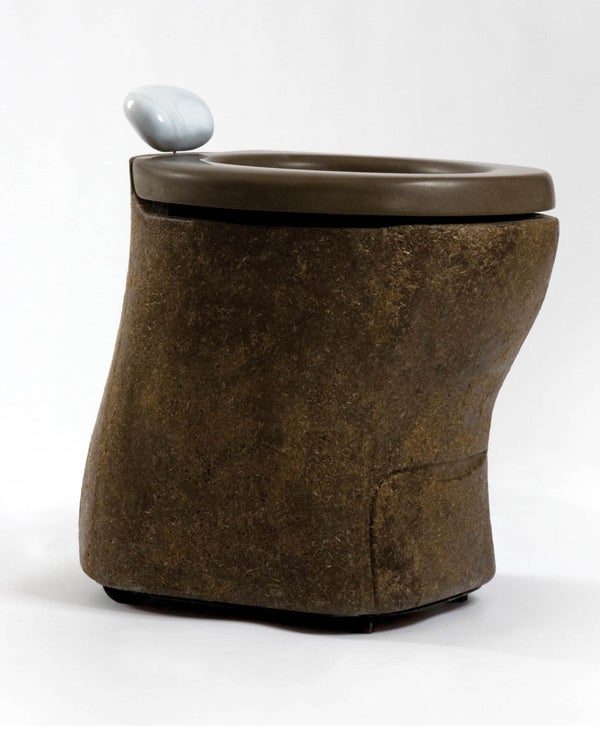
In José Saramago’s novel Blindness, when an epidemic of sightlessness sweeps the city, among the foulest signs of civic breakdown is its inability to handle its own excrement. Human waste piles where it lands, left to the elements and not modern plumbing. To newly minted industrial designer Virginia Gardiner, we might as well be blind to our own waste. Her plumbing-free toilet project, the Gardiner CH4, makes us personally responsible for our intimate product—and makes it useful. The toilet turns human waste into biofuel, which could prove indispensable to the 40 percent of people around the world who have no toilets at all.
Gardiner took all these factors to heart while developing the toilet to satisfy her master’s thesis last year at London’s Royal College of Art. The exterior is molded in 90 percent horse dung (royal dung from the Queen's Household Cavalry, no less). A carbon-rich biodegradable material lines the toilet’s interior. After the user does his or her business, a mechanical “flush” drops the package into a lining-wrapped sealed container. Like rolling luggage, the person trucks the container to a community biodigester unit, which composts the waste to produce methane gas.
“Human waste by itself has too low a carbon-to-nitrogen ratio to produce a lot of methane,” explains Gardiner. “The packaging material enhances methane production.” From experiments done with chemical engineers at Imperial College London (and in her own home), Gardiner estimates that a full-scale biodigester could convert 14 kg of human waste to 110 liters of methane to be used for cooking meals.
Gardiner is now taking donations to develop her working prototype into a full-scale system through the Design London program and to begin field testing in Ibadan, Nigeria. Contribute and receive a lovely deer-head candleholder molded from royal dung! The power of poo is the palm of our hands.
Stay up to date on the latest news of the future of science and technology from your iPhone with full articles, images and offline viewing
Featuring every article from the magazine and website, plus links from around the Web. Also see our PopSci DIY feed
Share links with friends, comment on stories and more
In our December issue, Popular Science names the 100 best innovations of the year: bombproof wallpaper, self-parking cars, the fastest helicopter, and 97 more. Plus inventor profiles and videos.
Check out the best of what's new here.
I love picture number 2 (Pun Intended) with the carry on luggage. Am I the only person who keeps thinking of TSA and the x-ray machine?
Is it available in colors other than **it brown?
I keep picturing an entire subway car packed with people and their poo luggage !
The system would have to be much more convenient before most people would get behind it. Even the greenest of us would hesitate to cart around packages of poo. Perhaps a special container to roll out to the curb so it can be picked up along with other recyclables would do the trick.
from Lehi, UT
Virginia Gardiner brain is the only thing here that is full of poo.
Well you guys don't seem to realize that this would be implemented in places with a lack of proper plumbing. They wouldn't be lugging their poo around on a train or on a sidewalk (or an airport for that manner...) because if a country doesn't have proper plumbing, why would they have those amenities?
This would provide the poor with a place to dump their load, and to provide a use for it, which would all be too great a hassle for us first-worlders.
from Detroit, Texas
"The power of poo is in the palms of our hands." Hat's off to the author of this piece...absolutely loved the voice and composition.
This might be best for India or some other third world country,but in first world countries,it probably makes more sense to use the infrastructure already in place.Process it at the sewage treatment plant,and get methane to power things,as well as rich fertilizer at the end.
I think that Virginia Gardiner should be commended for TRYING to do something other than sitting in front of her computer and poo pooing (no pun intended) other people's ideas. Most of the comments reflect our inability to look outside the box and find new solutions to age old problems. While I see the need for this in underdeveloped countries, I think it's time for us to get off our high horse and take responsibility for our own waste. Every community spends millions of dollars to make going to the bathroom something we take for granted. Our attitude needs to change and we need to accept and learn new ways that don't waste water and money.
That illustration, ignoring the sequence, look like it's saying...
1. Poop into a can.
2. Take the can with you on the airplane.
3. Drink out of the can like Gatorade or other energy drink.
4. When you're all done, take your can to a power plant where you can recycle the can.
I think its a good idea for undeveloped countries with limited infrastructure. the design could use some work (maybe another colour) The picture showing the process, unlike the article is badly done it gives off the wrong message (the post above is a good description).
1) The developing world usually does this already in a cheaper method:
A) Poop in the sun
B) Let it dry
C) Burn it for warmth and to cook food
Of course, herbavore poop burns better and cleaner, so where possible, non-human poop is burned first.
2) This also mirrors modern plumbing, only in a dry mechanical rather than aquius mode. Very similar to the small tankless port-a-johns used on many boats and rvs, where the waste is stored (usually in a plastic sack with blue-water). While this is commendable for dry areas where water is a precious resource, this system does consume a great deal of resources. You can imagine in the third world people struggling to see just how many of the family can go before exchanging the box.
3) Rural communities really just need education. Creating "poop holes" for sanitary purposes and then using the nutrient load as the bases for planting a high yield crop tree (almonds, etc), has been used in land reclimation projects with success in sub-saharan Africa.
4) Urban centers need infrastructure to dispose of human waste. There is no cheap alternative. Plumbing, dry carting, and every other method requires cash outlays that exceed even inflated fuel estimates from human waste. Since no one wants to shell out that money, this nor any other system has any hope of sucess.
In many 3rd world urban centers, however, there is one method that is likely cheaper than any other: pay for it. Put a price on waste, and like the "recycling children" of Brasil, an employment, market, and likely criminal organization will arise for the collection and transport of this waste. Because, after all, it really just comes down to how many pennies a ton do we love our fellow man.
What I love to see is a home methane generator system with the toilet tied directly to it and a kitchen food scrap shoot, too.
IMHO, the truly innovative part we see here is in the material, which was used to build this concept. i've never heard of horse dung used this way and would be very interested in finding out more on that.
the self composting toilet idea is by itself not a new one, here is an interesting link on that topic:
http://home.howstuffworks.com/composting-toilet.htm
according to this article, we could save 6,600 gallons of fresh water/person/year with a self composting toilet.
nice design as well.
often, good ideas are just packaged too plain ugly - and that's why many of them never make it big.
all you inventors, keep that in mind!
"Oh honey...can you take our Sh*t out with the garbage so I can start cooking dinner with it sh*t..."
Interesting, I like the thought.
I **it biofuel! methanol is one crap away!
(TSA taking poo out of the bag) saying sir is this dangerous? or, this material exceeds the 100ml limit i must discard it. " thats my sh*t your throwing away! give my biofuel back!!
dried poop can fuel campfires or something.
THANK YOU
http://www.tamders.com/