The water-choking stuff could be the key to reversing climate change
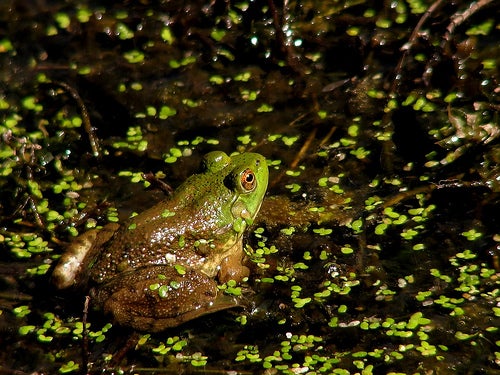
Duckweed Could this green stuff be the key to a cleaner tomorrow? Noël Zia Lee (CC Licensed)

Biologists at the Waksman Institute of Microbiology at Rutgers University have a strange fascination with pond scum. But the fascination may prove more useful than anyone could have imagined.

Most recently, the aquatic plant duckweed has gained attention after being targeted as a possible source of biofuel (not unlike that other pond-choking stuff). But that's just one of the potential applications scientists at the five allied institutions have been uncovering. Thanks to its high nutritional value, duckweed holds promise as a livestock feed, one that's more sustainable due to its ability replenish itself relatively easily (duckweed creates biomass faster than any other flowering plant). It's also being tapped as a means to extract nitrogen and phosphate pollutants from sewage and agricultural wastewater.

Abundant throughout the world, duckweed can be found through North and Central America, Europe, Africa and Asia in fresh water ponds, marshes and streams. Each frond absorbs nutrients through the entire plant, not a central root system like a plant that grows in soil. Because the body of duckweed is composed of metabolically active tissue, photosynthesis is dedicated primarily to producing proteins, which gives the plant its high nutritional value. It's also the smallest plant to bear fruit, each of which is about 1.5 mm wide.

The merits of the plant must have been persuasive, because the U.S. Department of Energy's Joint Genome Institute recently selected duckweed for genome sequencing as part of its 2009 project portfolio.

Who knows what further research will bring? In the future, if anyone says you’re pond scum, you may be inclined to thank that person and be on your way.

Via Science Daily

Want to learn more about the environment, solar energy, sustainability, and more? Subscribe to Popular Science today, for less than $1 per issue!

10 Comments

This sounds like a very interesting concept. But not sure how practical is this. This article does not mentions how much pond scum is required for a few gallons of bio fuel. That has been the problem with the most of the bio fuels, actually. They are technically possible, and financially not very viable.

Ishan

www.dealguide.blogspot.com

The scientest have been talking about this and other plants for fuel and cleaning the world for years. The question is why don't they stop talking and start doing.

www.freewebs.com/algaeisthefuture

www.freewebs.com/algaeisthefuture

www.freewebs.com/algaeisthefuture

www.freewebs.com/algaeisthefuture

im sorry, i didnt mean to post more than once, i just clicked the button too many times

The genetic information will probably help the development and subsequent commercialization of this.. Just hate to see the DOE financing this research when oil company profits are as high as they are. Soylent Green anyone?

http://media.cleantech.com/2189/shell-to-grow-algae-for-biofuel

So All those times my old girlfriends called me "Pond Scum" they meant I was a good guy...........Whooda knew

LoL!


June 2013: American Energy Independence

Five amazing, clean technologies that will set us free, in this month's energy-focused issue. Also: how to build a better bomb detector, the robotic toys that are raising your children, a human catapult, the world's smallest arcade, and much more.


Online Content Director: Suzanne LaBarre | Email
Senior Editor: Paul Adams | Email
Associate Editor: Dan Nosowitz | Email
Assistant Editor: Colin Lecher | Email
Assistant Editor: Rose Pastore | Email

Contributing Writers:
Rebecca Boyle | Email
Kelsey D. Atherton | Email
Francie Diep | Email
Shaunacy Ferro | Email

circ-top-header.gif
circ-cover.gif