Carbon Discredit
Russ George knew how to fight global warming: Grow rainforests' worth of plantlife in the open ocean, plantlife that would suck carbon dioxide from the atmosphere. He had the boat, the money and the team to make it happen. Everything was going according to plan—that is, until the environmentalists mobilized
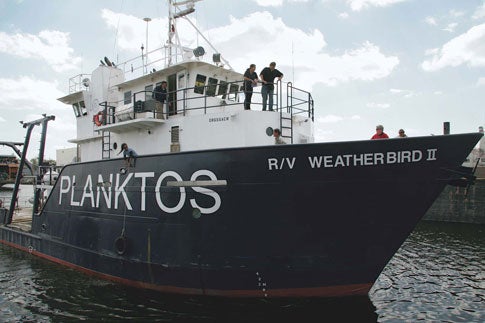
When the Weatherbird II cruised up the Potomac River and into the nation’s capitol in March of last year, spirits were high. The freshly painted 115-foot research vessel was about to set sail for what would be the world’s first for-profit effort to “fertilize” the ocean with iron, growing a vast forest of marine plant life that would pull the greenhouse gas carbon dioxide from the atmosphere. The lap through Washington was an effort to drum up support for the voyage to the iron-deficient waters west of the Galápagos Islands.
The Weatherbird‘s captain was former Greenpeace officer Peter Willcox, a man who had devoted more than 20 years of his life to protesting illegal fishing and nuclear testing at the helm of Greenpeace’s flagship vessel, the Rainbow Warrior. The crew was made up of earnest young environmentalists and scientists, some just a few years out of college. And the project was led by San Francisco businessman Russ George, a former fisheries and forestry worker who had himself once stood night watch on the Rainbow Warrior in his native Canada.
George had been studying the science behind oceanic iron seeding, as the fertilization practice is called, for a decade. Early last year, with the help of private investors, he had transitioned his small nonprofit research organization into Planktos Corp., a for-profit company with shares trading on the penny stock exchange known as the over-the-counter bulletin board. His business plan was simple: Sell the carbon that the plankton sequesters to individuals and businesses that want or need to lower their net carbon emissions. (In Europe, regulations compel businesses to lower their carbon output. The U.S. market is voluntary, at least for now.)
By early summer, George told a gathering at the Washington Press Club, the recently purchased Weatherbird would cross the Caribbean, pass through the Panama Canal, and head out into the Pacific, where the first of six planned iron-seeding trips would begin. The crew would scatter iron particles over a swath of ocean more than twice the size of Rhode Island. Then they would wait three weeks for the blooms of plant life to grow. Dispatches from the trip would be posted on the company’s Web site, where Planktos was already selling carbon credits for $5 a ton. Their first expedition, George later said, was intended to be a critical first step toward halting global warming, a cheap and simple way to let the ocean do the hard work of cleaning up the planet, and to make some money along the way.
But as any ecologist knows, fiddling with complex systems can have unforeseen consequences. Rather than applauding Planktos’s self-declared Voyage of Recovery, a chorus of environmentalists, tacitly backed by more than a few government officials and scientists, soon began an aggressive campaign against the company. Their concerns were both philosophical (should we intentionally change the Earth?) and practical (how do we know it will work out as promised?), and in their fight they established the initial front in the battles to come over geo-engineering, or large-scale modification of the planet.
And then there’s the money. Planktos and its founders were driven by a seemingly genuine desire to heal the Earth as well as a profit motive. But in the future, a sense of virtue may not always be part of the eco-entrepreneurial package. In the Wild West economy of carbon markets, where the stakes are high and laws have yet to take hold, who gets to decide what is right? If the free market farms out the job of saving the planet to the lowest bidder, how do we ensure that the Earth doesn’t get harmed in the process?

Russ George
The attacks came fast and hard. On May 2, 2007, as the Weatherbird and its crew were docked at a berth in Florida gathering supplies for their Pacific voyage, an ad hoc coalition of environmental groups, including Greenpeace International and the Ecuadorian nonprofit Accíon Ecologica, issued a press release under the heading “Geoengineers to Foul Galápagos Seas.” Planktos’s plans are a “risky gamble with sensitive marine ecosystems,” the statement read. “Climate change is a real threat, but common sense should not be its first victim.” The groups used the Galápagos Marine Reserve, a United Nations World Heritage Site that is widely considered one of the most delicate and unique environments on the planet, as their poster child, warning that Planktos’s “reckless experiment” could damage the island chain’s celebrated animal and plant life. “Large-scale modification of ecosystems is always a very dangerous business,” warns Greenpeace scientist Paul Johnston, one of the signatories to the anti-Planktos press release.
The environmentalists had other objections. If society relies on quick techno-fixes to ameliorate global warming, they said, people will stop putting in the hard work necessary to cut carbon emissions. They also latched on to Planktos’s online description of its iron particles as nanosize, warning that “the Planktos experiment may be the largest intentional release of engineered nanoparticles ever undertaken.”
George was incensed. Calling Planktos a nanotech company was dishonest, a calculated attempt to raise unfounded fears in the public, he retorted. Planktos planned to scatter a powdered version of the iron ore red hematite, essentially the same stuff that might rust off the side of an old dinghy or prompt natural plankton blooms when blown out on a dust storm. And local environmentalists, he charged, knew that prevailing currents would carry any iron away from the Galápagos Islands, not toward them. He described the crew of the Weatherbird as organic gardeners, helping the ocean along in a planet-saving process that was completely safe and totally natural.
His arguments failed to sway the ever-growing group of environmental naysayers—and the stakes were soon raised. Planktos’s widely trumpeted plans attracted the attention of the Sea Shepherds, a Greenpeace splinter group of self-professed “eco-pirates” committed to stopping whaling by any means necessary. This winter, the Sea Shepherds made headlines by chasing a Japanese whaling vessel around the Southern Ocean, pelting the crew with glass bottles stuffed with rancid butter. The Sea Shepherds patrol regularly in the Galápagos, where their usual mission includes confronting illegal long-liners and sea-cucumber poachers. Since 1979, the group has rammed and sunk nine ships. Captain Paul Watson made clear how they planned to greet the Weatherbird: “We are not Greenpeace. We won’t be just showing up to hang banners and take snapshots.”

Phytoplankton
As the Sea Shepherds made their threats in midsummer, the Weatherbird was still docked near Ft. Lauderdale, three months behind schedule. Planktos officials blamed the delay on supplies; it was harder than they had anticipated to get hold of scarce scientific equipment, they said at the time. But by mid-fall, the company was concocting a new plan, one that would allow it to avoid an attack at sea and, perhaps, the negative publicity that would evidently accompany any tinkering in the vicinity of the Galápagos. On November 5, the Weatherbird finally left Florida. Due to what the company called “the frontier nature of the research,” though, it kept the ship’s destination confidential.
The boat stopped to refuel in Bermuda and then cruised east across the Atlantic. By early December, the Weatherbird neared the Canary Islands, a Spanish territory 150 miles off the western coast of Morocco. The plan was to take on final supplies—including a 100-ton load of iron particles and, according to George, a team of local scientists friendly to the cause—and begin the first iron-seeding experiment in nearby seas.
But rather than welcome the self-declared “emergency eco-restoration” mission, Spanish authorities radioed Captain Willcox when the Weatherbird was still 18 miles offshore. The ship was forbidden from entering the country, they said. The “toxic waste” they intended to dump would not be spilled in Spanish waters.
“Give me half a tanker of iron, and I’ll give you an ice age.” Oceanographer John Martin’s quip to a 1988 gathering at the Woods Hole Oceanographic Institute in Massachusetts made plain the potential of iron seeding. At the time the director of California’s Moss Landing Marine Laboratories, Martin was the first scientist to propose that carbon might be sequestered by fertilizing the ocean with iron. Martin, who died in 1993, has been proved prescient in his vision that the world would soon want to rid the atmosphere of carbon. And he thought iron could play a major role.
Certain ocean regions, Martin noted, are rich in nutrients like nitrogen and phosphorus that encourage the growth of phytoplankton, the tiny plant life that forms the base of the oceanic food chain. But those regions are also short on iron, a key micronutrient that phytoplankton need to thrive. Martin predicted that sprinkling iron dust in well-chosen areas, such as the nutrient-rich waters near the Galápagos Islands, would cause huge blooms of plant life that would pull carbon dioxide from the atmosphere. Eventually, microscopic marine critters known as zooplankton would eat the carbon-rich phytoplankton. Their fecal pellets would in turn eventually sink, storing carbon in the deep ocean for hundreds of years or more.
Since Martin’s now-famous sound bite (delivered, he later joked, in his best Dr. Strangelove accent), a dozen iron-fertilization experiments have been conducted worldwide. Although Russ George repeatedly cites these studies as satisfactory precursors to his own voyage, in fact only three of the 12 studies conclusively demonstrated that iron seeding sequesters carbon for any considerable period of time, and even those studies made no attempt to track the long-term effects of the iron addition. The longest experiments lasted no more than six weeks, a consequence of the $25,000 to $35,000 a day it costs to keep a research ship at sea. “Every time we add iron, we create more plankton, which take up CO2,” says Ken Buesseler, a scientist at Woods Hole who has helped lead several iron-fertilization experiments. “But there’s a big uncertainty about the long-term fate of that carbon. You’ve got to get it deep enough so that when those plants decompose, it doesn’t just let the CO2 out back into the atmosphere.” Research to track the carbon’s eventual fate is “the next step,” he says.

Diatoms
On land, storing and mitigating atmospheric carbon is already big business. In Europe, any corporation that emits an excess of CO2 has to pay about $30 a ton for it on the European Union’s carbon market, the world’s largest. That market doesn’t allow credits from carbon-sequestering projects known as “sinks” (at least not yet; the value and trustworthiness of all such efforts is the subject of heated debate). But the credits can be sold on voluntary exchanges, or directly to consumers and businesses that want to reduce their carbon footprint.
These kinds of voluntary efforts have already made trees grown to sequester carbon into a fast-expanding business, as George knows well. The Planktos CEO was also a founder of KlimaFa, a company that plans to suck up carbon by growing forests in a national park in Hungary. KlimaFa made international headlines last summer with a donation of carbon credits to the Vatican that, George claimed, would cancel out all of the papal state’s 2007 emissions (despite the fact that no trees have been planted yet). The move was marketing genius: Even without the full blessing of the scientific community, George could now claim to be doing God’s work.
John Martin, the father of iron seeding, was an immensely experienced and respected ocean researcher. Yet a number of scientists were concerned by the possible ecological side effects of the “Geritol solution,” as it was sometimes called, even when Martin was its biggest champion. Russ George, in contrast, is a businessman with no advanced degree. His past ventures have ranged from documentary film production to a company that peddles home-based cold-fusion machines. When he suddenly became iron seeding’s most visible proponent, many scientists were repelled.
George had the opportunity to win them over last fall when Buesseler organized a conference at Woods Hole. Its goal was to allow leading scientists to address the questions surrounding commercial iron seeding in a forum with environmentalists, government officials and representatives of the fledgling for-profit companies. George was invited to sit on a panel at the event, but at the last minute he decided to attend a New York panel convened by the more investor-friendly TED (Technology, Entertainment, Design) conference instead, where he told attendees that if they rejected solutions to global warming, the planet would “reboot, and give us the blue screen of death.”
Nevertheless, soon after the Woods Hole conference, Planktos issued a press release that implied that the scientific community was united in their support of its mission. “Planktos Corp. (OCTBB:PLKT) is announcing on Thursday Oct. 4, 2007, that scientists met at Woods Hole Oceanographic Institute (WHOI) and agree ocean iron fertilization projects should proceed to define the role of ocean plankton eco-restoration as an effective tool to slow climate change,” the release began. “Russ George chose not to show up and give his talk,” Buesseler says. “Instead he wrote a spin PR piece at the end that really had nothing to do with what happened at the meeting.” (George eventually showed up on the last day of the conference.)
Although a handful of well-known scientists do believe that iron seeding could both sequester carbon and have beneficial side effects, such as increasing fish populations and improving the food stock for endangered whales, many more have serious reservations about the idea. In the January 11, 2008, issue of the journal Science, 16 of the field’s top experts, including a colleague of Martin’s who had been involved in running his posthumous experiments, summarized what Buesseler says was the consensus at the Woods Hole conference: “It is premature to sell carbon offsets from ocean iron fertilization unless there is better demonstration that [it] effectively removes CO2, retains that carbon in the ocean for a quantifiable amount of time, and has acceptable and predictable environmental impacts,” the article concluded. In other words, iron seeding is still more hope than fact.
Swirling Phytoplankton Bloom in the Arabian Sea
After its rebuke by Spanish authorities, the Weatherbird spent several more days languishing at sea before retreating 300 miles north, to the Portuguese resort island of Madeira. It would be the final stop for Planktos. In mid-December, the company, whose stock had plunged from a high of $2.56 in early summer down to just a few cents a share, announced that it was “winding down” operations because of “unanticipated events in the Canary Islands” and a subsequent “inability to secure sufficient funding for the continued operation of [its] business plan.” In early March, the Weatherbird was sold to an oil-exploration interest.
The same week saw much better news for Climos, the second San Francisco company with plans to seed the ocean with iron. On March 5, CEO Dan Whaley announced that Climos had secured $3.5 million in a first round of venture capital. Among the investors was PayPal founder Elon Musk, now chairman of the electric-sports-car company Tesla Motors. The company’s first cruise could come as early as next year.
Meanwhile, months after Planktos’s demise, George remains staunchly unapologetic about his methods and bitterly contends that a conspiracy of “radical environmental groups” (he lists among them Greenpeace, the World Wildlife Fund, Friends of the Earth, the Natural Resources Defense Council and the Environmental Protection Agency) “swift-boated” his company. Local Sea Shepherds spotted the Weatherbird in Bermuda, where it had stopped to refuel in November, he says, and alerted activists, who rallied to keep the ship out of the Canaries. “[They] lied to government officials and stated that we were some evil organization intent on dumping toxic material into the ocean,” he says. The local scientists who had planned to work with Planktos were helpless to do anything in the face of such united opposition, according to George, who says that many established scientists had planned to work with him but were hesitant to make their involvement public for fear of being blackballed by colleagues. (For his part, University of Las Palmas scientist Santiago Hernández-León, whom George says originally invited Planktos to conduct its research in the Canaries, says that he never had a formal agreement to work with the company.)
If there’s a single thing George and his detractors can agree on, it’s that many environmentalists will never be convinced that large-scale tinkering with the ocean is a good idea. “There are only two ways that we’re going to solve climate change,” says Greenpeace scientist Johnston. “Reduce the amount of energy that we use, and dramatically change the methods we use to generate it. I don’t think any quick geo-engineering fixes are going to work.”
Back in San Francisco, Climos is fighting that mindset, attempting to assure investors, environmentalists and the public that iron fertilization is a worthwhile endeavor. So far, the company’s chief science adviser, Margaret Leinen, is proving to be an impeccable advocate. Until recently, Leinen was the assistant director for geosciences at the National Science Foundation, where she helped distribute a $700-million basic research budget and became well-known and respected in the scientific community. She’s also well-known and respected by Dan Whaley. He’s her son.
Unlike Planktos, Whaley explains, Climos will work with scientists to design expeditions that make use of the established research fleet. He promises to conduct environmental-impact assessments and secure the relevant government permits. Climos has developed the industry’s first code of conduct, which is posted on its Web site, and recruited a board of independent scientific advisers. Finally, unlike Planktos, Climos will not sell carbon credits until the science is proven.
“You don’t just drive around in a boat and throw iron off the back,” he says. “The quantification of real sequestration from this, the understanding of what the impacts and tradeoffs are, if any, is something that requires a fairly deep collaboration with the scientific community. Instead of reaching out to that community, Russ George thumbed his nose at them.”
Of course, the slow approach seems like a tougher way to make a buck. “I keep telling people, we’re three to five years and $50 to $100 million away from knowing some of these answers,” Buesseler says. “That might sound like a long time and a lot of money, but in the scheme of hundreds of millions of tons [of carbon], hundreds of billions of dollars a year in markets, and a problem that’s not going away, that’s a small amount to pay.”
“People say they don’t think it’ll work,” Leinen says, “so why are they worried about doing the experiment? If it doesn’t work, nobody will sell any credits. Why not identify the way forward rather than just say, ‘Let’s not even do the experiment.’ I think that’s a non-scientific attitude.”