10 Audacious Ideas to Save the Planet
To rescue the Earth, we need bold engineering ideas that go beyond simple recycling

Heavenly Power
Making a dent in the climate crisis is going to take more than solar panels and recycled toilet paper. Scientists are finding ever more creative ways (pig pee! DIY tornadoes! mini nuclear reactors!) to clean up the Earth
Beaming Electricity from Space
The Vision Launch giant solar panels into orbit and send limitless clean energy back to Earth
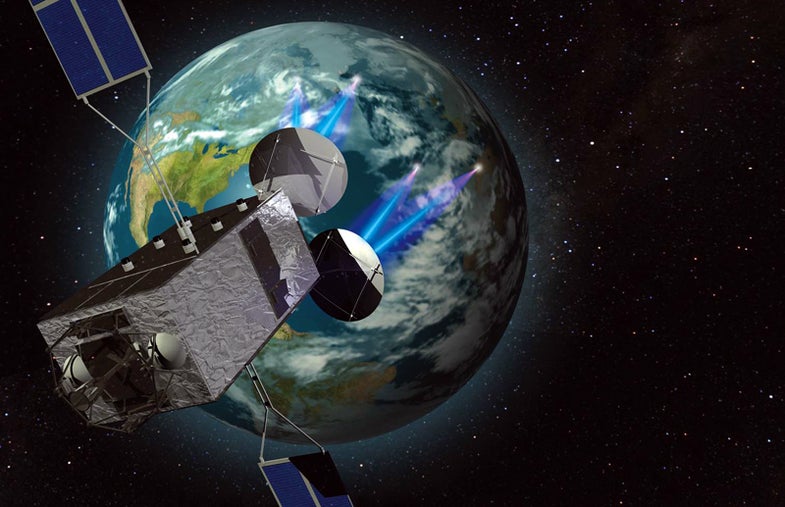
The Plan By 2030, Japan hopes to pull its power from the heavens instead of from polluting coal plants. The idea is to send satellites into geostationary orbit above the equator, where they will unfurl 1.5-mile-long solar arrays and soak up the sun 24 hours a day. Transmitters mounted on the satellites would convert the solar energy into microwave energy and beam it down to terrestrial receiving stations. Equipped with massive antennas measuring two miles across, each station would produce one gigawatt of electricity—enough to power 500,000 homes. That’s twice as much as a typical coal-fired plant, and without any of the greenhouse emissions.
Putting solar panels in space has one obvious advantage: It’s never cloudy 22,000 miles up. On average, there’s 8 to 10 times as much sunlight available in space as there is on Earth, where atmosphere and weather get in the way. Now, with satellite launch costs dropping (about five thousand dollars per pound today, versus $12,000 per pound a decade ago) and energy bills rising (already double what they were in 2005), researchers are finally warming to the idea.
Later this year, in fact, the Japan Aerospace Exploration Agency (JAXA) plans to test the idea on the ground, blasting a microwave beam some 170 feet to a 6.5-foot-wide rectenna, a type of receiver that converts microwaves into DC electricity. Not as glamorous as beaming rays from space, but it’s a vital first step.
Potential Uh-Ohs One frightful but improbable scenario is that the microwave beam misses the receiving antenna and fries something on Earth’s surface. Like a village. To mitigate that risk, JAXA scientists are developing an automated detection system that turns off the microwave beam if the satellite drifts out of line.
ETA JAXA aims to launch its first energy-beaming satellite into orbit by 2013, with a network of powersats that feed energy directly into the grid to follow by 2030.
—Rena Marie Pacella

Fur Farms
Hair Club for Plants
The Vision Thousands of acres of super-hairy plants around the world reflect extra sunlight and cool down the globe
The Plan While searching for ways to fortify crops against tomorrow’s stifling temperatures, earth scientist Christopher Doughty of the University of California at Irvine noticed that plants that thrive in hot, arid conditions are often covered in hair-like fibers. The tiny hairs, it turns out, reflect almost all near-infrared light from the sun, while allowing the light in the visible spectrum to hit the leaf and drive photosynthesis. By absorbing less heat energy and evaporating less water to stay cool, the plants are more efficient—and better suited to warmer weather. That got Doughty thinking: If hairy plants covered a substantial area of the Earth and were all reflecting near-infrared energy back into space, exactly how much might that cool the planet? So he fired up a global circulation model that takes into account hundreds of variables and estimates their effect on climate around the world. When he increased crop reflectivity by 10 percent, Doughty found that distribution of the hairy plants between 30 degrees latitude and the poles produced optimal results, yielding a reduction in regional temperatures of two to three degrees Fahrenheit.
Unfortunately, most crops aren’t nearly hairy enough to create this cooling effect, but some clever selective breeding could remedy that. “No one has really ever purposely grown hairier plants,” Doughty says. “But then again, there’s never been a good reason to try until now.”
Potential Uh-Ohs Super-reflective plants could evaporate less water into the atmosphere, causing a decrease in protective cloud cover, which in turn would drive an increase in surface temperature.
ETA Breeding crops hairy enough to gain a 10 percent increase in reflectivity could take decades.
—Bjorn Carey

In ‘n’ Out
Pulling Gas from Thin Air
The Vision A modified nuclear reactor that produces 17,000 barrels of gasoline a day—enough to fuel 54,000 Honda Civics.
The Plan Air contains hydrogen and carbon, the building blocks of gasoline. So why not turn it into fuel? That’s the thinking behind a plan from scientists at Los Alamos National Laboratory to transform carbon dioxide into a renewable resource using nuclear plants. As air enters a reactor’s cooling tower, it filters through a potassium carbonate solution, which captures 95 percent of the carbon dioxide and forms a bicarbonate solution: baking soda, more or less.
From there, an electrolytic cell turns the bicarbonate into 100 percent CO2. As for the hydrogen, the nuclear reactor is already generating electricity, and some of it can power electrolyzers that strip hydrogen from water. Finally, catalytic processes combine the hydrogen and carbon into methane, gasoline or jet fuel, all without toxic emissions. The researchers estimate that to produce 8,600 tons of CO2 per day, enough for those 17,000 barrels of gas, it would take six cooling towers and as many as 90 cells.
Potential Uh-Ohs The plan needs gas prices to continue to rise, since the new gas would cost $4 a gallon at the pump. If oil prices fall, the plan dies.
ETA The Los Alamos scientists plan to debut a prototype of the electrolytic cells next year, with a commercial version ready by 2013.
—Cliff Kuang

Big Catch
Sinking Carbon in the Sea
The Vision Sequester carbon dioxide in six-mile-long sausage-shaped plastic bags on the seafloor
The Plan It’s a hard sell. Cover thousands of square miles of ocean bottom with polymer-skinned sausage links 650 feet in diameter, fill them with carbon dioxide sucked from power plants, and leave them there for all eternity. “I thought the project was silly until I started to talk to marine engineers and do the math,” says physicist David Keith, a director at the University of Calgary’s Institute for Sustainable Energy, Environment and Economy. But by the time he finished a concept study on the project with engineers at Argonne National Laboratory and the University of Singapore, he was convinced that it was not only possible; it was downright practical.
“The basic physics is simple,” Keith explains. At ocean depths below two miles, liquid carbon dioxide is denser than seawater, so it sinks. In fact, for decades, scientists have suggested injecting liquid CO2 into depressions in the deep ocean so that they form lakes, an option that environmentalists have resisted because some of this CO2 would eventually dissolve and acidify the water. But contain that liquid in a corrosion-resistant material, like an organic polymer or titanium, and it could sit, safely, on the seafloor for several thousand years.
As for installation, the sausage skin is flexible, so engineers can roll each bag around a floating reel and then use a tugboat to tow it about 60 miles offshore. As the reel unwinds, the membrane sinks nearly two miles to the seafloor, where deep-sea rovers connect one end of each bag to valves along a main pipeline. After power plants capture CO2 emissions and compress the gas into liquid, a pipeline pumps two tons per second into the bags, which slowly inflate from their deepest end first. Since real estate is not a factor—the ocean covers 70 percent of Earth’s surface, and the necessary depths are reachable within 60 miles of most continental coasts—the pipeline can be continuously extended to accommodate new bags.
Potential Uh-Ohs Did we mention the vast quantities of CO2 that humankind currently dumps? It’s about 800 tons a second, enough to fill an oil tanker with CO2 every minute. To reduce current global emissions by even 20 percent, we would need to fill one bag every 11 days. Then there’s the problem of durability. What if a shark sinks its teeth into a bag, for instance, or the material falls apart? There’s no way to be certain that the bags won’t disintegrate after hundreds of years instead of thousands, as predicted.
ETA Keith says CO2 bags could be in place by 2020, pending regulatory hurdles.
—Rena Marie Pacella
Tastes Great! Less Global Warming!
The Vision Save six billion kilowatt-hours of energy annually (enough to power 20 million lightbulbs for a year) by blasting brew with supersonic streams of steam
The Plan Earlier this year, Shepherd Neame, Britain’s oldest brewery, began making its popular Spitfire lagers and ales with a powerful new “wort boiling” technology that cuts the brewery’s energy usage by 10 percent.

Better Brew
The primary ingredient in beer, aside from water, is a starch such as malted barley. Soaking the starch in water and enzymes breaks it down into a sugar solution called wort. The next step, boiling the wort to eliminate impurities from the malt, hogs 20 percent of the brewery’s total energy consumption. Enter the PDX Wort Heater, a network of nozzles made by the English company Pursuit Dynamics that fires steam at the wort at 3,000 feet per second. The impact breaks the liquid into mist droplets, which heat up faster than liquid wort and cut the brewing time from one hour to 30 minutes while using half the energy. If the world’s 8,000 major breweries adopted the technology, it could save the electricity equivalent of three million tons of coal a year.
Potential Uh-Ohs Leaky nozzles can contaminate the steam and spoil a batch. Beyond that, convincing breweries to pay for new technology that shoots steam into their time-honored recipes won’t be easy.
ETA Rising energy costs could make steam-heated beers the industry standard within three years.
Hot Bodies
The Vision Harness the warmth given off by millions of commuters and reduce global energy demand by 15 percent
The Plan Your average human generates about 60 watts just lying on the sofa, and about 100 watts hustling for the train during rush hour. Swedish civil engineer Karl Sundholm aims to capture some of that excess energy, starting in Stockholm’s Central Station, where he’ll use a car-size heat exchanger to absorb air made warm by more than 250,000 daily commuters and use it to provide up to 15 percent of the heating needs of a building next door. The exchanger heats water pipes, which funnel the warm water to another heat exchanger in the new building, where the process is reversed: The hot water warms the air, helping to keep shop owners and cubicle dwellers toasty. In the summer, when body heat is less welcome, the same exchangers will transport cold water from a nearby lake to cool the building and the train station.

Central Station
Potential Uh-Ohs Logistics may make the heat-funneling system a challenge to replicate in other cities. The proximity of the Stockholm station and the adjacent construction site is unusual, as is the fact that Sweden owns both the station and the future building site. “[The system is] more expensive and takes more space,” Sundholm says. But it should pay for itself in less than a year.
ETA Central Station could be capturing heat from hot Swedes by 2010.
—Corey Binns
Wild Idea
Harnessing Energy from Tornadoes
The Vision Draw power from man-made twisters and light up entire cities
The Plan Your average 100mph tornado can generate up to 10 megawatt-hours of power, about the same as a large utility plant. Now Canadian engineer Louis Michaud says he has figured out a way to trap a twister and make it spin indefinitely, generating a cheap, virtually limitless source of energy. His creation is a 13-foot-wide tornado-making machine that produces a powerful spinning column of air to drive electrical turbines. Last year, Michaud showed off a smaller prototype that produced a 6.5-foot-tall cyclone [see “Twister Power,” Headlines, November 2007], but this new one—due to have been tested in Sarnia, Ontario, in May—should produce the biggest artificial tornado yet
.
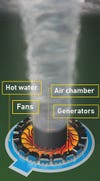
If the testing goes as planned, Michaud hopes to begin constructing a full-scale commercial version that’s nearly twice as wide as a football field and capable of producing a 150-foot-wide, miles-high vortex. Its outer wall will contain 20 fans that suck in air, blow it over hot-water pipes to heat it, and blast it through ducts to an inner chamber. Because the ducts are angled, the hot air will begin to rotate like a tornado. It will require about 2,000 megawatts of electricity to get the machine started, but Michaud’s plan is to recover the waste heat from power plants and use it to heat the water pipes. Once the twister is twisting, it needs no extra energy input to keep it going—the turbines keep working as long as there is low pressure at the bottom of the storm to suck in more air, which in turn feeds the tornado. The air flowing past the turbines will ultimately drive generators and convert the twister’s mechanical energy into 200 megawatts of electricity, enough to power about 200,000 homes.
Potential Uh-Ohs What if the engine spins out of control? What if it breaks from its base or grows too large? Michaud says he could simply close the ducts to the inner chamber, blocking the air supply, or reverse the direction of the incoming air.
ETA Expect the commercial machine within five years.
—Rena Marie Pacella
Biogas Buses Powered by Sewage
The Vision Turn civilization’s lowliest by-products—including human waste and animal carcasses—into clean-burning fuels for commuter transport
The Plan In a pilot project conceived by Warren Weisman, a consultant who heads the Oregon Biogas Cooperative, the nation’s first biogas bus would get its fuel from a wastewater-treatment plant in Eugene, Oregon. Weisman believes that sewage, supplemented with crop stubble and restaurant leftovers, could eventually power all of the city’s buses.
Biogas is created by anaerobic digestion, a process in which bacteria break down organic waste in the absence of oxygen. Hydrogen sulfide and carbon dioxide are removed from the biogas, and the remaining natural gas (mostly methane) is compressed.
There isn’t enough biogas to power every car on the road, but it could replace nonrenewable, polluting fuels such as diesel for mass transportation. And unlike natural gas extracted from deep wells, biogas does not make a net contribution to greenhouse-gas emissions because it doesn’t release carbon trapped in fossil deposits.
Cities in Switzerland, France, Spain and Iceland are already tapping their sewers for bus fuel. And in Sweden, the city of Linköping’s entire fleet runs on biogas generated from organic materials like manure and slaughterhouse leftovers. Linköping is also home to the world’s first and possibly only biogas commuter train.
Potential Uh-Ohs Getting a high yield requires a perfect recipe of waste ingredients. Municipal wastewater alone produces low yields, so it must be co-digested with other waste materials. Plus, transportation to digester sites cuts into the efficiency of the process.
ETA The Oregon Department of Energy’s Clean Cities Program is prepared to provide $1 million in funding, but local officials say they’re shelving the bus project for a few years in order to focus on other upgrades to the treatment plant.
—Dawn Stover
The New Gold: Turning Pig Pee into Plastic
The Vision Capture 90,000 tons of urine every day from the world’s billion pigs and recycle it into plastic plates
The Plan To Agroplast chairman Jes Thomsen, pig pee is just as valuable as oil, coal and gas. A chemical produced in a pig’s liver, urea, can be recycled in a variety of ways, from de-icing roads and airplanes to manufacturing so-called bioplastics, in which urea can replace petroleum as a bulking agent. Later this summer, the Danish company will begin collecting 3,000 liters of pig pee a day at a processing plant near Copenhagen in an effort to reduce costs and conserve resources.
Typically, pig urine and manure is dumped en masse into smelly pools and storage tanks vulnerable to overflowing and leaks. This can lead to dangerous levels of air and groundwater pollution. The Agroplast filtering system, on the other hand, collects the urine as quickly as a pig can eliminate it, which keeps pigpens clean and disease-free. Unlike conventional septic systems, the waste flows through filters that clean the liquid while removing particles, color and odor. By the end of the process, the urea is ready to be recycled into plastic, soap or moisturizer.
Potential Uh-Ohs Scientists disagree about whether bioplastics are environmentally superior to petroleum-based plastics. If you toss a plastic plate made from pig urine into a landfill, it will end up releasing the greenhouse gas methane. Recycling bioplastics poses trouble too, because most companies aren’t yet equipped to sort regular plastic from bioplastics.
ETA Thomsen expects the company’s second plant to be in Iowa or North Carolina, home to some of the largest pig farms in the U.S. With farmland and gas prices at a premium, he envisions building “pig cities”—efficient, land-conserving skyscrapers that would house the pigs while processing their waste into plastic and fertilizer.
—Corey Binns
Powering Remote Towns with Little Nukes
The Vision Generate heat and electricity for small-town America using pint-size nuclear reactors that will run for 30 years with no refueling, maintenance or noxious diesel fumes
The Plan From Toshiba, a company best known in the U.S. for its consumer electronics, comes a proposal for the world’s smallest commercial nuclear power plant. At 10 megawatts, the 4S reactor (short for Super Safe, Small and Simple) is less than seven feet tall and is sealed in a concrete vault about 100 feet underground. Some have dubbed it a “nuclear battery” since it will run without refueling for its entire 30-year lifetime.
The key to the hands-off maintenance plan for the proposed reactor is its coolant system. Most nuclear reactors in the U.S. use pressurized water as their coolant, but the 4S relies on molten sodium. Because sodium is a metal, it can be cycled through the reactor using electromagnetic pumps with no moving parts to repair.
Potential Uh-Ohs Of the 400-plus full-size nuclear reactors operating worldwide, only two are sodium-cooled. One concern is that sodium might come in contact with water, which could cause an explosion. Another question is whether the reactor can be safely operated for 30 years without any inspections or repairs. If maintenance is required, the reactor will have to be dug up and sent back to the factory in Japan.
ETA Toshiba hopes to install the first 4S in Galena, Alaska (pop. 700), by 2012. Far from the main power grid, residents now pay about 45 cents per kilowatt for diesel power, but the 4S could cut that cost in half.
—Dawn Stover