Biologist discovers that guns aren't always the best form of protection in the wild
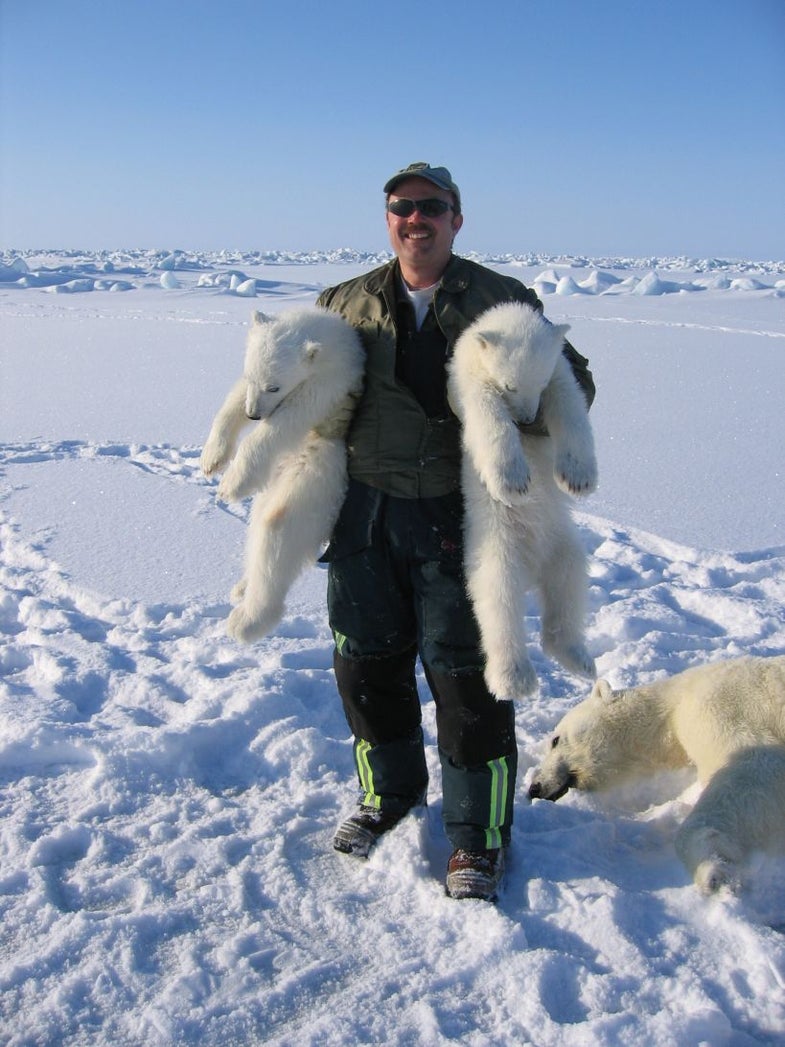
Bear Spray BYU/Thomas Smith

Brigham Young University bear biologist Thomas Smith says that guns aren't necessarily your best option when facing down one of the beasts.

Smith and his team analyzed 20 years worth of incidents in Alaska, and found that the wilderness equivalent of pepper spray effectively deterred bears 92 percent of the time, whereas guns only did the trick one-third less often. (He studied polar bears, too, hence the picture, at left, of an unconscious mother and her cubs. And yes, he did get away before everyone woke up.)

The odd thing, though, is that the effectiveness of the stuff doesn't seem to have much to do with the chemicals in the spray. In fact, Smith says he found some cases in which people actually attracted bears by applying the stuff to their tents or other gear. It may be that the cloud of spray, and the sound of its dispersal, are what really incite the bears to turn and run. So, you know, next time you stare down a bear, ditch the gun and whip out a spray.

Want to learn more about the environment, solar energy, sustainability, and more? Subscribe to Popular Science today, for less than $1 per issue!

8 Comments

Yeah... Bear spray may work in Alaska, on polar bears, but that is only one area and one species. Grizzlies and blackbears on the other hand, now hitting them with bearspray is like hitting someone in the face with ketchup. It's a shock at first, then it is an annoyance, and then it is a flavor enhancer.

Then there is the fact that bearspray is subject to short distance and wind direction. You could get it in your eyes before you get it in the bears. Personally, I would prefer a dead bear at 150 yards, to a hungry, royally ticked off bear at 50.

It's great to know that bear spray works so well but I'll still keep my trusty rifle, thank you. In the article you mentioned that 98% of close encounters occur in forest and with Black or Brown bears. Only 2% were encounters with Polar bears, the most dangerous of the species. If, for some reason that I don't foresee, I was anywhere near Polar bear country there's no way that I would exchange bear spray for a rifle.

Harvey Levy
http://harveylevy.blogspot.com/

Just thought I'd refer you guys to the whole article:

http://byunews.byu.edu/archive08-Mar-bearspray.aspx

The study actually focuses on brown and black bears, rather than polar bears (although the data does include them in the study):

"Nearly 70 percent of the incidents involved brown (grizzly) bears and 28 percent involved black bears. The study also reports the first two documented uses of bear spray on polar bears in Alaska."

And they actually did test the effect of wind speed and distance to the target on efficacy:

"The research debunks these common misconceptions about bear spray:

'Bear spray doesn't work when it's windy.' Wind was reported to have interfered with spray accuracy in five of the 71 incidents studied, although the spray reached the bear in all cases. Smith used a wind meter to test the speed of the spray as it streams out of the canister. Repeated tests showed an average of 70 miles per hour. Smith also noted that bears and humans can easily see each other in open, windy spaces. The surprise encounters tend to occur in wooded areas in which vegetation blocks wind."

...

"On average, the spray was used when the bear was about 12 feet away."

All in all, I think this was a very well-designed study. The brief abstract here didn't quite do enough justice to alleviate your well-founded concerns, but the scientists were aware of them and did address them in their research.

Of course, I just quoted from a more detailed summary--we should all probably read the actual published article straight from the source.

drizzit.

It is true what you said about only 2% being polar bear attacks, but polar bears are one of the few animals that hunt people as food. When an animal thinks of some thing as its food it takes a lot of convincing to change its mind.

Also, most brown (grizzly) bear attacks are a mother with her cubs. Most of the time some one is walking to soft and the bear dos not hear him 'till he is to close and the mother bear feels that her cubs are in danger, so she attacks before we can.

I think that bear spray is a good plan, but a would take a good firearm with me when i go into bear country. Personally i think that knowing what to do when a bear attacks is the best defense.

Great Study,

My life was spared, Thanks to God, a freind and pepper spray!
It all happened so fast. Next thing I know, I'm just seeing teeth and trying to jump out of the way. Oh God help me!
The bear lunged, biting me in the face and neck. I could feel my face ripping. Then I was on the ground, the sow on top of me. I felt her teeth crunching down on my head.
I screamed, She's got my head, she's killing me! However, my cry only intensified the attack. Then I realized, I've got to play dead or I'm going to be dead.
I made myself lie still as the bear mauled me. Then she left me and turned back to Bahnson, who hit the charging grizzly approximately 10 feet away in the mouth and nose with the nearly full can of pepper spray emptying it. Gasping and choking, the bear veered off into the woods, the cubs bounding after her.
The "head bite" had punctured my eyebrow bone, between the brow and the eyeball, and also the crown of my skull.Total head and face repairs required more than 15 inches of stitching. My arm was black and blue, and would be sore for several weeks, but was not broken or dislocated. The headaches, nearly constant, would continue for almost two years-all this from a mauling we estimate lasted less than 20 seconds.
The bottom line is you should be prepared and carry bear spray in bear country. Hopefully you won't need to use it-but if you do, it can save your life. It's better to have bear spray and never need to use it, apposed to needing it, and not having it.
Take from a Grizzly attack survivor
Bear spray Works!

i agree that bear spray is better then nothing! i'm not saying it's not, i know of a few people who are still alive because of bear spray. it works! i'd just rather have a good gun with me in bear country. i bring bear spray with me too. it's a good idea. i'd rather get the bear off me then kill it anyway.

but i will have a gun with me most of the time in bear country.

I do not believe the "mama" bear would lie down due to pepper spray use. Guess he didn't put down the rifle.
Think!! When it is life or death .. pass the ammo! Guns may not "necessarily be the best option", but they trump spray more often than not.

Fascinating how difficult it is to accept new facts contrary to old opinions. 4 of the 7 comments above state a preference for a gun over bear spray. In other words;

"I might use the (more effective proven solution), but I will certainly depend upon the (less effective traditional solution)"

When I started guiding in bear country 15 years ago, bear spray was still a novelty. Interesting to see it proving to be more effective than fire arms. Never would have guessed that back then.


138 years of Popular Science at your fingertips.

Innovation Challenges


Popular Science+ For iPad

Each issue has been completely reimagined for your iPad. See our amazing new vision for magazines that goes far beyond the printed page


Download Our App

Stay up to date on the latest news of the future of science and technology from your iPhone or Android phone with full articles, images and offline viewing


Follow Us On Twitter

Featuring every article from the magazine and website, plus links from around the Web. Also see our PopSci DIY feed


February 2012: The Future of Fun

Science is reinventing play, from extreme sports to gamification to ridiculous roller coasters to the playgrounds of tomorrow, and this issue is chock full of fun. Also, on a less fun note: Did global warming destroy my hometown?


circ-top-header.gif
circ-cover.gif
bmxmag-ps