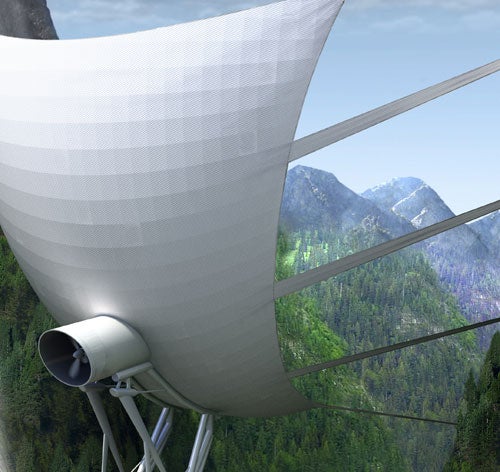
One common complaint about wind turbines is that they blemish the scenic countrysides and coastlines where they perch. Now an architect in London has an attractive solution. The “wind dam,” a giant swath of fabric connected to a turbine, looks more like a Christo art installation than a power generator.
The biggest inefficiency of current wind technology, says Laurie Chetwood, founder of the architectural firm Chetwood Associates, is that more wind passes around turbines than through their rotors. So he hit upon the idea of boosting productivity by capturing high-speed winds with a massive spinnaker sail—like those that yachts deploy to pick up extreme speed—anchored to cliffs on either side of a valley and funneling those winds through a central turbine. Based on a computer model of the dam, he expects it to produce up to 120 megawatts per year, enough to power about 35 homes.
But the design has drawn some criticism. Stephen Connors, a wind-energy expert at the Massachusetts Institute of Technology Energy Initiative doesn’t think the dam could stand up to winds gusting in multiple directions. And, because wind hitting the sail would create turbulence, the dam could struggle to concentrate wind on the turbine. Even if it did, Connors says, the wind would lose significant speed on its way to the rotors.
Chetwood is working on these problems—the sail will probably be conical to limit turbulence, and the architects will build in areas with winds that blow predominantly in one direction to reduce stress on the dam. He has teamed with a Finnish engineering firm and is seeking permission to build a privately financed $5-million, 17,000-square-foot Kevlar wind dam in a valley close to Lake Ladoga, near the Baltic Sea, as soon as 2009. After that, he may modify the design to fit on a bridge or skyscraper, where at the very least it would give passersby something colorful to look at. Here, a preview of Chetwood’s wind dam.
Two aluminum legs support the 17,000-square-foot Kevlar sail, which is anchored to cliffs in a valley near Lake Ladoga. The conical shape of the sail directs air to three in-line turbines, which are enclosed in a tube. The wind spins each turbine’s blades and turns an axle that runs into its gearbox. The gearbox steps up the rotational speed of a shaft that spins magnets around a wire inside the generator to transform the movement into electricity through electromagnetic induction.
For other alternative wind turbines, launch the gallery here.
Will jatropha-oil-derived biodiesel be exported to the Europe or the United States by the end of 2008?
Will the Northwest Passage be used for commercial shipping purposes by September 30, 2008?


Comments
Someone will probably mention birds pinned helplessly to the giant sail. I bet maintenance on the sail would be costly. Some sail boats use kevlar sails and cleaning them is a difficult and time consuming job. Imagine the time and cost to properly clean a 17,000 square foot kevlar sail. Once dirt starts to accumulate on the sail and get into the fabric it will begin to hold moisture that will add to the weight of the sail. The grit will also act as an abrasive and start to degrade the sail material. Salt and grit on a large sail can add almost 10 pounds of weight.
2 out of 3 people found this comment helpfulWhile kevlar is light, strong, and has a low stretch; it has poor UV resistance. The Sun's UV rays weaken kevlar over time. Kevlar also suffers from a rapid loss of strength due to flexing.
Vectran is better than kevlar and is naturally gold in color. It is very durable but is more expensive.
Taffeta would add film on film for abrasion, uv, and flex fatigue protection, but this adds weight to the sail.
Pehaps they could try a carbon or cuben fiber sail, although the cost would be much higher. 50~70% lighter and 4 times more durable than kevlar. It can flex without a loss of strength, has good UV resistance, and doesn't soak up water.
It would also be interesting to see if zinc oxide nanowires could be incorporated into the sail similar to the experiments with electricity producing clothing at Georgia Tech. 80 miliwatts per square meter is the potential.
5 out of 5 people found this comment helpfulMajor problem with architects proposal.
0 out of 1 people found this comment helpfulHas very large area ratio and very poor turbine duct entry.
Area ratio greater than 2 / (porosity less than 50%) means any excess collection area wasted. See Energy Storing Wind Dams on www.greenzephyr.co.nz. Link to UK Hydropower magazine article recommended for best quick overview of technology.
I question the decision to use a wind turbine vice a wind compressor. The use of a wind compressor would reduce the capital costs associated with turbine generators, the gearbox, and variable speed electric motors. Furthermore, any energy fed into the grid using a wind generator is going to be subject to a bell curve of pricing depending on the demand.
In contrast, using a system such as CAES (Compressed Air Energy Storage), the wind dam would convert the kinetic energy of the wind into compressed air and store it in a nearby geological feature such as a limestone cavern until it could be sold back to the grid during peak demand. This method would improve profitability for the dam because it would provide reliable power at peak demand price.
There was also mention of using a conical sail to feed three turbines. A conical sail will require a larger skeletal support structure either in the form of sequentially suspended metal rings or a framework around the cone shaped sail. If they decide on conical then why not just build a metal cone? A metallic cone could include stators to better funnel and align the wind into the rotor. Several effective surface coatings are available that would help reduce drag inside the cone.
0 out of 0 people found this comment helpfulcan anyone help tell me how this actually works in simpler langauge??
thanks
1 out of 1 people found this comment helpful