
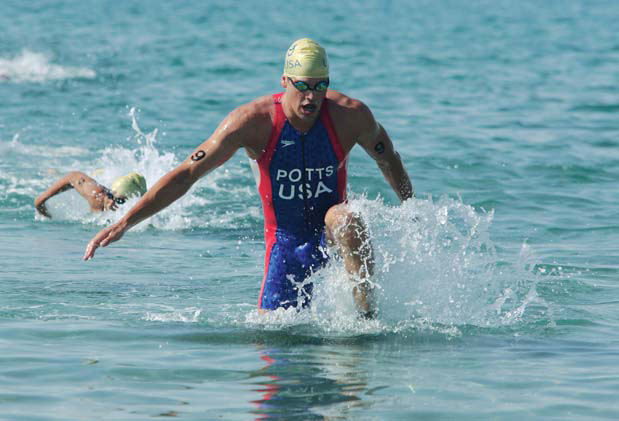
At the starting dock of the Olympic triathlon trials, the expression on Andy Potts’s face seems to say I will kill you with my eyes. As the starting gun fires, he plunges into the Black Warrior River in Tuscaloosa, Alabama, and, in a burst of white foam, quickly pulls ahead of nine rivals. The second-ranked Hunter Kemper manages to hold pace with Potts for a few minutes, then drifts back into third place.
Potts’s lead grows relentlessly to five body lengths as the rest of the field fans out behind him. He should dominate this Olympic-distance race—a 0.9-mile swim, 24.8-mile bike ride and 6.2-mile run—just as he dominated last year’s national championships and Pan American Games. He is, after all, the number-one-ranked triathlete in the U.S. Within minutes, he extends his lead to 30 lengths and swims for the shore alone.
His coach, Mike Doane, paces along the river’s edge. “When he can get his heart rate up around 165, he has a great race,” Doane says. Any higher than 165 beats per minute, and he’s using too much energy too early. Much lower—say, below 140 on the swim—and it means that he’s too tired to generate the tempo that would get his heart rate up.
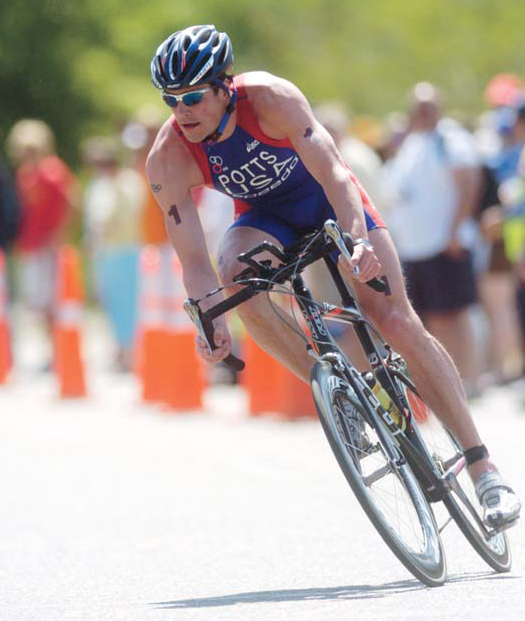
Potts leaps out of the water, charges toward his bike, and zooms onto the cycling course 38 seconds ahead of Kemper. His heart rate, monitored by a microcomputer on his wrist, is right where it’s supposed to be: 165. As Potts speeds by, Doane yells to him, “Forty-five-second lead!” Kemper and three others whip by in a thick pack. Potts zips past to begin the second of eight three-mile loops. “Thirty seconds!” The third time: “Twenty-five seconds!” They’re gaining on him.
Potts signals to Doane that he’s going to slow down and draft off the pack to save energy. Doane nods. Potts’s heart rate drops to the 140s. The foursome, reaching 30 miles an hour, soon gobbles him up, and for the next 20 miles, Potts and Kemper remain axle-to-axle. Potts’s heart rate drops to 127: He’s getting a free ride. Doane presses his lips together and nods. His athlete is on track for an easy win. The numbers are perfect.

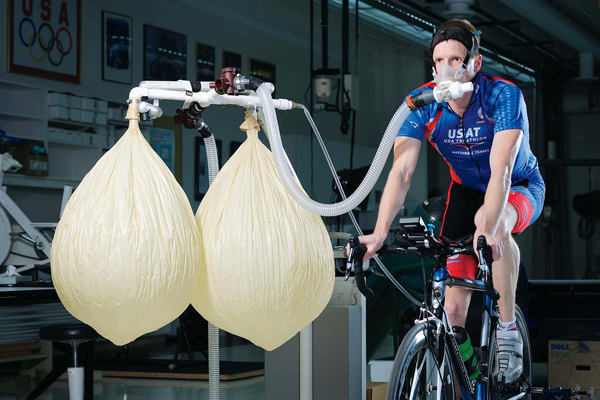
THAT LAST BIT is essential, because for Andy Potts, 31, the numbers rule everything. In a break with training orthodoxy, Potts and his coach have created a regimen called feedback training in which the training plan is reassessed every 24 hours based on the constant monitoring of three variables: wattage (the power Potts’s body produces), cadence (the tempo of his arm and leg movements) and heart rate. No lap times. No mileage. No grand training schedules planned months in advance. Only raw biological data. “My coach and I talk a lot about engines,” Potts says. “In auto racing, you want to put out the highest amount of power with the least amount of fuel. We do the same thing. My heart and lungs are my engine. The goal is to always increase the efficiency of the engine.”
Every night, Doane analyzes his athlete’s response to the day’s training. He’s looking for the best way to expand Potts’s aerobic capacity, power output and lactate threshold, without overtraining. If Doane sees that Potts’s heartbeat has been sluggish—say, beating 140 times per minute while Potts is trying to produce 410 watts—that means his body is struggling to recover from earlier training, so he’ll dial back the intensity of his workouts. If, on the other hand, his heart rate stays in the sweet spot around 165 while he churns through a series of 360- to 400-watt intervals, that means he’s fully recovered and ready to be pushed again. “We’ve created a feedback loop,” Doane says. In other words, Doane subjects Potts to a careful dose of punishment, and Potts’s body tells Doane, through empirical data, what he needs to do next.
Potts is certainly not the first guy to use monitoring tools—Lance Armstrong pioneered the use of cycling power meters, and every other weekend jogger straps a heart-rate monitor to his chest. Potts is, however, the first to allow these gadgets to rule his life. “I really don’t know anyone else who’s done what Andy’s doing, and I’ve been doing this since 1992,” says coach Troy Jacobson, a former pro triathlete. Joe Umphenour, a competitor in the Tuscaloosa trials who has trained with Potts at the Olympic Training Center (OTC) in Colorado Springs, can attest to the novelty of the approach. “There’s a lot of data available, and he’s found a way to turn it into a precise science,” he says. “And it’s obviously working. Andy’s capable of winning any race.”
Nearly all of Potts’s competitors use a training regimen called periodization, which typically involves a preplanned year’s worth of block-scheduled training and rest. These athletes use some of the same tools as Potts, but only to measure progress incrementally. “We’ll do a 20-minute time trial on a bike or a three-mile tempo run on a track to establish benchmarks,” Jacobson says. “I’m a proponent of using devices to occasionally establish some empirical data, but not all the time.”
Periodization is essentially an attempt to predict the body’s reaction to training stress using those benchmarks. But it can only provide estimates, and there’s no reason to believe it’s the only way. “There’s not a great deal of scientific evidence out there showing that a periodized training schedule for endurance competitions yields superior results,” says Neal Henderson, the head sports scientist at the Boulder Center for Sports Medicine in Colorado and a triathlon and Olympic cycling coach.
Only by constantly monitoring an athlete and endlessly tweaking his workouts can a coach design a training plan that scientifically reflects the body’s response to stress. And that’s exactly what Doane does for Potts. Every day, Potts’s Suunto T6 body-monitoring system feeds Doane a minimum of 4,320 data points—his heart rate measured every five seconds for six hours—which Doane can either graph into a condensed chart or expand over 10 pages. Some days, Doane uses figures from Potts’s CompuTrainer Plus microcomputer as well, and that adds data points for wattage and cadence to the mix. “In terms of training, there’s nothing unique in the world—it’s just different combinations of how to put it together,” says Joe Friel, a triathlon coach and the author of The Triathlete’s Training Bible. “But Andy’s coach is monitoring him and making decisions on a daily basis, and that’s very difficult to do.”
In less than five years, Potts has morphed from an overweight former swimmer into a member of the athletic elite. His teammates are confounded by his rise. “We don’t really know what he’s doing. He’s a little mysterious,” Umphenour says. “We call him the Phantom Trainer.”
MUCH OF POTTS’S “mysterious” training takes place in the living room of his thoroughly unmysterious Colorado Springs home. From the street, there’s no indication that someone worthy of a Wheaties box lives inside. His front door is 100 yards from a Safeway supermarket, where he gets his 4,500 daily calories. The walls are lined with photos of Potts, his wife Lisa, and their toddler son, Boston. Most of the time, there’s no sign of a bike. “Lisa prefers that her home not be a gym,” Potts says.
But a part-time gym it is. Every morning after breakfast, Potts hoists his bike out of a closet, sets it down next to the coffee table, straps on his monitoring system, and starts pedaling. “Things are controlled indoors,” he says. “I can easily manipulate the conditions and guarantee consistent workouts that I can monitor and reference.”
Six weeks before the Tuscaloosa race, I sat on a red couch in front of Potts’s red, 14-pound Felt F1 hybrid carbon bike and watched this morning ritual. In the previous days, he had performed well, exceeding his target wattage outputs at low heart rates, so today Doane’s plan was pushing him repeatedly to hit 400-plus watts in a painful hour of intervals. Fifteen minutes into the ride, his legs were spinning 84 times a minute. An electric load generator on the back wheel applied 400 watts of magnetized pressure, creating the same level of resistance he would encounter if he were climbing a hill during the Tour de France. The room was muggy with his effort. Potts grimaced, stood up, and pumped his legs up to 106 rotations per minute.
Suddenly the room went dark.
“Shoot,” he muttered, and hopped off the bike. He looked around to see what else was plugged in. The fan needed to stay, because last year he melted his load generator while spinning at 410 watts. Even with the fan, the load generator is burn-your-skin-off hot. He decided that an extra lamp was the culprit. He unplugged it and headed out to the circuit box.
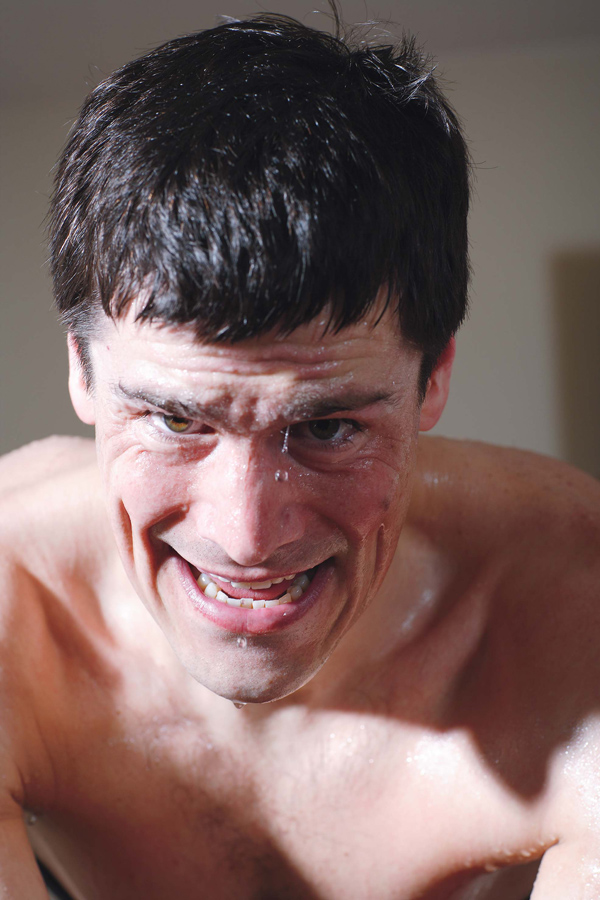
A moment later, he was back on the bike, tapping at the CompuTrainer’s handlebar touchscreen to recalibrate the load generator. He reset his watch, which connects to a chest strap and foot pod that together monitor his cadence, heart rate and workload output. “I wish there was a way to collect all the wattage I’m putting out, you know?” he mused. “I mean, it’s a lot. I could power the house.”
If he focused his vision out the window, he could just make out a tree in a certain neighbor’s yard. Hunter Kemper’s yard. The ropey-muscled 32-year-old lives there with his wife and toddler. (Oddly enough, another rival in the coming Tuscaloosa race, the fourth-ranked racer Matt Reed, used to live down the street with his wife and toddler.) Because of their clashing egos and personalities, Kemper and Potts avoid each other. Their wives, though, both former athletes themselves, bring their kids together for playdates.
But Potts wasn’t looking out the window; in fact, his eyes were about to roll back into his head. At just about the time he looked like he might vomit, he swapped out his bike pod for a GPS foot pod, a small black clip that communicates with his wristwatch, and ran out his front door: 10min @ 150hr, Doane’s prescription dictated. A little over two miles later, he arrived at the U.S. Olympic Training Center, where he spends three to five hours most afternoons.
In this 27-building former military complex, filled with advanced versions of every training tool imaginable, it’s impossible to forget what’s at stake: Americans on the Olympic podium. The magazine choices are Olympic Beat, Olympian and the Olympic Review. There is constant murmuring about the U.S. triathlon team’s world ranking, which usually hovers somewhere between fifth and eighth—and below eighth, the team gets to send just two, not three, athletes to the Olympics. The number-four American Jarrod Shoemaker won the first spot in an upset last September, and in Tuscaloosa, Potts, Kemper and eight others will compete for the second spot. The pressure can be distracting. It’s no mystery why Potts prefers to bike at home.
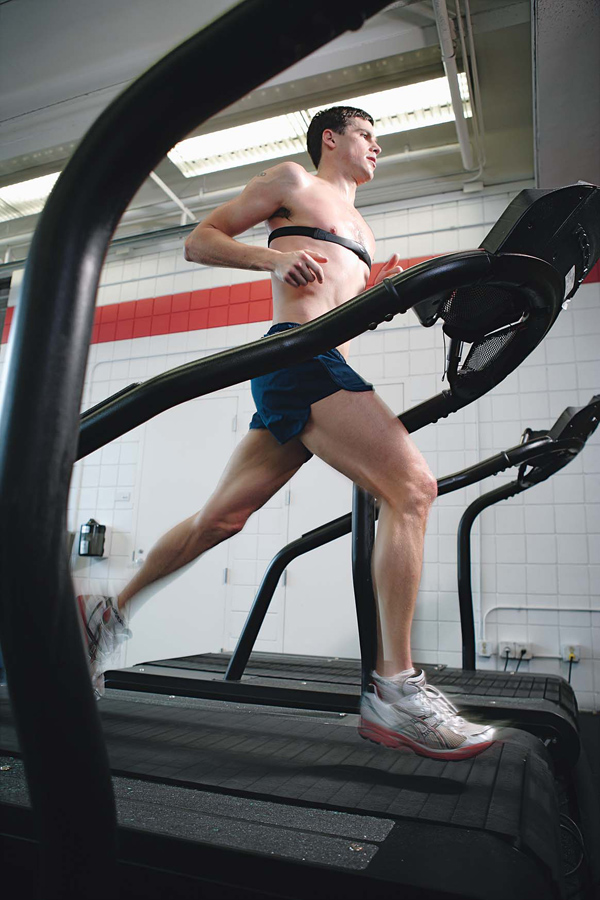
Potts jogged into the OTC gym, past a group of weightlifters twice his width and half his height. He jumped on a mammoth $16,000 Woodway treadmill and pounded out 6.5 miles while watching the weightlifters hoist loveseat-size barbells above their heads, drop them onto the rubber-matted floor, and then wander around. After the run, he took a lunch break in the cafeteria, where he looked ashen among the roomful of sun-touched bodies. He headed to the 50-meter pool—which is monitored by ceiling, floor and side cameras that connect to a 13-screen audio-video room where coaches perform stroke analysis—for a 5,500-meter (nearly 3.5-mile) swim. He emerged from the locker room wearing a Speedo FSII suit made of fabric modeled after shark skin; he wears a full-body cut so that his chest monitor stays in place. The FSII suit is not actually the fastest in the world—that would be the LZR Racer—but the LZR doesn’t breathe well, which renders it useless for triathletes, who bike and run in the same suit. His day would end when he plugged his watch into a USB port on his home laptop and e-mailed the day’s numbers to Doane.
While Potts swam, Doane and I stood in the pool’s audio-video room and looked through some of the binders that store data from every day Potts has spent training or racing since 2004. He showed me how, during Potts’s second-place performance at the June 2007 Vancouver World Cup, his heart rate dipped as low as the 120s in the middle of the race and averaged around 161. It was an ideal race: His consistently moderate heart rate left him plenty of energy to draw on in the final 10 minutes. Doane had written “A++” next to the graph. Then I saw a chart from the 2007 Escape from Alcatraz, during which Potts’s pulse spiked to 172 and stayed above 160 for most of the two-hour race. He won, but it hurt. Underneath, Doane had scrawled “DEATH MARCH!” Taken together, the numbers showed that these days, Potts can produce 11 percent more power than he could two years ago with the same amount of effort. Doane wants to squeeze that up to 12 percent by the Tuscaloosa trials.
“Some people look at what we do as nuts,” Doane says. “But I know exactly what we’re doing and why. What we’re doing is quite scientific. There is no guesswork.” So far, feedback training has allowed Potts to trot right on the edge of the overtraining crater, in which his body would break down and potentially take months to recover, without ever falling in. But overdoing it is still a constant concern. “It’s a very tricky and potentially dangerous strategy,” says Tom Crawford, the director of coaching for the U.S. Olympic Committee between 1990 and 2000. “The risk is his body crashing, if he’s on the edge that long.”
After we left the audio-video room, we stood and watched Potts as he churned out a hard swim. I asked Doane if Potts is a lab rat. Doane paused. “If he is a lab rat, then he’s a different kind of lab rat—one that’s dictating what’s going on,” he said. “We’re just doing what his body is telling us to do.”
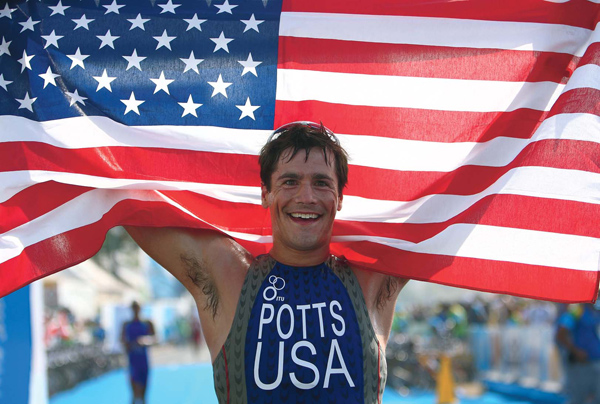
DOANE AND POTTS came up with feedback training when they were both triathlon virgins. “Doane had never coached a triathlete, so he threw out the mold of what everyone else had been doing,” says Lance Watson, the coach of 2000 triathlon gold medalist Simon Whitfield. “I think he just figured out what works for Andy”—and, in the process, opened the door to a new kind of training.
Potts’s Olympic obsession had previously expressed itself in competitive swimming, a low-tech sport in which life revolves around the pace clock. He finished fourth at the 1996 Olympic trials in the 400 individual medley and retired in 1999. He floated around, worked in carpentry, and quickly found that his life had no structure. In June 2002, Potts trained for two weeks and competed in an amateur triathlon in Colorado Springs. He placed only 28th, but he made sure to let the national team coach know that he would soon be joining her squad. Nearly two years later, he qualified for the 2004 Olympics in a fluke; he had an unexpectedly great race, while some of his competitors were injured or performed poorly. He placed 22nd at the 2004 Olympics, a strong showing for a rookie.
Two months later, his wife was diagnosed with thyroid cancer. She underwent radiation treatment throughout 2005. At one point, Potts had to stay 25 yards away from her so that he wouldn’t get radiation poisoning. “It actually committed me to my training,” Potts recalls. “She had four tumors that spread to her lungs, and the news just got worse and worse and worse. I remember running and thinking, You know what? We want to live on our own terms. We want to do what makes us happy without being dominated by outside forces. And that’s when I sat down with Mike and said I wanted to see how good I can be at triathlons. And Mike said, ‘I’m here.’ ” Lisa was betting her life on science (and won—she’s been stable for almost three years), so Potts figured he’d bet his career on it too.
Working with Doane was risky. Although he was the resident swim coach for triathletes at the OTC, he wasn’t trained to evaluate runners and cyclists. He did, however, know the basic principles of endurance training—increase stress and force the body to adapt by improving aerobic capacity, lactate threshold and strength—and figured that if he could measure the body’s stress load, he’d see what needed to be done.
At first, Potts was skeptical about the constant monitoring. But Doane convinced him that, at his age (then 29), feedback was essential, particularly for a guy who thinks four-hour half-Ironmans are fun. Over time, Potts grew to enjoy being freed from the athlete’s usual obsession with time and distance. “I’ve found that my inner gauge has married what I’m told by my watch,” he says.
What neither Doane nor Potts anticipated was that their made-up program might provide a template for future endurance training. Joe Friel is already working on software that will automatically translate feedback data into workouts, much like Doane does each night. And because a feedback loop can be created from just about any data source—stress-hormone and lactate levels, muscle-tissue testing—programs similar to Potts’s could work for any number of sports. The Austrian gold-medalist skier Hermann Maier, for example, has tried monitoring neuroendocrine and lactate levels for signs of muscular fatigue. Maier’s program requires constant access to a blood lab, so for most athletes it’s overly invasive and prohibitively expensive.
But in the years ahead, technological advances should make feedback programs increasingly feasible. Says Henderson, “I believe that in the next decade, the price on monitoring tools will drop, and they will be used more effectively to adapt daily training schedules.” Portable blood readers could one day be the new heart-rate monitors.
FORTY MINUTES from the finish line at the Tuscaloosa Olympic trials, Potts’s death gaze is trained on Kemper. The cycling pack has dwindled to three contenders: Potts, Kemper and Reed. As Potts enters the last of eight bike laps, Doane studies his form and nods approvingly.
Doane can’t stop pacing. Potts is riding even with Reed and Kemper, his heart rate still at a smooth 165. “If this thing boils down to Andy and Hunter running together, I think Andy can outrun him,” Doane says.
Today’s 10 competitors know one another’s abilities and strategies intimately. Almost all of them live in Colorado Springs, and they compete constantly. So when, with one mile of cycling to go, Reed makes a break for it, no one blinks. Doane watches Reed whiz by. Potts and Kemper follow 20 seconds later. “He’s made that move lots of times,” Doane says. “Andy can catch him on the run.”
Moments later, they ditch the bikes. Reed is still running 20 seconds ahead. Potts is nearly stepping on Kemper’s heels. “If Andy can stay with Hunter for five kilometers, he’ll break his spirit,” Doane murmurs. Potts maintains his position through the second of four laps. With three miles left to determine the next Olympian, Potts is in third place. The crowd goes crazy at the prospect of a tight three-way race.
Reed is too far ahead for Potts to see when Potts scrapes past Kemper. But as the two approach a fork in the track, a race volunteer directs Potts down the lane that leads to the finish line—a lap too early. Potts takes only a few strides in the wrong direction, but at a breakneck 4:55-mile pace, the effect is devastating. He has fallen seven seconds behind Kemper. Reed is 30 seconds ahead. Doane stares at his watch. He turns purple. “I don’t have a good feeling about this.” Lisa, unable to watch, sits in the grass 20 yards from the racecourse.
In the fourth lap, Potts’s heart rate hits 180. With a quarter mile to run, the death gaze returns, and he charges. He strides past Kemper with 200 yards to go, then crosses the finish line four seconds ahead of him—and 20 seconds behind Reed. Kemper storms off the course. Reed, a New Zealander who received U.S. citizenship only four months earlier, starts talking ecstatically to television cameras about the Olympic berth he has just won. Andy Potts and Hunter Kemper, the country’s two best triathletes, are still not on the Olympic team.
POTTS SPENDS the evening with Doane, poring over data. His numbers were as good as they could possibly be. Roughly 110 minutes of the 112-minute race were perfect. “As an athlete, Andy is a diesel engine, and he should be on that team,” says Olympic coach Lance Watson. “But any triathlete is always subject to the events of the race. Even Andy.”
Potts waxes philosophical. “You win a race by having the fastest swim and the fastest run,” he says. “I did. I just didn’t respond when I should’ve. I don’t feel like I had a mental lapse—it was just a tactical move that I didn’t counter. That’s the best run Matt’s ever put out.” He pauses. “I did a good job handling all the things that I could control.”
And that’s really all an athlete can do. No matter how meticulously someone like Potts trains, on race day he confronts chance, in the form of bad weather, equipment failure and, yes, misinformed volunteers. The triathlon will always be a game of training the body to take advantage of opportunities, and then praying like hell that those opportunities appear.
On June 22 in Des Moines, Potts and Kemper will fight it out one more time for the last spot on the Olympic team. As of press time, the U.S. team was safely above eighth place in the volatile international rankings, so that third Olympic slot was secure.
And so the day after Tuscaloosa, Potts flew home and continued his feedback training, preparing his body for the many things that could go wrong, or right. And that’s really what gives the Olympics its drama: the fact that the best athlete—the one with the most finely tuned training regimen, the most phenomenal genetics and the most passion—doesn’t always win.
Arianne Cohen, a former competitive swimmer, is the author of The Tall Book_, a scientific exploration of the tall side of human stature to be published next year by Bloomsbury._
