A new college course intends to teach future Hollywood artists the basic science necessary to make virtual worlds look realistic
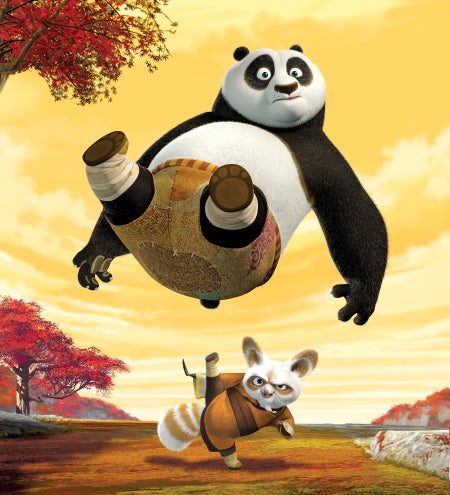
Is This Fight Physically Realistic? Dreamworks Animation

San Jose State University is soon going to start offering a class called "Physics of Animation," that aims to teach future animators the proper way to render a leaf falling to the ground or a person walking with a realistic gait. Or a kung-fu fighting panda getting launched into the air by a furry little creature.

Physics is a key element of realism, says the course's professor, physicist Alejandro Garcia. Any movie-viewer can spot bad physics, though they might not always recognize what's bothering them. And for all the progress that has been made in animation in the last decade, and all the science homework that effects experts say they do prior to creating scenes, most movies still let through a glitch or two that makes the attentive viewer wince. For example, that rogue wave in Poseidon was certainly better than the one that rolled through The Perfect Storm a few years earlier, but it still looked fake.

The professors involved hope to start offering the course in the fall of 2009 - which means we the people will have a long time to wait until the results of their work start showing up on the big screen.

Via SiliconValley.com

6 Comments

I sure wish I had this course available to me in college. I agree with its application towards physical simulation: IE Waves, explosions, etc. I disagree with necessarily applying realistic character animation towards something like Kung Fu Panda. Stylized characters require stylized motion. This is why motion-capture fails horribly in movies like Monster House. It looks creepy.

It's a kids' animated movie for crying out load. It suppose to be funny. Do you suppose that little Timmy cares about physics and motions. Things are exaggerated to be funny. A little guy beating up a big guy. That's funny! Well obviously this movie is all wrong. Animals can't do kung-fu let alone kicking a panda into the air like that.

No wonder there's the stereotype of science and "geeks" as not knowing how to have fun.

Antaro: Spoken like someone who isn't an animator. Not that I'm being snooty -- most people simply don't realize that technical details are a part of animation. It's not just about drawing pretty pictures. (This goes back to the earlier days of drawn animation, never mind CGI.) Little Timmy doesn't have to care about "physics and motions," but as Alejandro Garcia says in the article, people will notice bad physics even if they can't put their finger on why it's bad.

A couple of examples: some of the first exercises that beginning animators go through in school are the bouncing ball and the walk cycle. They quickly learn that if they don't understand certain concepts about physics the ball or the character walking just won't look right. Gravity, acceleration and deceleration affect the ball's bounce; how the ball absorbs the impact of hitting the ground determines how it deforms to relay the idea of that impact to the viewer; and walking requires an understanding of centre of gravity and weight distribution. Get any of those things wrong and the audience will spot it right away.

Creating animation isn't just anarchic whimsy, and physics isn't all about calculations on a blackboard. Even the wackiest cartoons you ever saw growing up depended on the animators' knowledge of how things move.

Emru Townsend
Editor, Frames Per Second
www.fpsmagazine.com

i wish that they could give high school people courses like this it would be an awesome experience to have
AND TO EMRU AND ANTARO STOP BICKERING AT EACH OTHER IT IS REALLY IMMATURE

I would have to say it's about time, for the more serious animations like teenage mutant ninja turtles they really need to stick to physics as much as they can without dumping the rest of the film in industrial acid. but for some of the animations that are supposed to be funny like monsters inc., kung-fu panda, and the emperors new groove the how can be as lax as they can because really part of the show being funny is the entire absurdity of something like Willey coyote trying to fling himself using a catapult and ends up flipping the catapult onto himself. yes it is impossible but it is still funny non the less.

Hello, I'm Alejandro Garcia, the professor who is teaching physics to animation students at San Jose State. Let me assure you that our intention is to help animation artists understand realistic motion so as to use that as a foundation for their work. This is in the same spirit as learning to draw realistic people and animals, even if when animating them an artist may exaggerate or distort their features.

We hope that our students will create movies in which the audience won't even notice that the physics is correct (or not) because they'll be so immersed in the film's story and the world it creates. If you're interested in learning more, look us up on the web at animationphysics.com


June 2013: American Energy Independence

Five amazing, clean technologies that will set us free, in this month's energy-focused issue. Also: how to build a better bomb detector, the robotic toys that are raising your children, a human catapult, the world's smallest arcade, and much more.


Online Content Director: Suzanne LaBarre | Email
Senior Editor: Paul Adams | Email
Associate Editor: Dan Nosowitz | Email
Assistant Editor: Colin Lecher | Email
Assistant Editor: Rose Pastore | Email

Contributing Writers:
Rebecca Boyle | Email
Kelsey D. Atherton | Email
Francie Diep | Email
Shaunacy Ferro | Email

circ-top-header.gif
circ-cover.gif
bmxmag-ps