
OnLive delivers high-powered games over the Internet to TVs and PCs

OnLive MiniConsole An Internet-connected adapter plugs you into games running on computers up to 1000 miles away. Courtesy OnLive

Start buying your Mountain Dew in bulk: Later this year, the new OnLive Game Service will deliver digital fun directly to the TV, instantly. All you'll need is the compact OnLive MicroConsole (not much bigger than an iPod), a wired or wireless controller and a broadband internet connection. Alternately, most PCs and Macs can run the games, using only a small browser plug-in that will be available from OnLive.com.

Since the heavy lifting is done by OnLive's remote computers, a laptop or desktop powered by anything friskier than a hamster should be able to play even the most demanding titles: OnLive has inked deals with major publishers such as EA, Ubisoft, Take-Two Interactive, Warner Bros. Interactive Entertainment, THQ Inc., Epic Games, Eidos, Atari Interactive and Codemasters.

Online distribution should make gaming quick and easy, providing a portal to a variety of on-demand titles, solo or multiplayer options, different genres and skill levels. The platform also supports an online community, for de-rigueur social networking, in the living room or at the keyboard. You can even view live feeds of your buddies in the midst of gameplay.
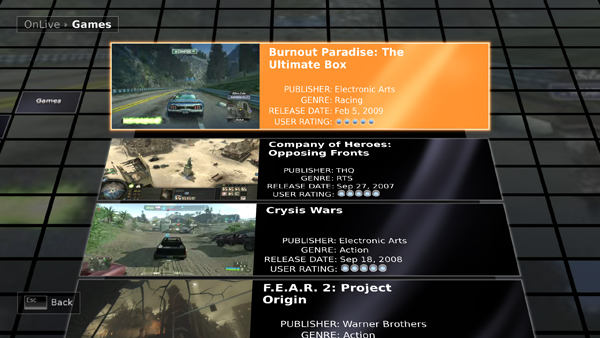
Select Games to Rent:  Courtesy OnLive

Seven years of stealth techno-tweaking have improved the user experience, notably reducing lag time to an imperceptible 80 milliseconds or less. So while the game is running on a server up to 1,000 miles away, you feel like it's running on a computer in the same room with you. We played a round of Crysis with no perceptible lag time.

OnLive founder Steve Perlman, one of the minds behind QuickTime, developed new compression technology that he claims is far less data-intensive than anything else on the Net but allows fast action to appear smooth. Individual freeze frames might reveal skewed or missing data, he says, but OnLive drops bits in a way that isn't perceptible in moving video. Typical home routers were also tested to ensure that data packets won't be hassled by overprotective firewalls, reducing lag time.
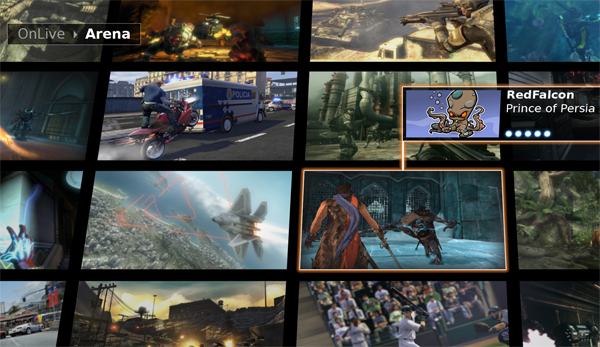
OnLive Community: In the Arena, you can view other players who are online and drop into watch their games.  Courtesy OnLive

The Palo Alto, California-based OnLive has begun to show working demos of the service, including its compatibility with Epic Games' Unreal Engine 3. Look for OnLive to ArRive this winter. Hardware prices and monthly subscription fees are yet to be announced, although they promise it will all be affordable--"less than what the average person spends on software and hardware (consoles) annually."

Want to read more articles like this, plus stories on gaming, music, movies, and more? Subscribe to Popular Science today, for less than $1 per issue!

9 Comments

So their claim is that you can run a high-end game more efficiently on a poor system by letting a remote server handle most of the processing? I doubt it. In fact, in all likelihood it would make things worse.

Remote-processing a video game doesn't alleviate the biggest chokepoint for a gaming PCs; the game's graphics engine will still have to be run at your end on your PC (you know, so you can actually see things). All you'll really get is the same game performance, except with added control latency due to the fact that your game input and its results will need to be transmitted via broadband to the remote server.

If instead the remote server is handling graphics processing as well, you have just switched from set of problems to another. Sure, the graphics have become high-end, but you're still seeing them a half-second or so late, and now you've added to your internet connection the unnecessary strain of what amounts to a continuously streaming high-definition video. That, of course, further increases the latency inherent in the system.

In a genre of entertainment that demands split-second reaction time, most gamers prefer to avoid as much latency as possible. This system would effectively add multiplayer level latency to all your single-player games, and double the latency of your multiplayer games.

Don't forget, you'll still have to pay for that processing power you didn't bother to put into your own PC, through the fees the service charges to maintain the servers that are doing the work instead. I think I'd rather buy the hardware myself than pay to use someone else's; isn't that why the rise home gaming marked the end of the arcade era?

Here's the thing. Like qlmmb said before, the most important thing is lag-time. I play Gears 2 and experience lag all the time, but I don't like it. I don't want to play something that inputs my actions a second after I do them. It just disturbs the flow of the game.

On the other hand, the usefulness of such a system is tremendous. The need to buy consoles would be so little that people who can't afford to buy a new Xbox or Playstation every few years can still play the most recent games. Plus, companies could focus more on the games themselves if they aren't working on new consoles. If Microsoft, Sony, and Nintendo all jumped in on this and lowered the amount of consoles (not stop the production because some people would still buy consoles regardless), we could see new technology and better games faster than if we kept going with consoles.

Additionally, DLC would be effortlessly intertwined with the games you play since both the game and the content would be available on the same server and whatnot.

While I'm surprised we'll be seeing such technology so soon, I'm happy to say that it will certainly be in a step in the right direction. It just has to work. The future of gaming is riding on this because if it falls flat, companies will shy away from any other technologies that come after it. But if it works, then and only then, will we see a new kind of gaming.

qlmmb

The reason why games require high end graphics cards on your computer is because they have to process the graphics. That means it has to create what you see on the screen. If the processing was done remotely then all your computer would have to do is display, just like streaming video which doesn't require any serious power.
As for lag, it wouldn't increase lag in multiplayer because in currently multiplayer you still have to wait for other people's commands to come to your computer anyway. The path is still the same, your computer to server to opponents computer. All that that has changed is the processing is now done on the server and not your computer.

lhopki01, the path is not the same under this system. In a normal multiplayer game environment, your connection runs from your computer to the game server and back again. With this setup, your connection runs from your computer, to the OnLive servers, to the game server, back to the OnLive server, and back to your PC.

Eggman002 (not verified)

Ihopki01 has the idea. All the graphics processing is done remotely. The only thing that has to be sent over the networks is basically your input and the video of your actions.

The only question I see is whether you can send video that is that high of quality over the network with no buffering time and no lag time (or nearly). They claim you can. I haven't seen it so I can't dispute that claim.

But if that is possible why do Hi Def videos over the net lag so much?

And how long before your internet supplier decides you are using too much bandwidth and wants to charge you more.

How fast of an internet connection do I need?

I think it will be a wait and see deal. According to the articles I have seen they have demonstrated it and it seems good. But they are almost certainly demonstrating it under the ideal conditions. Lets see what it looks like when you try and do it over a slow wireless internet connection with lots of interference.

I'll be very surprised if this works without delay issues. if you're running a high-end game console like the ps3 or 360 (i love you nintendo, but you dont have the graphics for this :( ) the processing for graphics is done, and presented immediately through the cable that runs to your tv. Even if they have their own massive amounts of graphics processing power, keep in mind that you need to keep a framerate of at least 25fps to have a fast paced game be playable. The 360 and ps3 have some very impressive graphics capabilities, and if you expect to have a constant stream of HD quality graphics like these systems have running through your internet connection, i think you may be dissapointed.

I love the idea very much, but it just doesnt seem practical with current technological limits. After fiber-optics prices come down from $1200/month, i can definitely see this working though, and i think it will be very popular.

I don't think that those of you panning this really quite grasp how much bandwidth is necessary for this and how much is available. They are recommending a minimum 1.5Mbit pipe, presumably for download, as the up to send player input is negligible compared to the video deltas they will be sending.

Consider this: an acceptable framerate for most FPS gaming is around 60 fps. That means that the minimum amount of data they plan to send is around 1.5Mbits/60 per second. Believe it or not, your video screen doesn't change much in 1/60th of a second when you're playing a FPS game, and if their algorithms and compression are smart, they can probably pull it off. I would also add that they're probably expecting 10-20Mbits to be more typical for their customers.

As lhopki01 mentioned, what you're seeing in a multiplayer game is not accurate because your opponents aren't exactly where they appear to be. That's because in typical games, the opponent's data lags your own and the server can only give you an approximation of where they are. In this system, the frame you see will be exactly what the server sees, so it is a more accurate representation of the server's state.

Developing games for the various flavors of video and sound cards, not to mention different platforms like PC and Apples adds considerably to the costs of development. If developers can target just one really functional and fast platform, then it's much easier to develop and test. They can then focus on content and game play instead making sure various revisions of multiple drivers work with their game.

Further, OnLive can make investments in better hardware than you can because they can use and buy it more cost effectively than you (their cards and cpu's can be kept at high utilization while you're working or sleeping). They might also have video effects that would be otherwise unavailable to the average gamer. And they can run data centers in multiple geographic locations like gaming companies do today to help reduce latency. I actually look forward to something like this.

"In this system, the frame you see will be exactly what the server sees, so it is a more accurate representation of the server's state."

kstauff, this assumption is incorrect. OnLive will not be running their own dedicated game servers. It would be unrealistic for them to do so; they would need servers for all their available titles, which would force their customers into a narrow set of server choices and prevent them from playing with anyone not using OnLive. Consider games like World of Warcraft, for example. Any particular "world" sever you connect to for WoW is not being run by OnLive.

All this service promises to do is to act as a middle-man between you and the game you are playing, in order to perform the more hardware-intensive aspects of the game for you. They are essentially connecting to the game server on your behalf, while you instead connect to them. Adding this extra step in the connection will always increase the total latency of the system. First, you have the latency from your PC to the OnLive servers, which in all likelihood will be greater than if you had connected directly to the game (due to the greater bandwidth required to stream the video display to your computer). Then, an additional measure of latency is applied going from the OnLive servers to the game server (the connection you would normally be handling yourself).

So no, the frame you see will not be "exactly what the server sees"; it will be the frame the game server approximated for the OnLive server, delayed by the time it took for OnLive to send it to your PC.

There's just far too many catches in this system for my taste. Case in point, you need a broadband connection just to play single-player games, which normally wouldn't require any connection at all! Perhaps, in a distant future in which server lag has become as negligible as the latency from your box to your monitor and the internet is so reliable you can assume you will always have connectivity, this service will find a place as the eliminator of peripheral hardware. For now, I'll continue to build and optimize my own PCs.

I think it's just all around lame.
With Xbox 360 if my Live account runs out I either buy another year or just play offline. With OnLive you HAVE to pay for the service to be able to play the game. That is a conspiracy to suck your money out of you because you feel obligated to buy more of the service because you just dumped a few hundred bucks into it because you thought it would be cool.

They need to add a SD Flash Memory Slot (or any number of different forms of memory) so you have the option of being able to play a few games offline.

My internet connection sucks even though we have the highest internet service available in our area. I live in an old city that does not have the high quality internet so I won't even have the option of being able to use it.
The idea of the OnLive console is years ahead of the average internet connection quality and stability. They need to wait at least 10 yrs in order for most of America to equip themselves with optical wires. Otherwise the OnLive will be even worse than the Wii(don't get me started on how much the Wii sucks c**k).


July 2013: The Future Of Flight

The incredible innovations, like drone swarms and perpetual flight, bringing aviation into the world of tomorrow. Plus: today's greatest sci-fi writers predict the future, the science behind the summer's biggest blockbusters, a Doctor Who-themed DIY 'bot, the organs you can do without, and much more.


Online Content Director: Suzanne LaBarre | Email
Senior Editor: Paul Adams | Email
Associate Editor: Dan Nosowitz | Email
Assistant Editor: Colin Lecher | Email
Assistant Editor: Rose Pastore | Email

Contributing Writers:

Kelsey D. Atherton | Email
Francie Diep | Email
Shaunacy Ferro | Email

circ-top-header.gif
circ-cover.gif
bmxmag-ps
