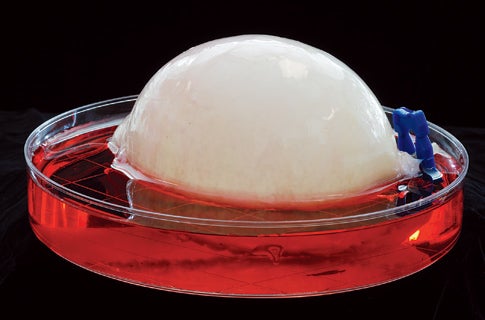
Almost 100,000 people languish on organ-transplant waiting lists. But new tissue-fabrication techniques should make swapping in a man-made liver as easy as snapping Lego bricks into place.
Blood vessels
Method: 3-D printer
When: 5 years
Gabor Forgacs, a tissue engineer at the University of Missouri, is making blood-vessel networks by culturing three types of vessel cells and loading them into a fridge-size bioprinter. This machine prints out the cells to build capillaries in preprogrammed patterns.
Liver
Method: Grown using stem cells from umbilical-cord blood
When: 15–25 years
Colin McGuckin has made silver-dollar-size, functional “mini livers.” They aren’t large enough to do a full body’s worth of work, because livers have hard-to-replicate ducts with specialized cells.
Kidney
Method: Grown on a polymer framework
When: 10–20 years
His artificial bladder breakthrough in 2006 grabbed all the headlines, but Anthony Atala of the Wake Forest Institute for Regenerative Medicine is forging ahead on other artificial organs. In 2002, when he transplanted artificial kidneys into cows, the organs survived for months and even produced their own urine, albeit not very efficiently. But to build one for humans, he has to figure out the precise combination of seeder cells that will transform a lab-built scaffold into a fully functioning, transplantable organ.
Five amazing, clean technologies that will set us free, in this month's energy-focused issue. Also: how to build a better bomb detector, the robotic toys that are raising your children, a human catapult, the world's smallest arcade, and much more.


Online Content Director: Suzanne LaBarre | Email
Senior Editor: Paul Adams | Email
Associate Editor: Dan Nosowitz | Email
Assistant Editor: Colin Lecher | Email
Assistant Editor: Rose Pastore | Email
Contributing Writers:
Rebecca Boyle | Email
Kelsey D. Atherton | Email
Francie Diep | Email
Shaunacy Ferro | Email
Lets hope the development and production of transplantable organs come sooner than the estimates.
If in 5 years the blood vessels are perfected, would #2 & 3 still be 10 - 15 years away or could the first success make the next ones reality sooner.
Knowledge is not information, it is transformation. ~ Osho ~
I agree collaboration is the way to go. All three examples sound like they could be used together to make a more complex lab organ, say a heart or lung. Frame it up, print it out, and grow it up. I think with progress on the stem cell front, along with progress in epigenetics and and chemical culturing we are on our way to not only lab organs but robust usable ones.
could we possibly be able to create new super organs?
like replace our ribs with the webbed rib cages on Indiana Jones or have like a super heart that filters out cholesterol or something?
JFeatherston, kudos, mucho kudos.
I think that would be cheating out science with science.
But, hey its just like the saying, just because we use cheat codes doesn't mean we aren't smart.
what we can come up with is amazing.
Karly-San Diego midwife
http://www.mobilemidwifery.com