Gray Matter
Playing with fire

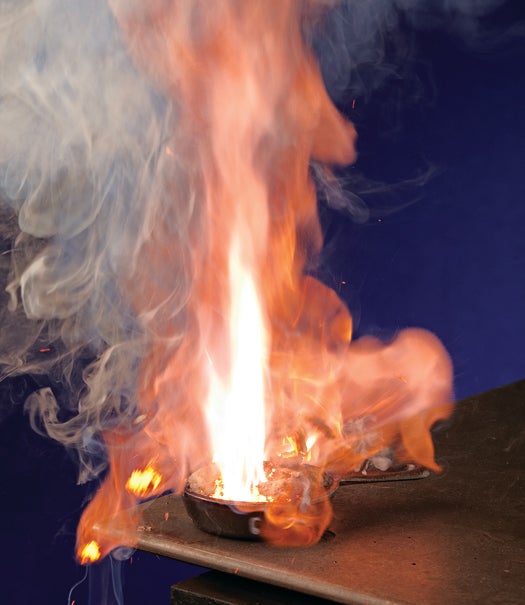
Combustion Science An exothermic reaction takes place between potassium permanganate and glycerin. As the reaction speeds up, generating heat, the mixture eventually catches on fire. Mike Walker

The facts about spontaneous combustion are easily lost. Mostly this is because spontaneous human combustion is a favorite among conspiracy-theorist types. Reports of people suddenly going up in flames tend to omit an essential detail, such as a lit cigarette. Yet as with many phony scientific concepts, the possibility is so intriguing that some people just want to believe.

The same is true of spontaneous non­human combustion. A video recently made the rounds that showed a cotton ball catching fire after having been soaked in several tubes of Super Glue. How cool is that! Of course, I had to try it—again and again—with every kind of Super Glue and cotton ball I could find. It never worked.

There’s no question that Super Glue gets really hot when mixed with cotton. The high surface area of the fibers causes the glue to harden very rapidly, releasing energy in the form of heat. Manufacturers warn about burns caused when Super Glue drips onto clothes, which has happened to me personally. The hot fabric gets stuck to your skin, and any attempt to pull it off just means that it also gets stuck to your fingers.

But there’s a big difference between burning skin and an actual flame. As far as I can tell, the cotton ball in the video does not catch fire; a closer look at the footage suggests that the video was edited just before the blaze starts.

The beautiful thing about science is that for every fraudulent phenomenon, there’s a real one that’s even more extraordinary. Take, for example, a lesser-known form of spontaneous combustion that is genuine and easy to reproduce: spontaneous enema combustion (no, really).

To demonstrate it, I made a depression in a small pile of finely ground potassium permanganate, the chemical sold for recharging iron water filters. Then I squeezed the contents of a glycerin enema dispenser into the depression. Potassium permanganate is a powerful oxidizer and reacts with the carbon-hydrogen bonds in glycerin. A few seconds later, the mixture burst violently into flame. It worked every time—no mystery, no doubt about it.

Warning: Super Glue on clothing can cause burns. Potassium permanganate and glycerin is a serious incendiary.

Want to read more articles like this, plus tips and tricks, home hacks, DIY projects, and more? Subscribe to Popular Science today, for less than $1 per issue!

14 Comments

Huh huh, cool. Fire!

I prefer melted cheese.

Self/spontaneous combustion is mostly because of rapid oxidisation of the substance (remember oxidisation is exothermic), combined with the condition: rate of heat generation > rate of heat dissipation. This leads to an accumulation of heat, and when its warm enough (=combustion point of the fuel), the system catches fire.
For the super glue chemistry, a quick search tells that its an exothermic hydrolysis chain reaction, assissted by the air moisture. The surface areas is high leading to higher reaction rate, hence more heat.

Other common examples of self combustion are:
1. in carpenter´s workshop, Linseed oil is used, which has high amount of Linolenic acid, which is highly unsaturated. They soak cotton rags in this oil, and throw them in the bucket after use. This leads to oil´s exothermic oxidation, and eventually self combustion.
(http://en.wikipedia.org/wiki/Linseed_oil#Spontaneous_combustion)
2. In waste handling units (landfills), or industries where powder with high metal content is handled, metal oxidises with the air trapped and heat is generated, leading to large scale fire.
(http://www.waste-management-world.com/index/display/article-display/3111412016/articles/waste-management-world/volume-11/Issue-4/Features/Understanding-landfill-fires.html)
3. Heat emitted by the biological degradation of the waste can be of assissting nature to such incidents.

ANYTHING will oxidize and spontaneously combust if you grind it fine enough. When a special limit is reached for fineness--even simple sugar will combust violently once the reaction has reached a critical point. Small particles of course react faster with oxygen and the smaller they are the faster the reaction (or the larger the surface area is in relation to the particle). This is a problem also in the manufacture of small carbon based molecules as carbon can oxidize rapidly in some forms and sizes. Every Chemist knows this.

So.. Cottonballs+superglue isn't enough to burn but it does get hot. Does that mean that activated carbon would because of it's stupendous surface area?

Volt,
It means, do not go camping and expect to use cottonballs and superglue to cook.

Now, isn't this useful to know. ;)

My guess is the cotton ball fibers were saturated with water when it was used. That would've sped up the reaction of the glue since it's H20 reactive.

The KMnO4/glycerine reaction is actually very useful for another fun exothermic reaction: thermite. it works very well as part of a two-step thermite starter. it is used to ignite magnesium tailings, which in turn ignite the thermite (Fe2O3 and Al)

and gizmowiz, that's simply not true.

would antifreeze produce the same effect?

Initiating a chemical reaction doesn't exactly qualify as "spontaneous combustion" but, I suppose it does suggest a general explanation for why seemingly random ignitions occur.

Another 'spontaneous combustion' mixture is aluminium powder and iodine. The set it on fire you simply add a drop of water! The result is very spectacular with clouds of purple iodine vapour 'smoke' being given off.

A discovery has been established and proved in that a separate transaction takes place between the heat (burn) and it's resulting damage.
Fire and heat activate that burning piece of wood to destroy itself and is on it's own in self destructing. And no it does not need atmosphere. Like spontaneous human combustion this wood is still producing it's own oxygen.

When particles (AURA) of our Sun collide with particles (AURA) of our Earth we associate this as heat and light not fire.

When particles of Earth collide we call this heat, light, fire.
Fire, as we see it, is the collision of many small particles.

A reaction causing an atomic reaction that causes a gas (oxygen) to enter into reverse evolution where expedient cell division takes place in which each new cell is smaller than the last.
The phenomenon fire is the collision of these chaotic particles.

These minute organisms (heat, light, fire) are a size to interact with the Earths force centrifugal and join the universe with their nucleus intellect as expanding dark matter.

Along with water; Evaporation is another misconstrued phenomenon.
Evaporation is simply a reaction causing temperature to rise changing water back to fire.
It's difficult to detect the fire in gas, keep looking, it's there!

Talk about paranormal, the following is so simple yet it will take some to get your head around this one!!!

If you pour a little Water on Fire, fire will influence this water to change back to what it was made from. By pouring lots of water on this fire, water will dominate and change fire back to what it was made from.

So basically Fire is Water!

My discovery and invention promotes the fact 100% that;
Fire and heat activate the body to destroy itself. The body does the damage NOT the flame or heat.

Think HOT as being nuclear particals orbiting in chaotic orbit directions and Cold being chaotic nuclear particles orbiting harmonically in same orbit directions.

You just might want to wonder and worry about that wet rotting bail of hay heating up in the barn and gad if you happen to be suffering the hot flashes of menopause!

Oh, and as far as putting those fires out!
As it took a reaction to ignite this fire it will take a reaction to stop it. One must experiment and find a tone as it is the phenomenon SOUND that can do it.

In short for all you DIY experimenters. If your a fruit of the loom type or just wear lots of cotton, keep the super-glue away from your balls. I assure you the reaction will be spontaneous, and you will think that something just burst into flames. At a minimum, your face will be flame red when you arrive at the emergency room. Don't worry, they've seen weirder stuff than this. :)

Popular Tags

Regular Features


June 2013: American Energy Independence

Five amazing, clean technologies that will set us free, in this month's energy-focused issue. Also: how to build a better bomb detector, the robotic toys that are raising your children, a human catapult, the world's smallest arcade, and much more.


Online Content Director: Suzanne LaBarre | Email
Senior Editor: Paul Adams | Email
Associate Editor: Dan Nosowitz | Email
Assistant Editor: Colin Lecher | Email
Assistant Editor: Rose Pastore | Email

Contributing Writers:
Rebecca Boyle | Email
Kelsey D. Atherton | Email
Francie Diep | Email
Shaunacy Ferro | Email

circ-top-header.gif
circ-cover.gif