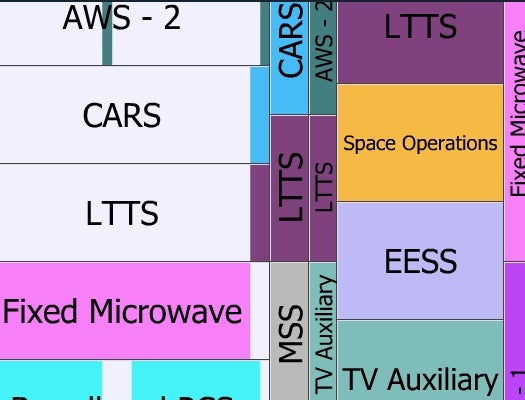
As part of its grand new plan, the FCC is making a major push to involve and inform the public. RSS feeds, a blog, and a Twitter account have all made relatively recent appearances, along with a home broadband speed test. To better help the public understand the current frequency allocations, the FCC has also rolled out several great new interactive tools on their website for "reviewing how spectrum bands are allocated and for what uses, and who holds licenses and in what areas."
The tools on the FCC's Spectrum Dashboard provide access to information about the current spectrum allocations by frequency, type of use, and user. Study enabled by this dashboard can help us to better understand how portions of the spectrum are used and in what areas experimentation and innovation are possible.
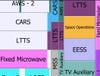
The Spectrum Band Browser provides a color-coded breakdown of the current spectrum allocation scheme. Moving the mouse over a portion of the spectrum gives key details on the type of use.
If you find you like this spectrum chart so much that you would like to have a copy of your very own, the full chart is available for download here. Regrettably, the Government Printing Office no longer carries this poster, so you will have to make your own printing arrangements if you'd like to have this on your wall, as I do.
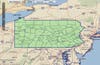
The Spectrum Dashboard also provides two tools for researching license holders and the portions of the spectrum to which they have been given access. Pictured above is a screen shot of the Map tool, which reveals license holders by county. Searching by both the legally registered and common brand name of the license holder is also supported.
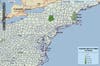
The spectrum availability map by county provides a visualization of the amount of the licensed bands not currently allocated to license holders. For most of us at the present time, it is somewhere right around none.
If you find yourself interested in the details of the frequency bands, don't miss the "Search by FCC License Categories" tool. This is a search interface for detailed information about each of the allocated bands in the radio spectrum.
Radio-wave tinkerers may find something else to like. According to a recent New York Times article, "The plan will advise that some of the spectrum become unlicensed, so it can serve as a test bed for new technologies."
While there are already parts of the spectrum available for public usage, both through the portions allocated for amateur radio and the portions allocated for unlicensed operation, the FCC broadband plan acknowledges the benefits and innovations that have resulted from federal support of research and development and specifically addresses the issue of expanding the parts of the spectrum that are made available for research and experimentation. In section 7 of the plan, it states "Allowing research organizations such as universities greater flexibility to temporarily use fallow spectrum can promote more efficient and innovative communications systems."
Five amazing, clean technologies that will set us free, in this month's energy-focused issue. Also: how to build a better bomb detector, the robotic toys that are raising your children, a human catapult, the world's smallest arcade, and much more.


Online Content Director: Suzanne LaBarre | Email
Senior Editor: Paul Adams | Email
Associate Editor: Dan Nosowitz | Email
Assistant Editor: Colin Lecher | Email
Assistant Editor: Rose Pastore | Email
Contributing Writers:
Rebecca Boyle | Email
Kelsey D. Atherton | Email
Francie Diep | Email
Shaunacy Ferro | Email
The spectrum map by FCC its a great idea to inform the public but most people will just ignore all these efforts. I think it surely a great tool for amateur radio and the portions allocated for unlicensed operation only.
Oi Torpedo | bingo | Hoteis
Smith also pledged to disrupt the renewed drive of the cable and satellite operators to weaken the hand of broadcasters in retransmission consent negotiations by revamping FCC rules governing the negotiations. Smith suggested that the government encourage broadcasting and broadband simultaneously. Smith also said that broadcasting is regulated to observe community standards of decency. Taking spectrum away from broadcasting might also disenfranchise the disadvantaged and elderly who tend be among the 15% of the population that still relies on free, over-the-air television. Smith said an intact broadcasting service was critical to homeland security.
| Written by Dimitri from Eat Healthier Foods |
Well, since I do like this spectrum chart I might as well download a copy of my own. Thank you for the link and the interesting article that you create here, it reminds me other good websites and after a visit to http://www.electricgriddlereviews.net I hope to get exposed to more content on Pop-sci.
Happy to see your blog as it is just what I’ve looking for and excited to read all the posts. I am looking forward to another great article from you. After skimming through your website
http://simulationassuranceauto.org/simulation-assurance-voiture/
It’s a nifty tool and all, and I for one am glad to have access to it but it doesn’t cool my displeasure with the FCC’s closed-bid dissection bandwidth spectrum - one of our shared national resources - to a monopoly of giant, corporate interests. I suppose this tool will be useful to see exactly how much we have lost and who we’ve lost it to.
www.broadband-expert.co.uk
is this some kind of a gps system? i'm looking for a new gps system for my mom's car, but i just am not able to find one. I've heard garmins are good, but they are quite expensive. pimples on scalp
is this some kind of a gps system? i'm looking for a new gps system for my mom's car, but i just am not able to find one. I've heard garmins are good, but they are quite expensive. http://pimplesonscalp.net
There have been updates to the Spectrum Dashboard.
rfblog.lbagroup.com/fcc-updates-spectrum-dashboard/
Sorry, the link was spammed out. There is a link to the updates
If agency open up parts of the spectrum for private experimentation, then this good for others.http://www.imsoftwaredevelopment.com/
t’s a nifty tool and all, and I for one am glad to have access to it but it doesn’t cool my displeasure with the FCC’s closed-bid dissection bandwidth spectrum - one of our shared national resources - to a monopoly of giant, corporate interests. I suppose this tool will be useful to see exactly how much we have lost and who we’ve lost it to.
www.promdresspicture.com
Many things that you explain in your article. I think that's good for readers to know it. http://www.amerisleep.com/mattresses.html
C'est un outil astucieux et tous, et je suis pour ma part heureux d'avoir accès à elle, mais il ne refroidit pas mon mécontentement avec le spectre de la FCC fermé offre une bande passante de dissection - l'un de nos ressources partagées national - à un monopole du géant, des entreprises intérêts. Je suppose que cet outil sera utile pour voir exactement combien nous avons perdu et qui nous l'avons perdu.
www.AUTO-GEARS.COM
www.autoinsight.biz
www.thaicarnews.com
I am happy to find this informative post here and i can't stop myself for the comment.
Thanks
www.mcintoshlabs.com