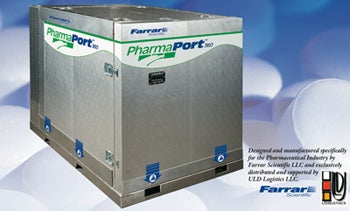
A new refrigerated cargo box for moving pharmaceutical products has attracted the likes of delivery giant UPS, but its inventor may go out of business first because of a lengthy review process by the Federal Aviation Administration (FAA).
The Columbus Dispatch brings the story of Scott Farrar, owner of the small Ohio company Farrar Scientific. His reinvented "PharmaPort" cargo box uses a "passive" technology to keep drugs and other products at a constant temperature, and can fit anywhere on a cargo plane. Small battery-run fans help circulate air within the boxes, rather than the usual "active" compressors or heaters
Trade show appearances created a buzz among shipping companies, and UPS has already expressed interest and run Farrar's invention through a series of tests. But the FAA could not decide whether the invention counted as a "passive" system, and has now decided to write an entirely new policy for the invention. That means Farrar faces a waiting time possibly as long as three more years, on top of almost a year spent talking with the FAA.
That delay could mean life or death for the small company that is already down to seven employees from a high of 17. Farrar says that he would immediately hire up to 25 employees upon getting FAA approval, and in time could employ up to 150 people.
We, of course, love to recognize such local inventions during its annual Inventions Awards, and we even follow up on our winners' latest activities. So it's a bit heartbreaking to see when an invention that appears technologically and commercially sound might falter in the final stages of a regulatory process.
Farrar plans to meet with FAA officials in Washington this month to try and persuade them to ditch the new policy approach, and he has also gained some support from Ohio senator Sherrod Brown. We'll keep our fingers crossed.
[via Columbus Dispatch]
Stay up to date on the latest news of the future of science and technology from your iPhone with full articles, images and offline viewing
Featuring every article from the magazine and website, plus links from around the Web. Also see our PopSci DIY feed
Share links with friends, comment on stories and more
In our December issue, Popular Science names the 100 best innovations of the year: bombproof wallpaper, self-parking cars, the fastest helicopter, and 97 more. Plus inventor profiles and videos.
Check out the best of what's new here.


Brian P.
Leave it to our dopey government to ruin opportunity for the little guy. I hope this gets approved, sounds like a simple and affordable idea.
This is the kind of bloated bureaucracy that allows big inefficient companies to stomp all over the little guys. I'll bet if GE owned this thing the FAA wouldn't have given it a second look before passing it off. I here if a small telephone company wants to put internet in to rural school they have to spend five to seven years fighting the BLM to prove that they cant legally be stopped. It is even worse for independent films getting a fair rating from the invented bureaucracy called MPAA.
I'm somewhat sympathetic to the FAA on this one. Agencies get beat up on both ends. They're criticized for for being slow on one hand, but they're really castigated should something happen with an 'approved' item.
Oh, and never mind about that underfunding.
It's also possible that if they aren't careful with the classification on this product, they'll open up Pandora's box. If manufacturers smell a shortcut, they will try and take advantage of it, if they think that it's at all feasible.
My background is in industry -- with a very ethical employer -- so, I'm not a government apologist. I'm just mentioning some of the things that could be happening here.
Of course we need our own government to ruin it...
Someone needs to run a petition
Yadda-yadda-yadda... I bet you guys would be singing a different song if there was some kind of accident related to one of these containers. Say the cooling system or containment failed and released harmful drugs into the plane or caused a fire in the cargo hold, or batteries overheated... etc... etc... You'd be asking "Where was the FAA and why did they certify an unproven product???".
Safety first! I'm very pleased with the job the FAA has done! It is phenomenal, given it's global reach.
This inventor should have factored FAA certification into his biz plan. He can seek investors to help out easily. He will wait in line for testing and certification like everybody else.
And it doesn't matter what size the company is, they all have to wait for due diligence to be completed. Remember, prototypes have to be made and tested in real planes under almost every circumstance imaginable and meet or exceed 150% of the normal use requirements.
This, my friends... takes time... so think about it next time you're flying!
I understand the need for safety, but why does a device like this cause so much more concern than normal packages and luggage that are routinely transported on planes?
The FAA is notorious for being limited to the intelligence of it's dullest employee. It inspires operators to hide problems, while in Canada, the DOT works with them to resolve troubles. However, let's get some information on what is in the box before we decide if someone is being stupid, corrupt, or is doing a good job. Three years does sound excessive, though. There are lives at stake on the ground as well as in the air.
Bob Stuart
Conspiracy Nut Bob: ItS a ConSpiracY i TeLl yOu!! :O :O
Reporter: And there you have it folks, whatever your problems are, the government did it. (no sarcasm)