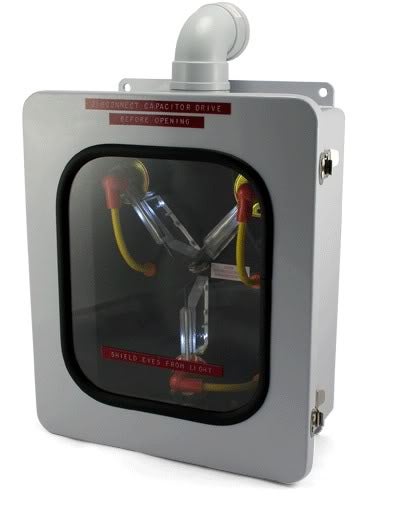
Flux Capacitor via Photobucket

Future hybrid cars won’t just have powerful batteries — they will be storing energy in their doors, hoods and roofs. Car parts could serve as capacitors, which would allow for smaller and more lightweight batteries, thus increasing a hybrid’s range.

Researchers at Imperial College London are working on lightweight auto body components that also store electricity, reports the New York Times. The car frames would be made of plastic composites reinforced with carbon fiber. The resin that binds the carbon fibers is doped with lithium ions, the Times reports — this allows the car’s frame to store electricity.

One of the biggest obstacles to increasing a hybrid car’s range is the size and weight of the battery. More powerful batteries can power a car for a longer distance, but they also weigh more, and this saps more energy, counteracting the power increase. High-efficiency lightweight batteries are a ripe field of study. But this research, which also involves automaker Volvo, takes energy storage out of the battery and directly into the car.

The capacitor car parts do not add much energy, at least not right now, but they can be used to smooth the demands on a battery, according to the Times. They could provide an extra jolt to re-start a car after it’s idling at a red light, for instance. Researchers want to test a prototype electric vehicle with an energy-storing trunk floor, whose extra energy storage could reduce the battery's weight by 15 percent, the Times reports.

Ultimately, if capacitor car technology reaches the efficiency of current lithium-ion batteries, you’d only need to make a carbon-fiber roof, hood and doors, and they could store enough electricity to power the car for 80 miles.

[New York Times]

Want to keep track of the latest concept cars, automotive innovations, and more? Subscribe to Popular Science today, for less than $1 per issue!

7 Comments

I'm not sure why anyone would want to make the capacitors into the panels of a car which are the most exposed, easiest to damage, and most often have to be replaced. It seems like it would make more sense to make the capacitors with parts/panels that are more internal and less often replaced. Just to bring the cost down.

But hey, HHVs are already more cost effective and longer lasting than electrical storage of kinetic stopping energy for hybrids, so I'm not entirely sure that this idea will even matter in a few years.

not everyone drives like a maniac though, i have a pretty good record for not damaging my car. if people would actually drive safe for once then worrying abut replacing doors wouldn't be a problem.

when cars are int he equation the problem is always PEBKAC.

to mars or bust!

Random parts of the car acting as capacitors? That would make me a little hesitant of reaching my hand...anywhere.

I have a proposal to solve our mobile energy crisis it will cost around a hundred dollars more per hybrid vehicle, and perhaps a billion in Infrastructure. The price on natural gas per vehicle may be more complex and cost a bit more.

If we turn the dials on our alternate fuels, just right, we can reduce the amount of each to bridge the gaps between each other while at the same time reducing the over all price. We use hybrid car batteries to reach far fewer alternate fueling stations. A 2,000 mile coast to coast trip would only need 80 alternate fueling stations along it. Only 500 alternate fueling stations would be needed to replace our current 10,000 gas stations because of the added distance batteries provide. At five to seven percent new vehicles in the system every year it could take only ten to fifteen years to replace oil for your commute, and only about half that to bust down the price of oil.

First we turn most of the problem into a mobile billing problem. Local electrical home networking is still around, but because of band width never became popular. For the same reason broadband by electrical power lines never did either. If we take and use these failed networking attempts we can make every plug a mobile billing electric fueling station for your hybrid battery. We are going to update our power metering system anyway so the cost is integrated. A hybrid battery adds $2,000 dollars to the sale price of your hybrid vehicle, but pays for its self in fuel economy. Any more than that starts to lose value because of replacement cost. Adding more corrosive resistant tubing to your engine for around $100 dollars at manufacture will allow it to handle alternate fuels like E85 or natural gas, and the battery solves the infrastructure problem for those alternate fuels.

Seventy percent of all commutes are less then 30 miles away. Plugging in at home and at work will allow off the shelf plug in electric hybrid vehicles to power 95% of all commutes without any liquid fuels at all. That will transfer over 60% of gasoline to be powered by local electric power usually by domestic coal, and double the use of existing oil reserves in the process. Updating the power meters to create a smart power billing on a smart grid with smart batteries makes sense. Smart billing with smart batteries means your home solar can be stored on your batter plugged in at work. From just a civil defense stand point if the Middle East blew its self up you could plug your hybrid vehicle in at work for an emergency we just apply that principle to push the price of oil down.

Only compatible with DeLoreans though.

wow. another aged technology that is just recently being talked about to the public. i guess theirs just to much money and business in oil.

Storing lithium ions and large amounts of electricity in easily damaged parts of the car! What could possibly go wrong?


June 2013: American Energy Independence

Five amazing, clean technologies that will set us free, in this month's energy-focused issue. Also: how to build a better bomb detector, the robotic toys that are raising your children, a human catapult, the world's smallest arcade, and much more.


Online Content Director: Suzanne LaBarre | Email
Senior Editor: Paul Adams | Email
Associate Editor: Dan Nosowitz | Email
Assistant Editor: Colin Lecher | Email
Assistant Editor: Rose Pastore | Email

Contributing Writers:
Rebecca Boyle | Email
Kelsey D. Atherton | Email
Francie Diep | Email
Shaunacy Ferro | Email

circ-top-header.gif
circ-cover.gif
bmxmag-ps