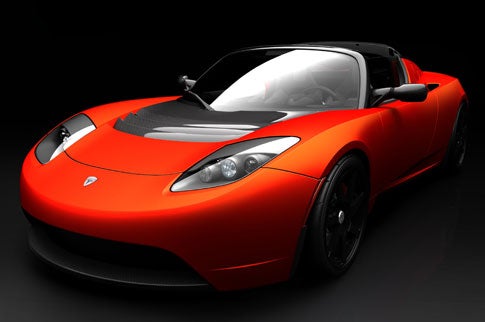
We knew the Tesla Roadster was fast, but not this fast: after just three years on the market, the Roadster is no more. In about two months, Tesla will cease taking orders for the all-electric Roadster in the U.S., marking the end of an era during which the company helped prove to an often-skeptical public that electric vehicles could perform alongside conventional gasoline performance cars (for a six-figure price). But Tesla isn’t going anywhere. The company is winding down its Roadster production so it can focus on the much more moderately priced Model S, its $58,000 all-electric sedan that is expected to go on sale in mid-2012.
Five amazing, clean technologies that will set us free, in this month's energy-focused issue. Also: how to build a better bomb detector, the robotic toys that are raising your children, a human catapult, the world's smallest arcade, and much more.


Online Content Director: Suzanne LaBarre | Email
Senior Editor: Paul Adams | Email
Associate Editor: Dan Nosowitz | Email
Assistant Editor: Colin Lecher | Email
Assistant Editor: Rose Pastore | Email
Contributing Writers:
Kelsey D. Atherton | Email
Francie Diep | Email
Shaunacy Ferro | Email
I believe this was a wise decision by Tesla Motors. For one, however cool and nice the Roadster is, it is still only attracting a niche market. Switching production to a car that can attract a broader market will help the company to position themselves to provide a larger vehicle selection in the future. And perhaps then they will bring the Roadster back, with a lower pricetag of course, due to the rate at which this technology is becoming more efficient and inexpensive.
My only problem with the idea of an all-electric Tesla sedan is "Will it perform?" The Tesla Roadster was physically a smaller and lighter vehicle (minus the battery pack), which allowed it to match the performance of some other sports cars. A four-door electic sedan I imagine, when fully weighed down with the maximum amount of passengers, should see a decrease in performance. Perhaps I'm the only skeptic here. I was never one for all-electric vehicles, but the Tesla Roadster truly is a marvel worth admiring. All-in-all, the company definitely has an interesting road ahead.
I hope they do make a few million of the model S.
Hope it gets closer to $20K rather than the projected $70K.
It was NEVER going to get off the ground.
Simply practicality - that its tethered by needing a station to recharge.
That is where the Nissan Leaf will fail as well.
You change change YOUR habbits but you cant make everyone elses infrastructure change to suit yours.
This is where the Volt stands strong. It will be slow in sales but consinstantly grow as people realize the complete impractability of all electric cars.
I think they are doing this because the model s will have more advanced technology's than the roadster and they don't want to spent the energy doing an overhaul at this critical time.
@Jabberwolf - The point of weaning off fossil fuels is that it's a limited resource, whether you have a green mentality or not we shouldn't become complacent with gas just because we've invested so much in it. Most abundant element in the universe is hydrogen, so either we get on board with the electric movement or the internal combustion fanatics find a way to effectively shift to hydrogen.
You still have to go to a "station" for gas after a limited tank is exhausted. Why not go to a similar station to have a robot quickly swap your spent battery for a new one? Like a massive underground conveyor belt that has recharged batteries ready to swap out. Simply drive your car over a spot and theres no need to even get out of the car. Of course a universal redesign of electric cars would be required to accommodate the idea. Quick Charging batteries are most likely the more viable solution ;)
Another thought is, there is merely a single way we obtain oil. We dig for it. And burn how much of it just ferrying the stuff around? How many different ways can we harness electricity? Hydro, wind, solar, nuclear..
@Jono : i completely agree with your sentiment.
the adaption of a 'battery exchange' station is the game-changing mechanism that will eventually let electric cars supplant the gas powered ones.
add the possibility that the electricity used to pre-charge those batteries could be produced via different varieties of sustainable eco-friendly powerplants working in tandem with each other and it finally becomes clearer to see why delaying the transition towards electric cars would only prove detrimental to the further development of our civilization.
but that's just my own humble opinion. as always, feel free to agree or disagree.
*adoption not adaption
hmm.. why is there no edit comment here?
Bill Dale
@ Jabberwolf:
You make perfect sense. Electric vehicles need to be recharged periodically, that's all you need to know... you'll never drive one. I just checked, and I found out that poison ivy has a wonderful assortment of protiens, minerals, vitamin A, and a host of micronutrients and antioxidants. Stop by and I'll fix up a heaping salad full of the stuff for you, I'm sure you'll love it... it's got all these goodies, and that's all we need to know, right?
when I was a baby, gasoline was 25 cents a gallon. It stayed at that price until I was about 25 years old or so, and OPEC had their first oil embargo... lines at filling stations snaked around the corner, people were shooting each other because someone tried to cut in line ahead of them... my GF at the time asked me to get up at 3 am with her and get in the gas line so that it would not take as long to get gasoline, since she had to drive a long distance, and she had odd numbered plates... it was the day for even numbered plates to be able to get gas.
On the day the embargo started, the price jumped from 25 cents to the unheard-of price of 50 cents OVERNIGHT... the TV stations were interviewing truck drivers that were saying they'd be out of business, they could no longer afford to drive.
I don't recall the exact years, or the exact prices, and am not willing to google it to find those exact figures, but it was a long time before gasoline crept up even a little bit... maybe 5 years or so... it took maybe another 5 years to get to a dollar... and another few years to double again... the time it took to double in price got steadily shorter, until around 2007 it increased by a dollar in just a few months. It was part of the reason for the economic collapse of the country, and the world, to some degree as well.
OPEC is not full of people that go to Red Cross every few weeks to donate blood. They don't create benevolent groups to tend to the needy in third world countries. They aren't anyone you'd wanna have as managers of your stock portfolio... these are people that are totally self-absorbed, don't give a damn how hard life is for you, only that they can erect glorious monuments to themselves while their own countrymen starve and grovel.
We are buying our oil from our worst enemies... Iran, Libya, Syria, Saudi Arabia, and we turn a blind eye to it all, and call them allies only because we are addicted to their oil. Maybe you are content with continuing to get your gasoline from the same people that financed the 9/11 attacks... maybe you're willing to trust them not to cripple our country again with oil prices... I am not.
The money we spend on oil is gone immediately, with nothing to show for it-- if we buy furniture from Korea or a TV from Japan, it's a durable element of our lives for some time to come. Not so with oil... we buy it, we use it, it's gone. Up in smoke, literally.
What happens if we could wave the magic wand, and all cars in the country could suddenly be running on electrons rather than decomposed dinosaurs? That's hundreds of billions of dollars that would suddenly be available to handle our crumbling schools, roads and bridges, health care, our enormous national debt, and so much more. We cannot continue to think oil will be there forever, or even for a few more years. It's terrible financial planning, as history has shown.
Just a few months ago, gasoline started rising at an alarming rate once again... it looked like it would not stop... but this time, what happened? Obama started talking serious about getting an EV industry started, factories started opening in places like Kentucky and Michigan and California to support such goals. Amazingly, there was a huge fight the next time OPEC met, and rather that raising the price of oil significantly as Iran wanted, Saudi Arabia threw their weight around to keep it down... the Saudis did not do this because they were compassionate for us, of course, but only because they had the foresight to realize that if they tried to tighten the noose too much, the rope would break, and once their was a momentum to build EVs, it would never stop.
You look at one thing-- that you can't yet drive an EV the same way you can your noisy, inefficient smoker... and make a rash decision. Think again, because the sooner you do, and the sooner you realize EVs are already unstoppable, the sooner you can start finding ways to make your own life easier with them.
Even if you are the die-hard Luddite that thinks you'll never want to drive anything but an ICE gas guzzler, realize that you should do everything you can to assure that the EV industry thrives-- because for every EV sold, that is just that much longer that the oil reserves will last, and how much slower oil prices will rise.
You look at EVs today and see something that does not interest you... you assume, like the price of gasoline, that how things are today, that that's how things will be tomorrow... but if there is anything we can depend on, it's change-- the oil prices will change, EVs will become more practical and far less expensive, there will be billions of more people on the same planet competing for the same gasoline and the same vehicles you want to buy, and everything will continue to change regardless of how much you're willing to believe that all will remain the same.
THere are already lots of people such as myself that have EVs or hybrids, and if you'll notice, you don't see any of them on the nightly news sobbing to the reporter about how they did not realize what they were buying... EV drivers LOVE their cars. They are whisper-quiet... vibration-free... virtually maintenance-free... extremely inexpensive to operate... today's batteries can last for decades, and continue to improve... no smog tests, no tune-ups, no oil filters, air filters... no catalytic converters to replace because a spark plug was fouled, no oxygen sensors to buy because the Arco gas you buy is not top tier.
Just in the last decade, EVs have approximately doubled in range, and the batteries have improved dramatically in many ways, including cycle life (life span), time to recharge, cost, and energy density.
The car you drive now expends lots of energy just getting up to speed... and as soon as you have to stop, not only do you lose all of that kinetic energy, but every time you come to a stop, you have to burn up a bit of your rotors and brake pads that eventually have to be replaced. Not so with an EV-- instantaneously, that drive motor becomes a generator, helping to silently slow and stop the car, and at the same time it returns part of that kinetic energy back to the battery (regen, or regenerative braking). And with recently patented motor designs, the efficiency with which the motor pumps your battery back up will increase--so your car will be able to drive a longer distance between charges. The same features that make this motor so good at regen will be able to make wind farms, hydro generating plants and other generating stations more efficient; and as solar panels also become more efficient and affordable, you'll see all new homes with solar panels that will assure that EVs will have enough power to charge at home.
A prior post mentioned the "Better Place" battery swap infrastructure, which they already have in Israel, and which will be in the US and elsewhere soon. It will allow you to drive even more conveniently than you would with your gas guzzler-- it's far cheaper, you don't even have to leave your car, and it takes even less time than to fuel up as you do now. But it's my opinion that the Better Place system will be obsolete soon simply because you'll be able to charge your battery so quickly that a swap will be unnecessary. Many tens of billions of dollars are being spent every year to improve the charge capacity of batteries, and they are tantalizingly close to having batteries that can drive all the way across the continental US on a single charge... there is very solid physics that may allow such advances soon.
Don't be so hasty to say EVs will fail! If someone can drive an EV so much cheaper and more conveniently than with gasoline, they have a huge incentive to see how they can make such a car fit into their lifestyle. You may embarrass yourself soon by envying the very cars you vilify!
@Jabberwolf,
"It was NEVER going to get off the ground.
Simply practicality - that its tethered by needing a station to recharge."
Yeah! just like those gasoline powered cars. They are NEVER going to get off the ground either... they are tethered by needing a station to refuel.
Bill Dale's comments are so valid!
It's obvious that jabberwolf hasn't test driven a Tesla roadster! Most exciting car I've ever driven. The only thing standing between me and a Tesla roadster is a winning lottery ticket :-)
Now they will get to their primary market with a reasonably-priced four door sedan that will reach the masses.
Then onto their UPS delivery trucks. That makes even more sense.
If my congressmen would read my suggestions to have the POSTAL SERVICE return to their roots...the electric postal vehicle. That's a market that is MADE for EV's...low speed, short commutes, recharge every night. How many millions of tons of CO2 would that reduce, and how many millions of gallons of gasoline saved for more precious travel, like airlines?
Bill hit all the other vital points--especially the one of making the middle east billionaires out of US petro-dollars!
@ cbhendrick--
I'm glad you got a chance to test-drive a Tesla. I have a few friends that own them... they have this practical joke of sorts that they like to play on people the first time they take someone for a ride in the Roadster-- they'll get in, have their passenger belt up, and of course there is no sound coming from the engine, as you'd have with ordinary cars, so to the passenger, it's not really ready to start driving. Then the driver will ask the passenger to change the channel on the radio, but as soon as reach up to do so, the driver floors the accelerator pedal, and the G-force keeps them from doing so... a really spectacular baptism into the cult of EVs-- hehe...
I belong to the EV Association of So Cal, and we have meetings every month. In May there was a fellow from an EV startup that is specifically targeting the Post Office and similar large fleets, as you mentioned. They have already sold lots of their trucks for that purpose, and seem to be doing gangbuster business, as you'd expect. There are several other companies doing similar things. Such fleet sales are the biggest and best and most logical segment for EV makers to target.
I've started to notice large vans in the LA area that have signs painted on the back... I don't recall the exact wording, but they say something like, "congratulations, you're riding behind a Staples fully-electric delivery van!"... I don't recall for sure, but maybe something else such as "that means you're not breathing our exhaust!"
There's a very old, low-key British company, Smith Electric Vehicles, that has been making commercial EVs for something like a hundred years, and it was recently bought out by a company based in Kansas City, MO, USA. Smith have never made electric cars-- only commercial vehicles. I have not yet been able to verify it, but I suspect the van I saw may have been a Smith.
Clipper Creek, Coulomb Technologies, GE and some others are aggressively working to install the high-speed charging infrastructure necessary to support large numbers of EVs. They're being smart about it... the first places you'll find them is along heavily-traveled routes such as the coast from LA to SF, or between LA and Las Vegas. So you can drive such routes without getting stranded, even if it does mean you'll be making longer stops than you would if you were gassing up. The up-side, of course, is that such trips will cost you far less than if you are driving in a fueled vehicle. Charging EVs will soon take less and less time due to improved battery chemistries, that will allow faster charging.
Costco, Starbucks and other retailers have already begun to install some charging stations, which cleverly entices EV drivers to get charged while shopping. Ideally, EV drivers will charge up a bit wherever they stop-- the market, at work, church, etc.
There are museums, colleges and other locations within one mile of me that already have charging stations, and they have distinctive blue signs guiding you to their locations. There are hundreds of such signs all over southern California, although some are vestiges of the debacle a dozen years ago when the car companies were trying desperately to avoid selling EVs, but that is no longer the case. All the car companies are busy trying to fill the EV market with their own cars. Volkswagen was the last holdout, as far as I know... but every car maker... even the little ones in countries like China and India... will be selling EVs within the next year. Jabberwolf's delusional if he thinks EVs are going away!
It's reassuring to me to see that Mark Jannot, Seth Fletcher, Clay Dillow and Dan Nosowitz, all writers/ editors for Pop Sci, have no trouble seeing the future for what it is. Thanks, fellas.
The Tesla Roadster will soon become a highly prized classic. These cars will only increase in value over time.
Elsewhere in Pop Sci you'll find an article on new, radial engine designs. None of them seemed worth pursuing because they were still complex reciprocating designs with glaring problems-- all but one: a very intriguing concept from the University of Michigan. It looks and acts much like a turbine, but differs in that it cleverly uses a shock wave to compress the air/ fuel mixture to achieve better efficiency. According to the team that designed and built it, it is three and a half times as efficient, only has one moving part, reduces emissions by 90%, is cheaper to build and far smaller and lighter. As much as I'd like to see EVs drive the ICE car into obsolescence, this engine is a viable way to produce hybrids that are far more practical than any hybrids we have today.
I own a Prius, and I do like it, but it is hard to justify buying one on strictly economic benefits unless you're doing a lot more driving than most people. But using this engine in a hybrid-- which is what they intend to do with it-- you could power an SUV with an engine that a 7-year-old could hold without a struggle. It would not need a coolant system, pollution controls, a muffler or other typical accessories that make automobile engines so big, heavy and expensive-- today's engines can easily top 800 pounds.
Using this engine in a hybrid, a car can save a third of its weight and sticker price, making hybrids suddenly the only sensible way to build a car (at least, of course, until we can make batteries with greater energy density, making ANY use of fuel in a vehicle unnecessary).
My fondest wish is for our freeways to be free of gasoline engines, but this is a great way to help us get there.
YouTube has a couple of videos showing the engine, with an engineer giving some details. There are also some other good articles about it online.
Well, it is ineteresting innovation, newest technologies are widely spread nowadays. As for this project, maybe it will be cheaper for people to create coupe with less price. By the way, on http://www.torrentoff.com I saw documental film about similar device.