We expected efficiency to be the key challenge as we constructed our cross-country, ultralight electric vehicle. After all, we'd decided the car would use no more electricity than a continuously burning 100-watt light bulb. But durability turned out to be equally important. This car wouldn't be like the high-efficiency concept EVs that are confined to indoor tracks at universities and research facilities--this would be taking me and my son over mountains. Lots of mountains.
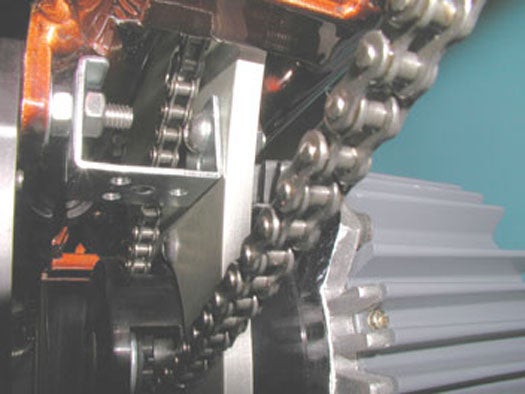
We were pretty confident that our vehicle’s welded frame and chain-and-sprocket drive system would hold up to the demands of hard daily mileage. The car was designed so that anything that did fail could be replaced with off-the shelf parts sourced from a bike shop or garage. The remaining part, one of the most important, was the electric drive, and we looked long and hard at the possibilities. The two most viable options for the electric drive seemed to be hub motors, which would be integrated into the rear wheels, or a stand-alone motor that tied into the vehicle’s existing chain drives.
Both systems have their advantages. Hub motors would allow for a cleaner, sleeker build, and the latest generation of hub motors has a surprising amount of low-speed torque for hill climbing--important, as we'd be going over several imposing mountain ranges, from the Appalachians to the Ozarks to the Rockies. But research showed that a slower-turning hub motor would likely require more power than a faster-turning stand-alone motor for a given hill climb, and that the off-wheel motor could be geared down for low-speed crawls up the numerous steep hills and mountain passed we’d face on our chosen route. In addition, a stand-alone motor could be repaired or swapped out quickly, while a failed hub motor would require us to replace entire wheel unit--not an enticing prospect, considering our route would take us through many rural regions.
Research led us to EcoSpeed, a small company in Portland, Oregon that builds electric-assist bicycle drives. The heart of these drive systems is a high-speed brushless DC motor fitted with an integrated clutch bearing and reduction gear. As compared to the slower-turning motors of a hub system, the EcoSpeed delivers a high power-to-weight ratio, and has earned a reassuring reputation for reliability. The system that seemed best suited to our needs was a 36-volt motor that could handle peak loads of up to 1,000 watts.
The other item that sold us on the EcoSpeed product was the speed controller. Their speed controller, equipped with a Velociraptor microprocessor, is nothing like the rheostat or transistor controllers found on previous generations of golf carts and EVs. It's essentially a limited function computer that checks in with and reacts to both the motor and the battery bank, and rations power based not only on throttle input but also on battery state, motor load, working temperatures and a number of other factors. Plus, all of those options can be tweaked in the software to deliver maximum power, maximum range, or any combination in between. This is a motor that lets you dictate exactly how it'll run--and as our needs were unique, that was vital.
The Velociraptor’s ability to ration power strategically would prove key to achieving our goal of 60 miles per day. The unit could also be programmed to limit output to maintain our status an electric-assisted bicycle, which opened up a few nice legal loopholes for us. Federal and state transportation laws don’t differentiate between two-, three-, or four-wheeled vehicles when defining a bicycle, and define an electric-assisted bike in terms of speed and power allowances.
By limiting motor output to a maximum of 1,000 watts--in some states, 750 watts--and by limiting maximum speeds over level ground to 20 mph, we would not be required to meet the more rigid criteria of a Neighborhood Electric Vehicle, or NEV, a low-powered electric vehicle like a security cart that's limited to certain roads. Being legally classified as a bicycle was definitely a strategic decision: Bicycles and electric-assisted cycles are allowed on the vast majority of secondary roads and city streets nationwide, and can also operate on bike trails, so we’d have no trouble creating a transcontinental route that kept us away from fast-moving freeway traffic.

140 years of Popular Science at your fingertips.
Each issue has been completely reimagined for your iPad. See our amazing new vision for magazines that goes far beyond the printed page
Stay up to date on the latest news of the future of science and technology from your iPhone or Android phone with full articles, images and offline viewing
Featuring every article from the magazine and website, plus links from around the Web. Also see our PopSci DIY feed
The 6th annual Invention Awards are here, from an inflatable tourniquet to a better lobster trap to spring-loaded hocket skates. This issue is all about the celebration of invention.
Plus: Making synthetic biology breakthroughs in a garage, building a constantly-moving ping-pong table, and a ridiculously overpowered barbecue.
I think you made the right choice with the motor and controller, but not with the chain drive. I am not an expert, but I read somewhere that a toothed rubber belt (like a timing belt) is much more efficient than a chain. Suggest you check it out. I suppose that the chain was chosen to make gear changing easy and admit that it would be a challenge to use a similar system with a belt. But if the belt was relatively narrow it might be accomplished.
Good Luck on a very interesting challenge.
@ Roy_H ; The thought was probably durability with the chain, plus the universally available part.
@ Roy_H the following response is from Pierce Hoover, thank you for your comment:
Belt drives are gaining popularity among mountain bikers for the exact reasons you described. However, we were unable to source appropriate belt lengths for some of the non-standard spans on our multi-sprocket drive system. As a result, we decided to stick with the time-proven chain system, which could be easily replaced or repaired with a few standard tools. There were a number of similar compromises made during the build process, and quite often, ideas that started with leading-edge concepts and materials was scaled back to a simpler, more conventional technology for reasons including a proven service history, ease of repair, cost and time to completion. If we ever decide to do something like this again, maybe we can get some grant money and a few bright engineering grad students, then go nuts on all sorts of futuristic concepts. This time around, our goal was simply to make it coast to coast on our self-imposed power limitations.
Thought I would pass these links on, I believe this is what Roy_H was describing for anyone that might be interested.
www.fennerdrives.com/high_performance_composite_vbelts/nut_supt_home.aspx
www.fennerdrives.com/high_performance_composite_vbelts/powertwist_home.aspx
According to Federal Bicycle Law HR 727 a `low-speed electric bicycle' means a two or three-wheeled vehicle with fully operable pedals and an electric motor of less
than 750 watts (1 h.p.).
How are you getting around this law?
A "clean" chain compared to any type of belt is about 15 % more efficient regarding roller friction. Belts are nice and light but can't compete. 15% is a lot when referring to minimal HP/High Torque as in this case and most bike applications. A tandem bicycle has about 150 ft./lbs. of torque, equivalent to many cars.
New generation cogged belts do work quite well on commuter type bike where low maintenance, light weight and increased longevity are an advantage.
BTW: A dirty chain can knock 15% efficiency right off.
First, I love your ideas, your ride. I'm president of the Illinois Electric Vehicle club and last summer we hosted thegreenriders.org as well as Tom Weiss on his rideforrenewables.com -- if you are able to take a diversion north to Champaign-Urbana Illinois, we'll put you up for the night, do a ride exchange, etc as well as find you a route back down to St. Louis (though I understand that this would be a pretty big detour).
However, regarding the portion of your blog where you state:
"Federal and state transportation laws don’t differentiate between two-, three-, or four-wheeled vehicles when defining a bicycle"
In fact many states DO differentiate between two, three and four wheeled vehicles with pedals (with and without electric motor assist):
For instance, in my home state of Illinois, there is no such thing as a 3-wheeled bicycle -- unless it has a motor on it. The regular bicycle law in Illinois requires "two wheels in tandem":
(625 ILCS 5/1‑106) (from Ch. 95 1/2, par. 1‑106)
Sec. 1‑106. Bicycle. Every device propelled by human power upon which any person may ride, having two tandem wheels except scooters and similar devices.
(Source: P.A. 85‑951.)
Now whether that is a maximum of two wheels, and they must be in tandem (one behind the other) or whether it can be one set "in tandem" and then countless more wheels (which would cover your 4-wheeler) is an interpretation and therefore for a court to hear arguments... but at least an argument could be made (though it is against standard concept of "bicycle" as well as UCI's -- the world bicycling governing body - racing/aka Tour de France).
Now of course you CAN get three wheels with two "in tandem" if you ride a regular bicycle with a tag-a-long for a child...
The Illinois electric bicycle code (625 ILCS 5/1‑140.10 -- www.illinois.edu/goto/ivc)is reliant on Section 38 of the Consumer Product Safety Act (15 U.S.C. Sec. 2085) which as you can see here does NOT include four-wheeled vehicles:
www.law.cornell.edu/uscode/html/uscode15/usc_sec_15_00002085----000-.html#b
Now to the important part: What this means for you (in Illinois and other states that base their definition on 15 U.S.C Sec. 2085): Your vehicle has no legal road rights as it is neither a bicycle nor an eBike (or even an NEV). While it is highly unlikely that you'll be pulled over, it does mean that if you get into an accident and regardless of fault a good opposing barrister can make a pretty solid argument that you never should've been on the road in the first place, and therefore their client is not at fault/culpable.
Note that I am not a lawyer, just a layman who has become very interested in legislation concerning weird little vehicles, as I've driven a Twike for the past 4 years (www.illinois.edu/goto/twike), one of the original human-electric hybrid vehicles as well as participated in the Automotive XPRIZE with the manufactures of the Twike in their next-gen vehicle, the TW4XP.
Now as you're sponsored by PopSci and GE, then perhaps they'd be kind enough to lend you their general consul to review my jailhouse lawyering...