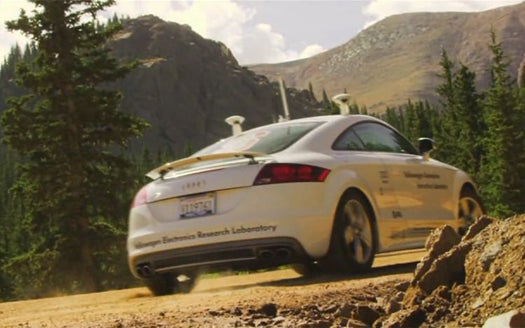
When it comes to artificial intelligence Google has a head start, what with all that free data we give them every time we search for a 30 Rock clip. So perhaps it’s no surprise that the search giant is the latest enterprise to pursue a future where cars drive themselves via complex, decision-making artificial intelligence software. Over the weekend it was revealed that Google has seven test cars that have driven 1,000 miles each without any human intervention whatsoever.
Of course, the cars aren’t exactly driverless. There is always someone sitting behind the wheel, ready to seize control should something go awry. There’s also a passenger, a technician to monitor the navigation system and ensure the software is running smoothly. But the cars do pretty much all of the work – one of them even negotiated San Francisco’s famously treacherous Lombard Street (that steep stretch of pavement that’s more or less a series of sharp switchbacks). If you count up all the miles that required only occasional human intervention, the cars have logged some 140,000 miles altogether.
The cars are years from commercialization and mass production obviously, but Google’s effort is just the latest in a series of attempts to create safer, more efficient passenger vehicles that move people around autonomously. An Italian team is currently en route from Italy to Shanghai in a pair of electric-powered driverless vans, and DARPA’s Grand Challenge has produced a handful of promising software and vehicle designs.In fact, the Stanford Professor behind the team that won the second DARPA Grand Challenge with the Stanley robot car is the brainpower behind Google’ fleet of artificially intelligent automobiles (he’s also a Google engineer). That fleet is made up of six Toyota Priuses and one Audi TT.
The idea behind all of this, of course, is to make roadways safer and reduce energy costs. A fleet of shared smart vehicles means cars could be summoned only when they are needed rather than being owned (and parked) by each individual. Robot drivers also react faster than humans – who are increasingly distracted by a growing cacophony of technological noise in our cabs – have 360-degree vision, and remain sober and alert even after weddings and football games. And if roadways were packed with automated, networked robo-cars rather than angry, lane-weaving, stop-and-go drivers, traffic would move more efficiently as well.
Ambitious predictions say self-driving autos could be deployed in the next eight years. Getting them certified for the road and brought within the letter of the law is going to cause unenviable headaches along the way, but the end result could be a complete re-engineering of car culture beginning before the decade is out.
Five amazing, clean technologies that will set us free, in this month's energy-focused issue. Also: how to build a better bomb detector, the robotic toys that are raising your children, a human catapult, the world's smallest arcade, and much more.


Online Content Director: Suzanne LaBarre | Email
Senior Editor: Paul Adams | Email
Associate Editor: Dan Nosowitz | Email
Assistant Editor: Colin Lecher | Email
Assistant Editor: Rose Pastore | Email
Contributing Writers:
Rebecca Boyle | Email
Kelsey D. Atherton | Email
Francie Diep | Email
Shaunacy Ferro | Email
"seven test cars that have driven 1,000 miles each " = 140,000?
overachieving decimal?
@winterflop
I had the exact same thought... 7 cars x 1000 miles = 7000 combined miles; where are they getting 140,000 miles from??
You missed the sentence in paragraph two that says, "If you count up all the miles that required only occasional human intervention, the cars have logged some 140,000 miles altogether."
in other words the 7000 is entirely without human intervention (I think)
They have seven cars that have reached the 1,000-mile mark, but they have other cars that have *not* reached the 1,000-mile mark. Outside the square, guys. Outside the square. It's Google; they can afford more than seven cars.
who cares about how many miles or who put the decimal point where, I can't wait for the day when cars drive themselves. Imagine all the ladies putting lipstick on behind the wheel and it would be ok, fat people eating behind the wheel, or taking a nap on your way to work. I love it, and I love Google.
I think there is going to be many problem with unmanned cars. If your running late for something the car will be doing the speed limit of like 45mph when you need to be doing 95mph. So now you get fired for being late, plus with all of the new tech say your in a hybrid all the cops will have to do is hit a button and your car will slow down and stop, and now you get a ticket :) got to love new TECH.
Nice work, Google.
@ Donte:
" If your running late for something the car will be doing the speed limit of like 45mph when you need to be doing 95mph"
You shouldn't have been lazy. keep your eye on the clock if you have something coming up.
"plus with all of the new tech say your in a hybrid all the cops will have to do is hit a button and your car will slow down and stop, and now you get a ticket :)"
*facepalm* said hybrid would be automated, therefore wouldnt exceed the speed limit. Also, tech like that would easily be abused/misused.
Well, if you take out human error, there is no reason to set the speed limit at 45mph, plus traffic is improved. So that trip that would normally take 30 min may only take 20 with less fluctuation. I agree with Giga though, pay attention, and don't be late.
The days of iRobot are coming soon! With Terminator close behind. BEWARE!
@Donte,
I would say, "Thank god for less idiots going 95 in a 45". :)
Also did you know a large proportion of traffic hold-ups are due to people over-braking when people merge? And that automated cars could travel with less following distance as well as coordinate lane changes, intersection crossings, and turns with greater exactness and speed?
you wont be late, because you will eat, shave, and get dressed in the car. Heck... just sleep in the car and set it to deliver you to work on time.
Too bad the article shows one Stanford researcher's vehicle (Prof Gerdes = Pikes Peak) while the whole article is written about another researcher's project (Prof Thrun = Google's work and DARPA Grand). It's a bit of an insult to both. Get it right...
if the car goes 45 mph and you need to go 95 to get to work on time...that will only save maybe 1 or 2 minutes of time. you would have to be going 1,000 mph to save 10 mins.
No-one would like computer driven cars more than I would but think about the legal logistics. If the car crashes, whose fault is it? Whose insurance goes up? How open to lawsuits does it make the AI developer or the auto company? The government will have to clear the legal way if this is to happen otherwise, I can't see companies opening themselves up to lawsuits if someone doesn't maintain their car, it crashes due to mechanical failure, which the software couldn't compensate for, kills a couple of people whose families sue everyone... A nightmare scenario for sure.
basildave, that may be the case in some areas but alot of canad and the united states have already movrd towards no-fault insurance. Quebec and Manitoba have pure no-fault insurance in place already and it works just fine.
Insurance worries are not an issue, just government corruption and capitalist profiteers.
I am waiting for autonomously driven cars to be offered to the public, to buy my next car. I have a 1999 Olds Intrigue and will maintain it until my self-driven car.
Imagine getting in the car at 6:00 PM in Baltimore, and waking up the next morning in Chicago.
Hey guys, read the article properly. They say that "over the weekend" seven cars have travelled 1000 miles each. So the total of 140,000 miles is over their entire lifetime. So I found no confusion there.
@Mime yes, speed limit changes would likely beimplimented as this became more commonplace, with a full system in place it'd be impressive how the commute times would be shortened as traffic congestion would be nearly eliminated by a network of vehicles communicating with one another. Rerouting would occur in real time to avoid congestion, the only issue I forsee is the roads of less populated areas (ie. back roads, dirt roads, gravel) and the issue of parking, which in some scenarios (mainly just at houses) will require some human input as far as appropriate location. Imagine the eventual removal of stop lights (only in a fully automated system)
@lokimotion The travel time is co-dependent on the distance. Time = Distance over Velocity, so if work is 10 miles away, at 50 mph it takes only 2 minutes (ideally, whereas at 10mph it would take 10 minutes and at 100mph it would take 1 minute. (diminishing rate of return)
At longer distances higher speeds see a larger savings in time. From a theoretical view excluding incalculable (on my part) alterations in traffic such as congestion and traffic light timing, if you lived 20 miles from work, and drove under ideal circumstances, at 45mph to and from M-F for one week, your travel time would be 26 minutes and 40 seconds of driving every morning and evening for five days a week. (200 miles over 4 hours, 26 minutes, and 40 secs)
The same variables, just increase speed to 55mph and you get:
21 minutes and 49 seconds commute to work
(saving almost 5 minutes a trip)
a total commute time of 3 hours and 38 minutes and 11 seconds a week.
That's saving over 3/4 an hour driving a week.. speed matters, but so does distance. :)