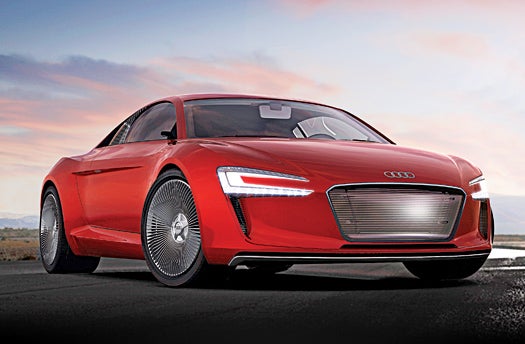
In September, Audi of America president Johan de Nysschen called the Chevy Volt a “car for idiots” and said that electric vehicles were “for the intellectual elite who want to show what enlightened souls they are.” Audi must have felt the need to atone for the harsh words, because the following month the German carmaker announced that it would build the baddest electric car yet: the E-tron, an all-electric supercar that could go on sale in the U.S. in two to three years. “I expect we will see running examples in the next 24 months,” erstwhile electric-hater de Nysschen told a reporter.
That could give electric-sports-car maker Tesla Motors some competition. The gas-powered Audi R8, on which the E-tron is based, is one of the hottest cars on the planet. Why go to the relatively unproven Tesla for a $101,500 roadster when you can get an Audi R8 with batteries where the engine used to be?
Aside from proving that you are a member of the intellectual elite possessed of an enlightened soul, one of the most appealing characteristics of electric drive is the massive, immediate burst of torque that only electric motors can provide. The E-tron seems designed to exaggerate this perk. The car will have not one but four electric motors, one for each wheel. Together they will produce a spine-snapping 3,319 pound-feet of torque, which means its tires will spin with three times the force as those on the Bugatti Veyron 16.4, a 1,001-horsepower monster that makes 922 pound-feet of torque. Top speed will be limited to 124 mph, but that will just keep you out of jail. And after all, an electric car’s range is limited by the amount of energy the battery can hold, so preserving energy is essential for getting back home; the E-tron will be able to travel 150 miles on a full charge.In concept form, the E-tron is loaded with far-horizon technology: gadgets that communicate with other cars, stoplights, road signs, and so on. We don’t expect all that to make it to production, but no matter. Any serious rendering of the concept you see here will be the first electric car worthy of a poster on a teenager’s bedroom wall.
Five amazing, clean technologies that will set us free, in this month's energy-focused issue. Also: how to build a better bomb detector, the robotic toys that are raising your children, a human catapult, the world's smallest arcade, and much more.


Online Content Director: Suzanne LaBarre | Email
Senior Editor: Paul Adams | Email
Associate Editor: Dan Nosowitz | Email
Assistant Editor: Colin Lecher | Email
Assistant Editor: Rose Pastore | Email
Contributing Writers:
Kelsey D. Atherton | Email
Francie Diep | Email
Shaunacy Ferro | Email
Germans are always pulling that elitist, uber shtick. If Audi really cared about the environment they would be building an electric "Volks-wagen", or affordable car for the common folks and masses to cut down on pollution - i.e. - something similar to the Volt. How ironic that they consider this car enlightening.
The best thing about this one-ups-manship between the Tesla, the E-tron and similar electric muscle cars is that it will bury forever any notion that EVs = golf karts. As the young crowd becomes excited at such cars and realize that to have real and affordable power they have to turn to electric cars, they will-- perhaps unintentionally-- usher in the Modern Age of Electric Cars.
If the heads of companies such as GM cannot see the value of EVs and cannot realize that we need to distance ourselves from fuel-powered transportation, this bravado on the street level will at least allow electric propulsion to blossom and mature.
The news earlier this week that a few smarties at Stanford found a way of using ordinary paper to make inexpensive, efficient, light collector plates for batteries may be the very thing that allows us to make energy storage cheap enough to compete with gasoline cars, and to make it possible to recharge EVs as quickly as a gas car can be refueled.
I 'm afraid for our region the greater Northeast coast of the United States we wil not see Electric cars the Grid isn't even up yet at gasoline stations plus How in world are you going to cruize the highway electric cars are quieter for highways or roads. However renting there is no Charge up station on the side of my street yet and I do not see it in the foreseeable future. You going to have covers for these Electric plug ins. We get alot rain here too. Plus Snow.
You now what would be cool if we to crank a electric car with a hand crank or like in movies by bicycle pedals and use small solar panels and don't say it cant be done because if i can crank a flash light i can crank a car to.
I've heard that being totally disconected from the grid is not as easy as it sounds.
#1- it costs almost $100,000 to be totally solar independant.
#2-most homes do not have enough roof surface area pointing in the correct direction for the amount of solar panels you need to generate enough power.
#3- the normal solar aray that most people today can afford (around $30,000)only reduces your monthly electric bill by $75.00 to $100.00 a month. Here in Florida thats peanuts. My monthly summer electric bill is $300.00, and thats reletivly small compared to larger homes.
Join the winning team! Jesus Saves!
What are you talking about.
Any way i was talking about on a car and i didn't mean all over the car i meant four 6inch square panels on the roof of the car the main thing is it would cool if we could use a crank system like on exercise bicycle to fuel electric cars if you run out of fuel on the road.
taking:
Yes, it's possible, but unfortunately your legs would tire quite quickly trying to generate enough power to recharge the batteries in a reasonable amount of time, and a couple of square feet of solar panels would not help much, either.
It would take several days to fully charge the batteries if the roof of your car was covered with solar panels of the kind we have available today, but there are 233 watts of power for every square foot of sunlight striking the earth, so if researchers can find a way to improve solar panel efficiency significantly, that really can be a workable solution.
Google "Sunraycer" to see a solar electric race car. But those panels cost many times more than the average car costs today, and the Sunraycer can only hold one driver, no passengers, no luggage, and has skinny, bicycle tires. It can be blown over in a stiff wind, making it impractical for now, but there are plenty of engineers that have the same dream you have and are working to find ways to realize that dream.
It's best that when you're driving an EV, that you have the location of charging stations registered in your GPS and know where they are. Virtually all the States, and several big utility companies, are working to provide charging stations at Starbucks, Costco, supermarkets and other locations that you'd be shopping at, so that by the time you finish your business, you'll have a bit more charge than you had when you arrived, making it safer and more convenient to drive electric.
Most EV owners will be charging up most of the time at home, at work, and at school. You'll also start seeing heavy-duty, quick-charge stations along the Pacific Coast Highway so that you can drive all up and down California without getting stranded; more such stations will be set up along the routes between major cities such as Los Angeles, Bakersfield, Reno, Las Vegas and Phoenix. Austin, TX, Portland, OR, Los Angeles and other cities have a heated battle for the title of "greenest city in the US", and the fight is surely to intensify.
New batteries that allow fast charging will be on the market soon. They will be necessary before EVs can replace ICE cars.
It's amazing that we don't look at what is off the shelf. If you bank the batteries into paired offset clusters, and link them to supercapcitors that store flash charges from an Auragen 15KW alternator, a small hybrid 'switchgrass' powered motor can turn that 'generator'for a 1000 miles worth of charges or more. By using the sophisticated computer software now available for graphic game engines, it can monitor battery levels, and performed a measured switch between banks effortlessly without notice, then power dump the supercapacitor charge into the batteries. Batteries last longer on high input fast charging as they heat up less which is the life reducing feature of overnight charging. Why do we have to reinvent the wheel to get a decent machine on the road? Because it's power. Power of the senior automotive stockholder to keep us coming back for a little better gas mileage every other year. If we could brew our own fuel, they would all be in the same tax bracket as us.