Green Dream
Carnett has an automotive setback

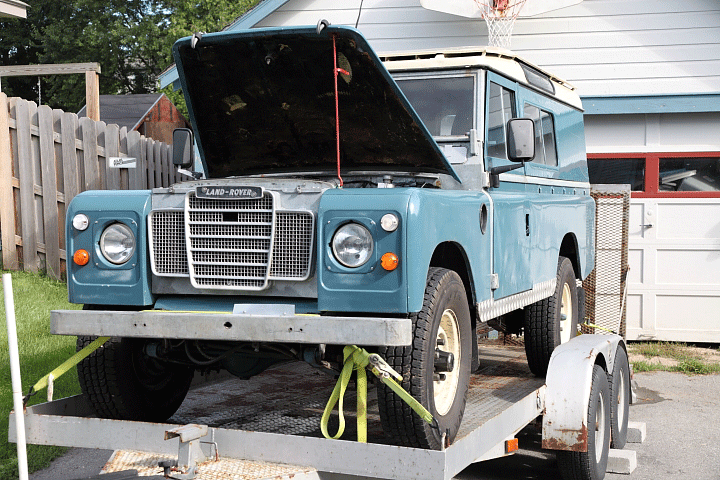
Carnett's 1979 Land Rover John B. Carnett

My primary means of getting around town is a 1979 Land Rover that has been fitted out with a 2005 300 TDI engine. You may have seen me walking this morning with my head down. Yes, I walked 30 minutes for a cup of coffee. I enjoy walking, but it is hard to build a house without a truck.

My Land Rover doesn't have one temp gauge; it has two. I look at both and compare them and wonder why one is higher. None of the gauges are correct, so it really matters very little. That was till yesterday, when I found myself at 65 mph with my head out the window, the cabin filled with white smoke, and a serious panic on. I managed to find the shoulder, and bailed out, thinking the rig was on fire.

What had happened was that the heater coil failed and the antifreeze got hot and created a semi-toxic steam. I had the heater blower on at the time in an effort to keep the windshield glass clear and the blower was more than happy to help fill up the cabin in seconds and almost cause a major crash.

The 2005 300 TDI Engine:  John B. Carnett
I disconnected the heater coil on the side of the road and looped the circuit at the engine. At this point I should have made it home, but this is my life, so it's never that simple.

I went no faster than 45 mph to a service station, and handed over $30 for some non-gold-plated 50/50 antifreeze. I topped things off and then got back on the road. Well, that lasted all of two miles when for no reason the radiator cap exploded off. It was at this point that I knew that something much more was going on with my engine: this was a major sign.

I could have stopped and called for help, but if you're like me this is never an option. Soldier on is the way. Typically the way to further trouble, but nonetheless it's always more fun than waiting for a tow truck.

I won't bother to tell you about the next 30 miles, the temp gauges both dropping, the engine sounding better... no, all that you really care about is how it ends up. I heard a strange sound and then another smaller white cloud appeared. It was at that point that I blew my head gasket, and perhaps much more. I was close enough that I could get a friend with a trailer to come get me. The Rover is in my shop. I just downloaded the engine shop manual and ordered a full gasket set. My friend suggested just closing the door on the Rover and buying a $1,000 pickup truck to get through the house build. No way, folks, I'm going out now and taking it apart. The parts will come tomorrow, and I'll be rolling by tomorrow night -- but just in case I fail, if you see me out walking, it's not for exercise. Please give me a lift.

John B. Carnett, PopSci's staff photographer, is using the latest green technology to build his dream home. Follow along as the project progresses on his Green Dream blog: popsci.com/green-dream

Want to keep track of the latest concept cars, automotive innovations, and more? Subscribe to Popular Science today, for less than $1 per issue!

10 Comments

Let that be a lesson to anyone reading this. If the radiator cap blows off, you likely have a problem with your cooling system and need to fix it or your engine will get too hot and you'll have a much bigger job on your hands...

PLEASE buy the cheap pickup and get back to the really important job: your house! I'm always excited to see your updates about the house, and while this vintage Land Rover would be cool to read about too (maybe a candidate for electric conversion?) I'm really excited to see your HOUSE all done!!!

The attitude in the article is what often gets geeks in trouble.

The "its not a big deal I can fix it, no problem"* attitude.

*This attitude may have cost me large amounts of grief in the past.

My 1998 Ford 4.6 V-8 gasoline engine makes the curious claim in the owner's manual that it can run with complete loss of coolant. Like newer engines that shut down cylinders to save fuel, the Ford shuts down cylinders to stay cool (believe me, this engine loves fuel too much to skimp on it even slightly.)

The manual claims that I should then be able to make it home by stopping every 20 miles and letting the engine cool down for half an hour.

I've never had to put that to the test, but on a previous truck the lower radiator hose blew in half on a wood cutting expedition in the mountains. Fortunately, duct tape did join it together again adequately but the tragedy was no available water whatsoever and two six packs of beer had to go into the radiator.

um, we dont care about your personal life. more science!

I have always loved this style of Land Rover. I have often thought that if they or someone else had continued to produce what looks like this workhorse, it would continue to be very popular. Like MB, change something only if it greatly improves it ability.

Who cares. Get back to the house project..

I do concur with your comment only partially. The reason,
I had to get my son to his high school for a very important and long bus ride for a basketball tournament out of our province (Alberta). I actually blew the keeper ring out of the block that holds in the frost plug and lost all of my anti-freeze in one massive shot. This was half-way to his school and if he did not arrive on time, he would stay home!
By watching the temp gauge and pulling over and shutting down, as I hit the 'red' zone, I managed to get him to school and back home where I could do the simple repair.
No damage done, but common sense has to rule the situation.

Hello John
I'm slightly curious, why have you not concidered using a hydronic battery to power your home and hydronics for your floor, and driveway heating/cooling? Least expensive and most efficient. Been being used in Europe, and the states for commercial high rises for years. Now available to local contractors, or self builders. Costing about $25 grand, will last 50 years. Can supply about 25 residential homes per month, no problem. You see I live in an area that is extreem building. (bruceolsoncontruction.com)Sysmic, as well as snow load, so we need to be aware of other options for heating, cooling, power, ect.


July 2013: The Future Of Flight

The incredible innovations, like drone swarms and perpetual flight, bringing aviation into the world of tomorrow. Plus: today's greatest sci-fi writers predict the future, the science behind the summer's biggest blockbusters, a Doctor Who-themed DIY 'bot, the organs you can do without, and much more.


Online Content Director: Suzanne LaBarre | Email
Senior Editor: Paul Adams | Email
Associate Editor: Dan Nosowitz | Email
Assistant Editor: Colin Lecher | Email
Assistant Editor: Rose Pastore | Email

Contributing Writers:

Kelsey D. Atherton | Email
Francie Diep | Email
Shaunacy Ferro | Email

circ-top-header.gif
circ-cover.gif