The pricey, small-batch lithium-ion powered Mini E has arrived. And it looks and drives like, well, a really quiet Mini Cooper
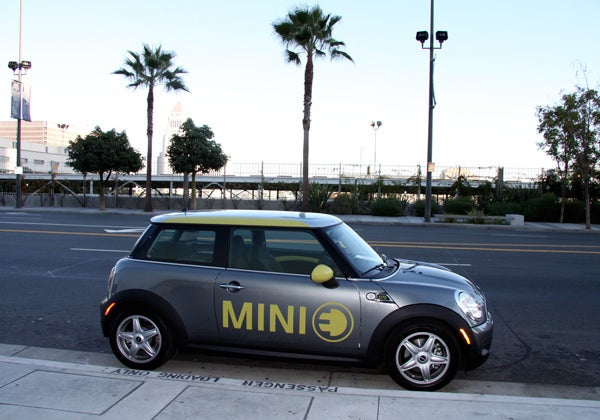
The Mini E Vomit-inducing? Hardly. Seth Fletcher

Regenerative braking, the process through which an electric car grabs otherwise wasted energy from the brakes as the car glides to a halt, is a brilliant bit of engineering for efficiency—take energy that's otherwise only good for burning up brake pads, and turn it into electricity that charges the battery.

It may also make the uninitiated driver want to vomit. This is what my handler told me as she guided me toward a fleet of Mini Es—electric Mini Coopers—parked in the basement of the L.A. Convention Center in downtown Los Angeles. See, regenerative braking starts to slow the car as soon as you let off the gas, as the braking system harvests the energy emitted by the decelerating vehicle. The experience can be unsettling at first—it can trick you into thinking you've been driving with the parking brake on. You might end up lunging unexpectedly forward in your seat as the regen takes over, until you learn to let this magical automatic braking system do its thing. It takes a little practice to learn to smooth the transition between speeding up and slowing down, between starting and stopping. Until then, Mini's publicist told me, you might feel as if you need to pull over and grab some ginger ale.

But in my drive around LA in the Mini E, it took only a couple miles in the car to learn when to cede stopping power to the regenerative braking. By then I'd also gotten used to the other notable difference between this car and its gas-driven brethren—the eerie silence of a pure electric vehicle (the only sound is that of the tires rolling along the pavement). The Mini E is no glorified golf cart. It's a little slow off the line, but once you get moving acceleration is impressive. On one traffic-free straightaway I hit the accelerator and realized I'd been underestimating this car: My head snapped back as the car launched ahead. The route Mini planned for me didn't include any freeway driving, probably because I'd just end up sitting in traffic, but the car has a top speed of 95 mph. In other words, the Mini E drives pretty much like a normal Mini Cooper.

It looks pretty much identical to the standard Mini Cooper, too, but there are interesting differences. What used to be the backseat is now filled with lithium-ion batteries supplied by AC Propulsion. (That company supplied the entire powertrain—batteries, motor, power electronics and all.) Behind the steering wheel you'll find a battery-charge gauge. The cars are numbered. They come with a custom charger that churns out 240 watts at 50 amps, which means you can charge the car fully in two to three hours.

Page 1 of 2 12next ›last »
Want to keep track of the latest concept cars, automotive innovations, and more? Subscribe to Popular Science today, for less than $1 per issue!

10 Comments

Whats the range on a full charge?

The range is 150 miles. Here is the link:

http://www.popularmechanics.com/blogs/automotive_news/4288459.html?series=19

Also, the recharge time is 24 hours using a 110 volt house plug. They have a 240 volt 48 amp connection for a 3 hour recharge.

I'd like to see the electric cost compared to gas cost to go 150 miles.

The car is also super heavy, and they had to adjust the suspension accordingly.

All this proves that battery technology is not for the masses yet. Hybrid vehicles are probably the best way to go with multi-fuel abilities. For really short trips less than 20 miles the battery is used, and for longer trips some fuel is used.

I would guess that by the time light weight 300 miles electric cars came to market, hydrogen fuel cell cars will be ready for market. I'm not holding my breath.

“It has a tremendous electric draw when it charges,” McDowell said. Based on average electric rates in the areas the company is targeting, charging the car will cost roughly half as much as filling a tank at recent gasoline prices, he said.

^From and MSN article, although that would be with the current gas prices, so if they go back up the savings would be more. Also, not sure if its true since I only saw it on one article, but read that BMW would be reimbursing the charging cost for the vehicle during the test period.

Recharge time of 24 hours? Hmm... that's long....

With the advances in solar panels technology - might as well slap some solar panels for better energy storing and usage... heck, slap in some small wind turbines as well....

And while we're at it, the article says that it gets energy as well from braking? maybe they could somehow design it in a way that it gets energy while it's moving...imagine the car's wheels as turbines... well... that's my crazy ideas and i'm sure most of you have thought about these as well.

Other downside I could think of is the weight as well, maneuverability-wise, this could be an issue when climbing steep inclines, that's assuming that other passengers and baggage contribute to the total weight of the car.

But so far it's nice... a good step towards the "green" car... Gratz everyone =)

Solar panals affect the aero dynamics or else must be crafted into the shell-shape of the car (a pricey addition to an already exspensive concept car). Also, solar cells are not going to add much to the moving range of the car. What they would do is allow a car parked in the sun to SLOWLY recharge. Likely not worth the exspense.

Wind turbines or wheel turbines would not serve to conserve energy at all. Actually, those would both loose energy to inefficienies in the system. A wind turbine would only increase energy consumption due to wind drag. Wheel turbines would also increase resistance, and thus energy use.

The basic process is this: energy is used to move the car forward. This energy is wasted any time the car is artifically slowed beyond what friction and gravity naturally due to slow moving objects. Regenerate braking gets back as much of that wasted energy as possible. Anything else that harvest energy from the cars forward movement is just burning energy to create energy (which is always a loosing process).

The headline reads: "Test Drive: The Elecric Mini".

"Elecric"?

And "They come with a custom charger that churns out 240 watts at 50 amps".

Man, that's one beefy 4.8-volt power supply, guys. That'll power a whole bunch of computers, eh? :-)

A nice article, but I'm sure your editor is wincing about now.

Hale Adams, the Grammer and Syntax Nazi

Yeesh. *I* need an editor, too.

Make that "Grammar and Syntax Nazi". :-D

Millions of nanoturbines that could be directly applied to the surface of the car need to be developed before any energy efficiencies can be realized from the effect of wind moving over the car. Until then, it's regenerative braking, batteries and/or hydrogen.

billdale

from Los Angeles, CA

I continue to notice there is vigorous response to Pop Sci articles on electric vehicles, whereas the stories on non-electric vehicles-- the new Porsche, for instance, or the chemical-powered car competition-- get few to no comments. I hope all the car makers take heed. We no longer have interest in yesterday's tech, we want cars that are efficient, mechanically simple, cheap to operate, non-polluting and that do not need hundreds of billions of dollars yearly in supplies from OPEC countries-- countries such as Iran and Saudi Arabia that want to annihilate us.

The Saudis, may I remind you, financed the 9/11 terrorist attacks and continue to finance suicide bombers and improvised explosive devices that have killed thousands of innocent people in Iraq, Afghanistan and elsewhere. They are NOT our allies, and we finance their terrorism by our addiction to their oil.

We need to rethink what is an acceptable distance we can drive without stopping. If we have enough quick-charge stations, and we are willing to get by with just 50 miles or so on a charge, it would be a rare day when we would actually need to stop during a day's travels since we would normally be getting as much charge as we need at home overnight. And if we are willing to get by on a shorter range, that means driving a lighter, quicker car with smaller, cheaper batteries, making EVs more affordable to more people. The key, therefore, is lots of charging stations... and "lots", in this case, means far fewer than the number of gas stations we have today since most of the time we'd only need as much charge as we get at home overnight.

With state-of-the-art nanotitanate batteries that can be recharged in just 6 minutes or so-- 10 minutes to charge a fully dead battery-- if we do need a charge it will not be inconvenient, and will be far cheaper than buying gasoline. A charge that will give us 40 miles of driving would probably cost less than a dollar-- try THAT with even the most efficient gasoline car.

When you consider the dynamics of a mature electric vehicle infrastructure, you'll see that it will have every advantage over our current use of gasoline cars-- you won't need to rely on capricious foreign oil companies that can restrict production on a whim, driving up gasoline prices artificially; you can generate your own electricity from a home solar panel or wind generator, or buy it cheaply from the grid. Stated differently, electricity is much cheaper than gasoline per mile traveled. Consider never again having regular smog tests, tune-ups, air filters, oil filters, and similar expensive and time-consuming maintenance; no mufflers, catalytic converters, oxygen sensors; even the brakes last longer due to regen braking.

The kinds of batteries used in EVs are currently expensive, but since the typical driver saves hundreds of dollars per month on gasoline, you actually achieve break-even very quickly-- much quicker than you would with today's hybrids that get all of their energy from gasoline anyway. A fully electric car is far more efficient than a hybrid-- even an ultra-powerful EV such as the Tesla Roadster only costs about 3 or 4 cents per mile for electricity, or the equivalent of well over 100 miles per gallon. And the best batteries made today can outlast the car itself, so there is virtually no maintenance and almost nothing to spend on parts and fluids: your biggest expenses could become insurance and tires.

In 2007, approximately $700 billion dollars was spent on foreign oil-- imagine if we were able to keep that money here at home, and could spend that money on our roadways, education, and health care. As soon as we can shift from gasoline to electric cars, we can begin to recover from the steep recession in which we are currently mired.

"...regenerative braking starts to slow the car as soon as you let off the gas..." Pardon me, but it's no longer "gas"! It's not even an accelerator pedal, since it controls both acceleration and braking. Might we call it a speed pedal?

Thanks for a very positive report.

This Mini wont handle like its normally aspirated siblings and the Electric facility only papers the cracks. Fuel efficiency could be much better on petrol and diesel engines but wheres the fun in that... follow the money. The only time id be interested was a hybrid with additional power to the rear wheels say from a small electric motor in the boot.
www.mercleasing.co.uk


138 years of Popular Science at your fingertips.

Innovation Challenges


Popular Science+ For iPad

Each issue has been completely reimagined for your iPad. See our amazing new vision for magazines that goes far beyond the printed page


Download Our App

Stay up to date on the latest news of the future of science and technology from your iPhone or Android phone with full articles, images and offline viewing


Follow Us On Twitter

Featuring every article from the magazine and website, plus links from around the Web. Also see our PopSci DIY feed


February 2012: The Future of Fun

Science is reinventing play, from extreme sports to gamification to ridiculous roller coasters to the playgrounds of tomorrow, and this issue is chock full of fun. Also, on a less fun note: Did global warming destroy my hometown?


circ-top-header.gif
circ-cover.gif