An engine squeezes more power­—and less pollution—from a slimmer design
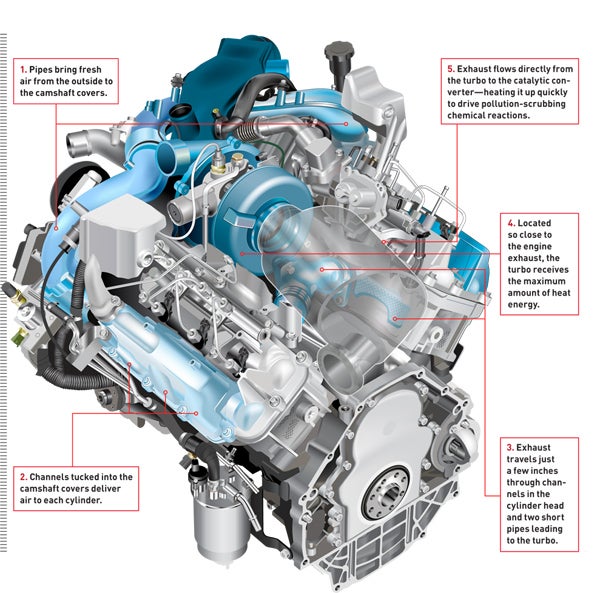
Five Steps to a More Efficient Engine (Blow it up!) Steve Karp

To make its Duramax 4.5 diesel cleaner and leaner, GM turned traditional engine design inside out and dumped 70 parts.

The biggest change was flipping around the exhaust system to direct hot gases through short pipes toward a central turbocharger and catalytic converter inside the “V” of the engine. This compact design harnesses more exhaust heat and requires fewer components than conventional V8s, which send exhaust through long manifold pipes that protrude from each side of the engine, taking up more space and losing heat before they reach the turbo.

GM also eliminated the intake manifold pipes that deliver air to the engine. Instead, air flows through the overhead camshaft covers, down to the combustion chambers.
The Duramax 4.5 engine debuts in the 2010 Chevy Silverado and GMC Sierra pickup trucks.

Want to keep track of the latest concept cars, automotive innovations, and more? Subscribe to Popular Science and enter to win $5,000!

9 Comments

I wonder, has anyone considered marrying a Sterling engine and a conventional combustion engine together in the same block; using the heat from the combustion engine to power the Sterling engine.

Boatman

that just seems like an aweful lot of heat in one spot right on top of the motor like that.. i bet gm will have to change the makeup of the paint they use on the hood of this truck to keep it from peeling away!! i don't know, i like my cummins 5.9l inline 6, easy to work on, cheep parts, everything out in the open. what is gm going to do to take up the "left over" empty space now? add about 10 more cooling fans to circulate the HOT air around this one?!!

iGenius1.0

from Dover, NJ

I wonder why those car companies don't put electric generators on the wheels of the car, use four(or however needed) many "metal stick things" to increase speed w/ less fuel and energy. They could also use the exhaust immediatly after the gas leaves the piston to another, burn fuel to make elctricity(hybrid). Can someone explain why not put all of those and more in a car or van??!!

How long will it be before we see major recalls like we did with the Ford 6.0? People and engineers push these new engines into the market before they actually test them for durability. It has been my experience that durability decreases when displacement decreases. There is a reason a semi engine weights 2000lb and can go 1 million miles without major overhaul. Smaller engines require tighter tolerances, which leaves less room for error and wear. I am not saying that a small engine can be durable, just look at Honda’s. Something that needs to be considered though, Honda did not develop their engine overnight, and they have stuck with a similar design for the past 15 years. I feel that a good quality design company doesn’t need to design a new engine every three years, but they need to make small changes to better the one they already have. If GM is successful, great, but the likelihood of their success is slim. I predict that the engine will hit the streets only to be pulled off two years later because of major complications. What is going to happen to the ones on the road? It seems as though you will be stuck with a truck or car that has no trade in value and worst case scenario its broke. I am open to new ideas but this kick the auto industry is on with a new engine every 6 months is getting old. New engines mean new parts, new parts mean new part prices, and new part prices just add an accelerant to an already wounded economy.

That's great that GM can create an ultra fuel efficient diesel engine, but diesel is not a big player in the American market. It should be, since it is generally cleaner and gives better performance/MPG.

http://timelessrides.ning.com/profiles/blogs/classic-car-insurance

@Stealth1

"I feel that a good quality design company doesn’t need to design a new engine every three years, but they need to make small changes to better the one they already have." - Stealth1

So no matter what.. you will bash GM even though the modifications are minimal & reduce the amount of parts within the engine. Then later on you change the new engine every 3 years to every 6 months. Their main issue is making too many different body styles as opposed to powertrains.

"There is a reason a semi engine weights 2000lb and can go 1 million miles without major overhaul." - Stealth1

Perhaps it has something to do with better materials utilized since time lost on road = money lost and towing semis isn't exactly cheap. Also, being majority highway travel it's minimal strain on the vehicle. More than likely the 1st thing to go is transmission or differential due to heavy load capacities and brutality of stop and go traffic.

Aside from all that.. A vehicle is normally as good as it's maintenance just as you are as healthy as you are clean and sanitary.

Large diesel engines typically go 400,000 miles before an overhaul, not one million. Also, like the one I drive...it goes 6000 miles a week without fully cooling down between trips. Longer trips means longer lasting engines. Size of engine may not mean anything at all. There are too many variables to point out just one.

The article does not make it clear whether the catalytic converter is upstream or downstream of the exhaust turbine. If it is the former then it is a good arrangement as more of the chemical energy released will be turned into useful work.It might also help if the compressor was driven electrically away from the engine compartment thus allowing the engine to run on a supply of cool compressed air. The air coming from a conventional turbo charger is not cool unless it passes through an intercooler first. A supply of cool compressed air can assist catalytic converters do their job by manging the temperature and supplying more oxygen. Exhaust turbines revolve very fast which is more suitable as a power source to generators than compressors.

I'm sorry , I should have checked the illustration. The catalytic converter comes after the exhaust turbine. The wasteage this involves could be rectified with another turbine after the catalytic converter, or putting the catalytic converter first and if the temperatures were too high , manage them by bleeding in a controlled amount of cool compressed air. It is a neat idea to use the camshaft covers as inlet manifolds, but it requires careful design of the camshaft and valve lubrication to avoid drawing lubricant into the combustion chambers. I stand by my assertion that exhaust turbines would be better powering the generator than some form of blower / compressor.In the world of air compresssion a big one going slowly is more efficient than a small one going fast and though bulkier, need not weight more as the components are less stressed and can be made of lighter materials.

Popular Tags

Regular Features


Download Our iPhone App

Stay up to date on the latest news of the future of science and technology from your iPhone with full articles, images and offline viewing


Follow Us On Twitter

Featuring every article from the magazine and website, plus links from around the Web. Also see our PopSci DIY feed


Become a Fan On Facebook

Share links with friends, comment on stories and more


November 2009: Astronaut 3.0

Inside NASA's astronaut bootcamp and the grueling new training regimen for deep space. Plus, ten young geniuses shaking up science today, one writer's quest to analyze every man-made chemical in her body and more.

Check out the issue's full contents online here

Popular Science Photo Pool


Share your photos in the Pop Sci pool at www.flickr.com!
tags_sprite.png
POP_embeddedForm_cover_May09.jpg