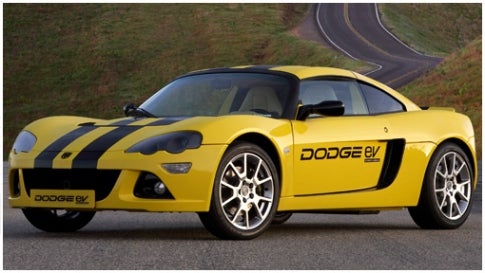
Not to be outdone by GM's Chevy Volt hoopla last week, Chrysler today revealed three prototypes from its own electric-car program earlier today on CNBC. Who knew Chrysler had an electric-car program? Practically no one. But the company calls it ENVI, pronounced "envy," and the first consumer product from the program could appear as early as 2010.
Each of the cars revealed are electric-drive vehicles, one of which is an all-electric sports car with more than just a visual connection to the Tesla Roadster. It's called the Dodge EV, and by the looks of it, Dodge has appropriated the body and chassis of the Lotus Europa, a mid-engine GT car not sold in the U.S. Chrysler isn't discussing where it got the rolling stock, but it is talking about the drive system. The two-passenger, rear-wheel-drive speedster is powered by a 200 kW (268 horsepower) electric motor, an advanced lithium-ion battery, and an integrated power controller. The electric-drive motor produces 480 pound-feet of torque, which can take the Dodge EV from zero to 60 mph in less than five seconds, on to a top speed of more than 120 mph.
The other two vehicles -- the Chrysler EV minivan and the Jeep EV Wrangler four-door -- share a similar powertrain setup as the Chevrolet Volt. That is, an electric motor drives the wheels and a small gas engine is assigned to charging the batteries as needed, and providing enough power to extend the cars' electric range. Like Chevrolet, Chrysler isn't calling these cars hybrids (though most engineers refer to such systems as "series hybrid") -- rather they're "range-extended electric vehicles."
Chrysler says it intends to bring at least one of the electric-drive vehicles to market by 2010 to consumers in North America, and later in Europe.

Stay up to date on the latest news of the future of science and technology from your iPhone with full articles, images and offline viewing
Featuring every article from the magazine and website, plus links from around the Web. Also see our PopSci DIY feed
Share links with friends, comment on stories and more
Inside NASA's astronaut bootcamp and the grueling new training regimen for deep space. Plus, ten young geniuses shaking up science today, one writer's quest to analyze every man-made chemical in her body and more.
Check out the issue's full contents online here
from Janesville, Wisconsin
General Motors must be crapping their pants. Here are 3 cars, 2 of which have the same stats as the volt but with larger passenger capacity, and a sporty little tricked out europa.
Wu
from hamilton, on
Once again, we have the technology and refuse to market it!Am I the only one who thinks we are wasting time!!!!!!!!I'm not just speaking about the new line of cars, but the fact that the technology has been around for years!!I am not a conspiracy theorist, but I cant help to think that the auto companies are sleeping with the enemy(oil co.).It makes no sense for the north american companies to produce vehicles that are non fuel efficient when the rest of the world is manufacturing them and(as we have recently been shown)the techno is available.And why doesnt the new chevy volt have solar roof panels so it can trickle charge while its parked??????????????????Or any electric vehicle for that matter!
from Los Angeles, CA
KUDOS!!!
Dodge is finally doing it right.
GM had to be dragged, kicking and screaming, into building the EV-1, and then sabotaged the program just because they knew they could make much more money selling cars that need constant service and parts; eventually the Prius and other "parallel hybrids" arrived, but were not even as good as the EV-1 since all were immensely and unnecessarily complicated just to keep the car buyers from servicing their own cars. They also continue to get all of their power from on-board gasoline engines, which defeats much of the purpose of driving electric. The much-simpler "serial hybrid" Chevy Volt is not yet even on the street, but it is still only marginally better-- too little too late.
The Dodge ENVI pure electric has leapfrogged them all with what we really need and want: like all EVs should be, it will be ultra simple-- its motor will only have a single moving part, the motor will be able to turn in reverse like all electric cars so it will not need a reverse gear, it won't need lots of forward gears to operate so its transmission will be very simple, small and light.
The ENVI will be better than the GM EV-1 in only one or two ways, but that was all the EV-1 really ever needed-- the ENVI will have state-of-the-art batteries that will give it a much greater range between charges... and if Dodge is smart they'll use batteries that can be quick-charged from special chargers in about the same amount of time it takes you to gas up the car you have now. The Altair Nanotech battery can be recharged in less than ten minutes and will last for the life of the car; and the A123 Systems battery can be recharged almost as fast and is cheaper, giving buyers options.
Dodge's announcement of the ENVI will undoubtedly prompt many huge developments-- the oil companies will be afraid to continue raising gasoline prices for fear of stifling sales of gas cars, and will likely give them reason to lower prices instead.
Executives at Starbucks, Costco, McDonald's and other large retailers, once they hear of Dodge's announcement, will likely want to be ahead of the curve and so install quick-chargers at their businesses so that as you are shopping or dining, your car can be charged for just a fraction of what it would cost for a tank of gas.
We have an enormous trade deficit that is in great part due to petroleum, so as we begin to shift away from gasoline to EVs we will undoubtedly begin to see a more favorable trade balance, and we can stop sending money to Saudi Arabia who financed the 9/11 terrorist attacks, and who continue to fund terrorism in Iraq and elsewhere.
Dodge's announcement has given me hope. Thank you, Dodge.
wheel generators: the faster u go, the more watts/minute for ur motor.
What!!!!! A two seat full electric? According to some comments on the 2011 Chevy Volt article the American public won't buy it, well, well, well, dodge seems to think so! Ha!!!
I even like the color! I want to be on THIS waiting list! ...Where do I sign up?
In 1974 I suggested to Chrysler to use flywheel storage units to kinetically store energy. The flywheel would spin a generator to produce electricity for thedrive motor. it was rejected. Today, I have been advocating the use of stacked flywheel units that would have a flywheel canister atop and below the motor/generator with the system being sealed to prevent leakage of the vacuum from the flywheel canisters. Either a liquid coolant or forced air would indirectly cool the armature of the motor/generator.
I would use either rock quartz or an ultra-stressed crystalline molecular solid material for the flywheels with possible a magentic band around them facing a magnetic band inside the walls of the canisters. This may produce a linear induction effect. My goal is to kinetically store at least 100 watt-hours per cubic inch of material.
If I had a sports sedan I would use two primary stacked units and two or four secondary stacked units for the systems of the car. The primary flywheels would be able to store at least 1000 KW of energy to power the twin 500 horse motors. If I traveled at highway speed, I could go from New York City to Chicago nonstop. If I were driving the car at LeMans, the 1000 horses might push the car to over 300 mph. The range might be over 300 miles. With the removable flywheel rack in the rear, a pitstop may take less than half a minute. The car would jack itself up, release the rack, and another rack could be wheeled into place and would be attatched to the connections to power the motors. The car might be the first one to exceed 4000 miles in 24 hours at LeMans.
If Chrysler was serious about building an electric sportscar, I would have it build stacked flywheel powered electric cars which would have a greater range than conventional vehicles and with it taking no more than 15 minutes to respin the flywheels, a driver could eat a meal in a restaurant or truck stop while the flywheels are being respun up to speed. Also, since the total flywheel power storage might be around 1500 kilowatts, if the electricity costs 3 cents per kilowatt, the driver would pay $45. With gas prices being so high, you could spend that much and travel only half as far as the electric car.
It's been 34 years since Chrysler rejected flywheels. If it rejects stacked flywheels and another company uses them and builds millions of vehicles people want and need, Chrysler will once again be in trouble for rejecting what it needed.
I will raise the same question as many others; why is it taking so long for the big auto makers to provide the US with economical options? Most (if not all) major auto makers offer diesel options in Europe. I have read articles about 75 MPG Nissan Versas and 60 something MPG Fords but to the best of my knowledge there are no diesel offerings available in the US for the 2008 model year. I am not aware of any offerings for 2009 either. A diesel engine would allow you to run bio fuels....if you can find a diesel engine.
Diesel has been shown to be significantly more economical than gasoline (and requires less refining to produce) so why isn't there a diesel/electric automobile offering in the US? How long has it been used in the marine industry, trains and in heavy equipment?
It is time the American public starts getting ticked off and starts making some noise to the auto makers.
Electric cars are fine, but with hydro dans being torn our to allow salmon access to streams and the Bonneville Power Authroity stating that witnin ten years their generating capicity even with the lower Snake River Dams on line they will not be able to generate enought electricy to meet the demand. Thiw Authority furnishes electricty into the Westrn Grid. The clean Air Act hinders building new coal generating plants and Atomic Power is a now no. Whereis the electricty comming from to charge the bateries for the electric powered cars.
from Los Angeles, CA
to extremechiton:
Sorry, but you're not communicating well. What do you mean? do you mean regenerative braking? If so, every hybrid and electric vehicle has that already, and it's a good thing. But if you are trying to imply that you think you can but a generator in the wheels and generate as much or more energy than it takes to power the car, you've been reading too many "overunity" blogs by guys that never actually try the ideas they insist are solutions to the problems of the world.
Get a generator of any size and design. Crank it by hand while it is not connected to any load, such as a light bulb or a battery that it is charging. Then, connect the generator to a battery that is discharged, and try to crank it again... as you do so, you'll notice it takes much more effort to crank it... the greater the load, the more energy it takes to crank. So if you connect a generator to a car and expect it to give you free energy, you're mistaken. Connecting a generator to your wheels is only a good idea when you want to use it help stop the car, which is called regen, which works quite effectively-- it will make your brakes last far longer than they would in an ordinary car.
If you want to use a generator on an EV, it only makes sense to use it to stop the car and to help recover some of the energy you used to get the car moving. It can't be used to keep a car running forever.
from Los Angeles, CA
To HOORGANVISOR:
I don't want to discourage you from your interest in flywheels, but it would be far easier to use a flywheel to store energy in a stationary application such as a home or wind farm than it would be to do so in a moving vehicle.
Flywheels have two serious problems: the more energy they need to store, the faster they must spin, and the more inertia will try to tear them apart. Secondly, flywheels must have bearings that can deal with all the weight and speed of the spinning mass, which is why magnetic bearings that have no physical contact is usually the approach of choice. Unfortunately it is far more difficult for a magnetic bearing to deal with the bumps and jolts of a moving vehicle, so if a flywheel is to compete successfully with batteries anywhere, it would be in a static setting.
If you've been into flywheels as long as you say, you probably know that actor Kevin Costner invested heavily in flywheels several years ago with a company called US Flywheel... they also wanted to use them in vehicles... their operation ground to a halt eventually, but they might have succeeded if they'd tried to apply them to homes and businesses first. It is not necessary for a flywheel to be used in a car for it to make an enormous difference-- if they can be cheaper and more effective in home storage when used with solar power, or with wind farms that also must rely on intermittent power, they can be of enormous value.
I do wish US Flywheel or someone had been able to find their way past the problems, and I hope if you're working on flywheels, that you succeed.
There is more than enough generating capacity if you charge at nite. No changes to the grid needed
Phil
from Pipersville, PA
the power grid needs to be upgraded. once it is, more power plants, whatever type they may be, can be built, and the power grid will be able to handle it.