Avoiding Pedestrians With the Help of Lasers

A concept for a safer crosswalk projects a virtual barrier to remind drivers where and when to stop
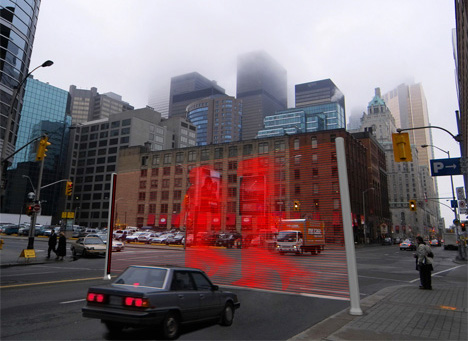
Virtual Wall: The theoretical design would project a virtual barrier in front of crosswalks Photo by Hanyoung Lee

Hanyoung Lee wants you to be seen. The South Korea-based product designer devised a prototypical warning device to prevent pedestrian strikes along roadway crosswalks. It's called the Virtual Wall, a visual barrier created from plasma laser beams. The system casts larger-than-life images of pedestrians in eye-grabbing red across the roadway, at a location where such peds are likely to be crossing.

We don't imagine the plasma lasers are the cutting type, however. We would never endorse a radical social engineering project that radical.

[Yanko via Jalopnik]

14 Comments

Comments

tgdavies
Article Rating:
1
2
3
4
5

Shame on you, Popular Science, for apparently not knowing any science!

What is a 'plasma laser'? There is no such thing!

How can a laser beam produce light at right angles to the beam at some particular point along its length? It can't.

Hanyoung Lee has not 'devised a prototypical warning device'. He has made a picture with photoshop of something which *cannot* *work*!

If I photoshop a perpetual motion machine will you write a credulous story about it?

0 out of 3 people found this comment helpful
crashdr
Article Rating:
1
2
3
4
5

@ tgdavies: I agree at first glance the concept appears fantastical, however casting my mind back I remembered an article from a couple of years back concerning focussed IR lasers being used to create 'dots' of plasma in air with the end aim being 'open air' 3D displays - I presume the idea would be realised using this technology: http://www.physorg.com/news11251.html

2 out of 2 people found this comment helpful
DotNetProgrammer
Article Rating:
1
2
3
4
5

Looks like 1970's a video game. How many points do we get for hit-and-run on a virtual pedestrian?

@tddavies - This isn't the old Popular Science that we grew up with. These little web articles are just cut and pasted from press releases and web sites. There doesn't seem to be any editorial oversight. There should be a disclaimer at the top of every article.

0 out of 2 people found this comment helpful
davepr
Article Rating:
1
2
3
4
5

@DotNetProgrammer: It's your right be a pedant, but please at least take some time to find out what a blog is, and what its role is, and how it differs from traditional editorial reporting. Think of it as the section full of conversation starters. A place where ideas are introduced to the readership, which in an ideal world, responds constructively, inspiring other readers to comment and contribute in kind. And so on.

If you find this distasteful, please return to your musty stack of past issues and leave the dialogue to those of us who don't have an axe to grind.

"Not the PopSci we grew up with" Thank heavens for small favors.

3 out of 3 people found this comment helpful
DotNetProgrammer
Article Rating:
1
2
3
4
5

@davepr - Thank you for confirming what I suspected. My confusion with this site is that articles are not represented as blog fodder or "conversation starters".

Most of us arrive here via to web searches and external links. We incorrectly assume that what we are reading is an extension of the edited and reviewed Popular Science Magazine.

In fact it is not. All I ask is that a disclaimer be displayed that informs the reader of this. Without proper framing articles damage the Popular Science brand.

0 out of 0 people found this comment helpful
davepr
Article Rating:
1
2
3
4
5

@DotNetProgrammer: Actually, you're right. There's nothing explicit in the layout to set these posts apart from traditional editorial content, other than the reverse-chronological blog format itself. Mea culpa.

0 out of 0 people found this comment helpful
HBillyRufus
Article Rating:
1
2
3
4
5

Even though it might be a valid illustration of how the system might work, it still looks suspiciously like a photoshop hoax. I suppose the aerial image could be created using the Japanese laser plasma system, or maybe with two lasers creating an interference pattern between them. But we're still talking about laser beams flying around right where people and cars are travelling. Isn't that going to be unsafe for everyone's eyes? Still I'd bet advertisers would love to get this technology working. Imagine all sorts of candy bars and soft drinks perpetually flying around overhead. At night it would look just like "Blade Runner"! And then the opportunities for hoaxes would be endless. Just imagine a ghostly floating Jesus image appearing at the Republican National Convention whispering "Why have you foresaken me?". It would be hilarious!

0 out of 0 people found this comment helpful
SephirothVIIAC
Article Rating:
1
2
3
4
5

Well if you took the time to read the caption underneath the picture. It pretty much tells you it is not a real photograph. It says it is a theoretical design. So that ends that little dilemna I would assume.

It definetly looks like it would be a good way to make people pay more attention to what is in front of them when they pull up to a cross walk. Even if you are scrounging down below you usually have one eye up. And who isn't going to notice two huge red pedestrians.

0 out of 0 people found this comment helpful
JRS ONE
Article Rating:
1
2
3
4
5

Is not hitting pedestrians in a crosswalk really that hard? It looks more distracting than useful.

0 out of 0 people found this comment helpful
imaduck
Article Rating:
1
2
3
4
5

I'm sure with the right mix of technologies you could produce the above effect (although making it cost-effective might be difficult). However, I would be more worried about how much your view of the city around you is diminished by this distraction. What if you want to make a right turn on red - won't this make it more difficult to see the pedestrians you're trying to avoid? Won't this make it more difficult to notice the other obstacles on the road ahead of you?

1 out of 1 people found this comment helpful
Page 1 of 2 12next ›last »

Popular Tags

Regular Features

PPX: The PopSci Predictions Exchange

RSS Link

Cars

Ready to bet on the future? Start here!

Subscribe for 2 free issues!

may2008_cover.jpg