If racecar designers weren't constrained by speed-stifling rules, they'd create monsters of suction capable of doing 300+ mph ... upside down.

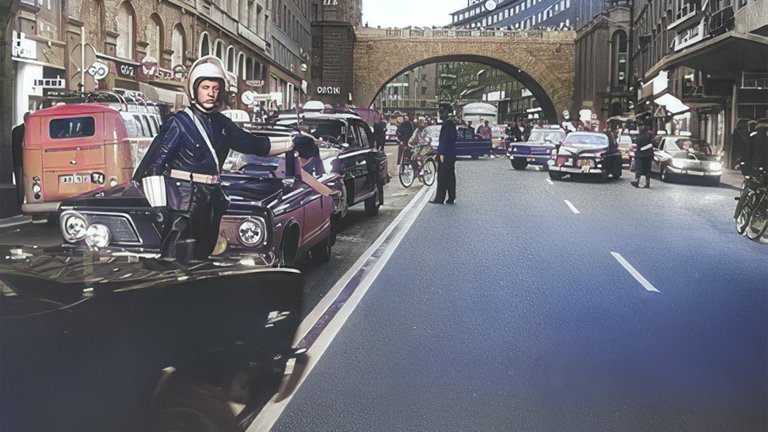
Cut Down to Size The Chaparral 2E Can-Am car—driven here by its creator, Jim Hall, in 1966—was the first to methodically exploit the benefits of downforce. It was outlawed because the rear wing was mounted to the suspension and could be adjusted by the driver.

Trevor Harris is laughing so hard, A waiter stops by to make sure everything's OK. Harris can't speak, so he just waves him away. Ten seconds pass. Twenty. Thirty. Finally he masters his breathing and dabs at his eyes. "And the crowd would be going crazy," he says, still chuckling despite his best efforts, "because the driver would be near death." Another laughing jag. "Not because the racing is so dangerous," he wheezes, the words escaping in a rush, "but because his blood vessels are on the verge of exploding!"

Harris isn't a contemporary Caligula salivating over a twisted 21st-century blood sport. He's an innovative engineer who's designed some of the most successful and iconoclastic racecars in motorsports history. But nothing he's created during a career spanning the Daytona 24 Hours and the Baja 1000 comes anywhere close to the bizarro vehicle he is now envisioning for the racecar formula I've suggested. Imagine, I´d said, a series with no rules. None. Zero. Zilch. The sky´s the limit. Any technology you can imagine. All the time and money you need to develop it. What kind of car would you create?


Harris´s salad goes uneaten. His wine goes undrunk. Thinking on the fly, he methodically works his way through the aero package, the chassis, engine options, braking systems, you name it. The conversation ranges far and wide. Then, suddenly, it stops. With Harris, a world-class talker, this is cause for concern. "This is ridiculous," he says, snorting with equal parts derision and amusement. "Oh, this is going to get ugly."

"What?" I ask him. "What's going to get ugly?"

Pretty soon we're both laughing uncontrollably, although to be honest, I'm not sure what's so funny. "Preston, this is what's going to happen," he says. "For the first time ever, we're going to have racecars that test the limits of human endurance. So instead of engineers in the pits watching telemetry from the cars, we're going to have a bunch of guys in lab coats monitoring the drivers' vital signs. We'll have Dr. Blood Pressure and Dr. Blood Oxygenation Level and Dr. Heart Rate." This prompts a new wave of laughter. "It won't be racing at all!" he says. "It'll be a war of drug companies and Ph.D. medicos!"


For much of the 20th century, racing was to automobiles what war was to airplanes-the crucible for technological breakthroughs. The rearview mirror debuted at the Indianapolis Motor Speedway in 1911, and disc brakes were proven on the road circuits of Europe in the 1950s. "Racing improves the breed" wasn't mere advertising; it was a truth revealed every Sunday from the chicanes of Le Mans to the salt flats of Bonneville to dirt ovals in Podunksville, U.S.A.


It all started to go wrong in the '60s, when engineers brought new technical sophistication to the sport, and the influx of millions of dollars in corporate sponsorship allowed them to play Mr. Wizard. Speeds made a quantum leap. Ditto driver fatalities. Ever since, Job One of the rule-makers has been to slow the cars down. And they've done it, for the most part, by banning leading-edge technology.


The result, ironically, is that contemporary racecars are, in many respects, less sophisticated than everyday econoboxes. "People talk about technology trickledown," says British aerodynamicist Mark Handford. "But it's tosh, really. If you look at the spec sheet for an E-Class Mercedes, you'll find electronic stability control and next-generation antilock brakes and all sorts of other things that are illegal in Formula 1. It's so frustrating to have all this technology and not be able to use it. If you want racing to be dynamic, to encourage innovation and get people excited about engineering, then the ideal formula could be written on a single piece of paper."

Modern motorsports rule books are tomes of dense engineering specifications. But historically, the least restrictive rules have produced the most imaginative racecars. So what would happen, we at PopSci wondered, if we trashed the rule book? "It all depends on what kind of circuits you're going to race on," says Tony Southgate, a British designer whose cars have won at Indy, Le Mans and Monaco. "And realistically, you have to have some rules, or you could design a car so wide that nobody could pass you or something ridiculous like that." OK, so the car's got to have wheels; any number will do. It has to be able to run a two-hour race at Le Mans, a circuit that features a challenging mix of long straights and tight corners. Dimensions? Bigger than a breadbox and smaller than, say, a Hummer.


Page 1 of 3 123next ›last »
Want to keep track of the latest concept cars, automotive innovations, and more? Subscribe to Popular Science and enter to win $5,000!

0 Comments

Popular Tags

Regular Features


Download Our iPhone App

Stay up to date on the latest news of the future of science and technology from your iPhone with full articles, images and offline viewing


Follow Us On Twitter

Featuring every article from the magazine and website, plus links from around the Web. Also see our PopSci DIY feed


Become a Fan On Facebook

Share links with friends, comment on stories and more


November 2009: Astronaut 3.0

Inside NASA's astronaut bootcamp and the grueling new training regimen for deep space. Plus, ten young geniuses shaking up science today, one writer's quest to analyze every man-made chemical in her body and more.

Check out the issue's full contents online here

Popular Science Photo Pool


Share your photos in the Pop Sci pool at www.flickr.com!
tags_sprite.png
POP_embeddedForm_cover_May09.jpg