Your Car: Weapon of Survival
At Bill Scott's anti-terrorist driving school, students learn to spin, shoot, and ram their way through any auto-borne attack.
The roadblock appears out of nowhere — two Caprice Classics aligned nose to nose across three lanes of backcountry asphalt. I have two options: Ram through the cars (and risk wrecking my own in the process) or spin around and speed away. I decide on the latter, just in time to see a third Caprice pull up alongside me. Its driver grins wickedly from behind the barrel of a Glock 9mm. I slap the transmission into reverse, stand on the accelerator pedal, and turn the wheel hard to the right. Rubber burns and tires squeal as my car careens into a 180-degree spin. The terrorist opens fire, painting my car, and then me, with bullets. I’m dead before my car ever stops rotating.
That moment’s hesitation, in which I evaluated my options like a rookie quarterback checking off receivers in the face of an oncoming pass rush, got me killed. But it’s far better to make such a mistake at the hands of an instructor wielding a faux Glock than in an environment where attackers employ very real AK-47s. That’s why almost every U.S. government agency and military branch — including the FBI, CIA, U.S. Marshals, Department of Defense and Marines — as well as foreign governments and private companies, send their drivers to Bill Scott Racing’s anti-terrorist driving school in Summit Point, West
Virginia, before stationing them abroad. Here, the automobile becomes both a weapon and a lifeline, and for the next two days, my classmates from the U.S. Army and the Hong Kong Police Department and I will learn how to put it to use against terrorist attacks ranging from carjackings to all-out assassination attempts.
Scott, a former champion Formula Vee racer, began offering antiterrorist driving classes in 1976 after noticing a serious flaw in the way the U.S. government protected its people abroad. “They were doing a great job at protecting an ambassador in a cavalcade of cars and cops,” he says. “But not with the attache or the guy who was out there by himself.” So Scott studied the history of auto-related terrorist attacks and designed a curriculum to arm the individual with the skills to survive one, skills like surveillance detection, fender-to-fender road combat, and executing 180-degree turns, as well as weapons training, shooting on the move (one of the most difficult skills to master), and how to use a car for protection.
“A high degree of emphasis is placed on avoiding the X,” says Scott, referring to the physical location where an attacker wants to corner you. If you can do that, “you’ve taken a huge element of surprise away from the terrorist, and exploited one of his weaknesses.”
Key to the training are the simulated environments created in the school’s 472-acre facility, which encompasses two road-racing courses (a third will be added this spring), three shooting ranges, an explosives range and several close-quarter combat rooms. The three-lane asphalt tracks contain features such as grass, gravel and dirt shoulders, hills, blind curves, wooded areas, and paddocks with simulated intersections — everything Scott needs in order to replicate an urban attack or rural ambush. “I can’t reproduce desert,” he jokes, giving a sideways nod to the snowdrifts lining the course. “But short of that, we’re able to tailor the driving environment to what the student is likely to encounter.”
Perhaps the trickiest maneuver Scott teaches is how to drive from the passenger’s seat. Once again I find myself facing a roadblock, only this time I’m riding shotgun when the driver is shot dead. Not wanting to share his fate, I slide to the center of the car, slam the brakes with my left foot, throw the car into reverse, and hit the gas. When the speedometer reaches 40 mph, I stand on the brakes and spin the wheel. I shift back into drive mid-turn and floor the accelerator pedal when the car spins a full 180 degrees. From there, the roadblock fades in my rearview mirror.
Scott and his team of 24 instructors — all of them former racecar drivers and military personnel — also emphasize more aggressive skills, like how to spin another car. Forget all the Hollywood nonsense about ramming the back of a car, or slamming against it from the side — all that does is bend sheet metal. Instead, give the target vehicle a hard nudge between its rear wheelwell and back bumper. Alternately, if you find yourself the target of such an attack, protect that flank as if your life depended on it, because it just might. Speed up and swerve, so your attacker can only hit you in the back bumper, or slow down so he comes fully alongside.
Such techniques are particularly well suited to the kind of opportunistic attacks that occur daily in Iraq and Afghanistan. “You get ambushed or sniped from a medium or short distance,” says Mike, a fellow student and U.S. Army captain who will head a team patrolling the countryside in
Afghanistan. Making a quick escape is critical to survival, because such impromptu attackers aren’t likely to have contingency plans for pursuit — they just want a shot at the first Americans who come along.
Fittingly, the final segment of the class concentrates on how to leave your attackers in the dust, which for Scott translates into high-speed driving techniques like entering a corner at 70 mph and cutting through it such that you lose a bare minimum of speed. These lessons aren’t unique to Scott’s curriculum; you can learn the same skills at any high-performance driving school. But taught against the backdrop of international terrorism, which amounted to 199 attacks in 2002 alone (77 of them pointedly anti-American), these skills take on a whole new dimension. “Without training, your chances of escaping a terrorist ambush without being injured or kidnapped are about 1 in 10,” says Scott. “With training, your chances are 6 in 10 of coming out safely.”
ADVENTURE GUIDE: SPY VS. SPY
You Don’t Have to be a secret agent or a Navy Seal to learn anti-terrorism tactics like spotting a “tail,” evading an auto-borne ambush, or engaging an enemy in close- quarter combat — you just need a decent bankroll. Here’s where to start.
Anti-Terrorist Driving
Bill Scott Racing, Summit Point, West Virginia
Scott’s two-day anti-terrorist driving school teaches you how to evade just about any kind of auto-based attack with skills like surveillance detection and 180-degree spins. $1,400
Covert Ops training
Incredible Adventures, Tucson, Arizona
Upon arriving at the Tucson airport, you’ll be whisked away to a secret training camp where you’ll learn evasive driving maneuvers, combat pistol techniques and espionage tactics. The three-day course costs $3,800.
Espionage Gameplay
Counter-Strike, Ritual Entertainment
Play either terrorist or counterterrorist in scenarios ranging from hostage rescues to assassination attempts. This popular PC title will be available for Xbox in November. $50
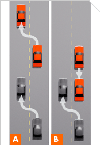
Illustration by John MacNeill
