Dodge’s 4-wheel Tomahawk
How designers created the 500-hp 4-wheel superbike
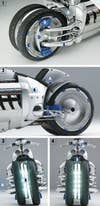
Photographs by David Dewhurst
It was all for power. The Tomahawk’s designers were so bent on making a brutally powerful motorcycle that they were forced
to mutate most of the bike’s components to accommodate the massive V10 Viper engine. Take the gas tank (1A): To shield it from the engine’s heat, they had to relocate it to the front fender. Two standard tires couldn’t
handle the power, so to keep the 4-wheeler feeling like a bike, designers devised a
unique independent suspension.
Expense, obviously, was no concern. Almost everything on the Tomahawk, from the blue anodized brake calipers (1B) to the valve covers, was custom-made from huge blocks of
aluminum milled down to size (imagine carving a pencil from a redwood tree).
All rockets go fast, but stopping them is another matter. The disc brakes, sporting 16 pistons in the front and eight in the back, take the job seriously. The drilled brake rotor (1C) is mounted on the edge of the wheel rim, while the calipers connect to a central crescent-shaped hub (1D). Designers linked the wheel to the frame with a double horizontal fork (1E) for more than just cosmetics: During strong acceleration and braking, the forces acting on the fork are parallel to the ground. A vertically aligned fork could snap if this force is too great, whereas a horizontal fork easily absorbs the stress. It’s much like a nail: easy to bend when you hit it from the side, strong and incompressible when you strike it squarely on the top.
The seat (2A) and panels underneath it (2B) started life as 1,500 pounds of block aluminum. Together they now weigh just 70 pounds. Riders brave enough to climb aboard adopt a semi-prone position, drag-racing style. The battery is nestled inside the seat, while the panels cover the 2-speed custom transmission (you don’t
need a low gear when you’ve got 525 lb.-ft.
of torque). Two drive chains designed for forklifts transmit power to the rear wheels.
The suspension was tricky. All four wheels are independently controlled, the front with
double arms (3A), and the rear with a trailing arm. These enable the rider to lean up to 45 degrees into a turn while keeping all four wheels on the ground. To prevent the bike from
falling over when parked, a switch locks the rear suspension, creating a de facto kickstand.
The headlights (3B) — 12 in all — sit between the front wheels. Each is a 5-watt LED with beam-modifying optics. Eight of them make up the taillights. Two air intakes (4A) oxygenate the fuel, and a forward fan (4B) sucks air into the radiator, where two banks of 18- by 8-inch cooling fins dissipate the engine’s heat. Placing the radiator on top of the engine, where the gas tank usually is, also helps insulate the engine from the rider. Even the tires are custom-made; if Dodge can find a wide enough tire, the bike could become a two- or three-wheeler.