Liquid lamps
For beautiful mood lighting, just combine off-the-shelf parts—and add mineral oil.
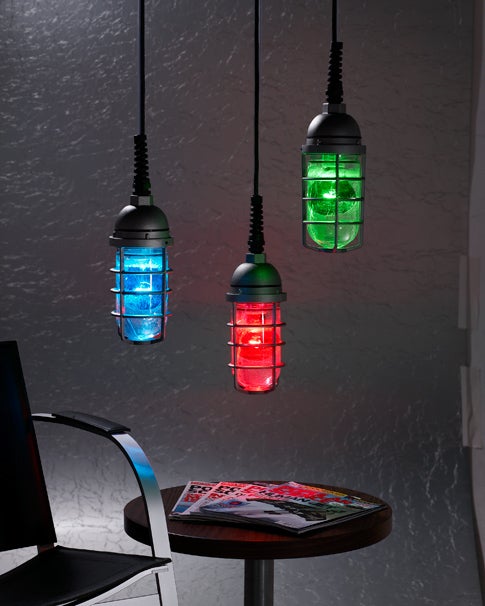
When you’re a performance artist, creating the right ambience in your show is everything. It all starts with lighting. So two years ago, my partner and I decided to build a lamp that would capture the aquatic theme of a show that our company, Radiohole, was putting on. We wanted to make a lightbulb look like it was submerged in water, so we used mineral oil, a liquid that’s clear and nonconductive (we spilled a lot of oil before finally hitting on a fixture that was both portable and leakproof).
We were also looking for a dynamic effect, so we ran a pump from a fish tank to blow bubbles in the oil, making it look as if it’s boiling from the bulb’s heat. The final design of the lamps wound up looking so good onstage that many people asked us about getting them for their homes. All the parts to build them yourself are available at home-improvement and electrical-supply stores. If you’d prefer to remain a spectator, though, you can order finished ones at radiohole.com.
Materials
All of these, except the aquarium air pump, can be obtained from McMaster-Carr, for convenient one-stop web shopping. All told it’s about $75 in materials.
A vapor-tight fixture with a half-inch hub. This is an industrial fixture, made from cast aluminum and used for outdoor or hazardous locations. It has rubber seals between the various parts to keep moisture out. In our case, we are using the seals to keep the mineral oil in. There are various styles and colors. These can be obtained at an electrical supply store or, like everything else here, over the internet. The price is around $40.
A basic air pump, the kind used to aerate an aquarium. Price: around $8.
Clear quarter-inch PVC tubing. This can be obtained at the same place you get the air pump. Some pumps come with the tube. Twenty-five feet will run about $2. The length depends on how far the pump is from the fixture. We’ve run lines up to 40 feet.
A length of three-wire 18awg SJOOW cord. Around $0.55 a foot. You could use any kind of 18awg wire, but we like to use SJOOW cord because it has a strong, flexible neoprene jacket and we like the look of it. Again, the length is up to you.
Nylon liquid-tight strain relief with flex fitting. Be sure to get the half-inch NPT thread, to match the threads on the fixture. This is McMaster-Carr part #69915K63, around $3.25.
- A 3-prong male plug.
- A couple of 18awg wire nuts
- Light-viscosity mineral oil. Mineral oil is a clear, odorless, and most importantly for us, non-conductive liquid. A pint costs around $11. We get it from McMaster-Carr (part # 3190K291).
- A colored clear 25-watt bulb—the color is up to you.
Tools
- Drill with a 9/32 bit
- Screwdriver
- Wire strippers
- Utility knife
Instructions
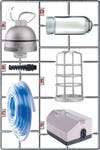
1. Decide what length of electrical cord and air tubing you want. Cut to appropriate length.
2. Wire the male plug onto the end of your cord.
3. Open the housing [A] of the vapor fixture. You should find two screws near the light socket on the upper part of the fixture. You will find the upper part (cap) and the base on which the light socket is mounted. Drill a hole in the base, through which you will run the air tube.
4. Screw the strain relief [B] to the cap, where you will find a threaded opening at the top.
5. Run both the air tube [C] and the electrical cord through the strain relief. Tie the electrical cord in a simple box knot—this will ensure no strain is placed directly on the connection between the socket leads and cable when the lamp is hung.
6. Strip the ends of the wires back and connect to the leads with wire nuts.
7. Feed the air tube through the new hole, again, leaving about 8 inches below the base.
8. Screw the base back to the cap. When doing this, you should ground the fixture by taking the green ground lead and twisting it around one of the screws that connects the cap to the base.
9. When you have reconnected the cap to the base, gently tighten down the strain relief via the nut on the strain relief. Don’t tighten too much or you will squeeze the air tube.
10. Screw the bulb of your choice into the socket.
11. Fill the glass globe [D] about one-third full with mineral oil. Remember that the light bulb will displace the mineral oil, so you don’t want too much. Even though the rubber seals work fairly well, if you overfill, a little mineral oil will seep out. For this reason, when you have the whole assembly completed, you want to keep the fixture upright and not on its side.
12. Screw the globe to the base, and then the aluminum grill [E].
13. Attach the air tube to the pump [F], plug the pump and the light in and, presto: bubble light!
You can hang it anywhere—a reflective surface such as a white wall picks up the reflections nicely. To hang, we generally use a quarter-inch eye bolt mounted in the ceiling with a toggler, though of course the method of hanging depends on what you plan to hang it from.
If you choose, you can put a switch or dimmer in line for the light. Do not put a dimmer on the air pump line, as this will burn out the pump.
Enjoy!