
_Kerstiaen_de_-_Fire_of_Troy.jpeg)
This article originally appeared in The Conversation.
Imagine a city that thrived for thousands of years, its streets alive with workshops, markets and the laughter of children, yet that is remembered for a single night of fire. That city is Troy.
Long before Homer’s epics immortalised its fall, Troy was a place of everyday life. Potters shaped jars and bowls destined to travel far beyond the settlement itself, moving through wide horizons of exchange and connection.
Bronze tools rang in busy workshops. Traders called across the marketplace and children chased one another along sun‑warmed footpaths. This was the real heartbeat of Troy – the story history has forgotten.
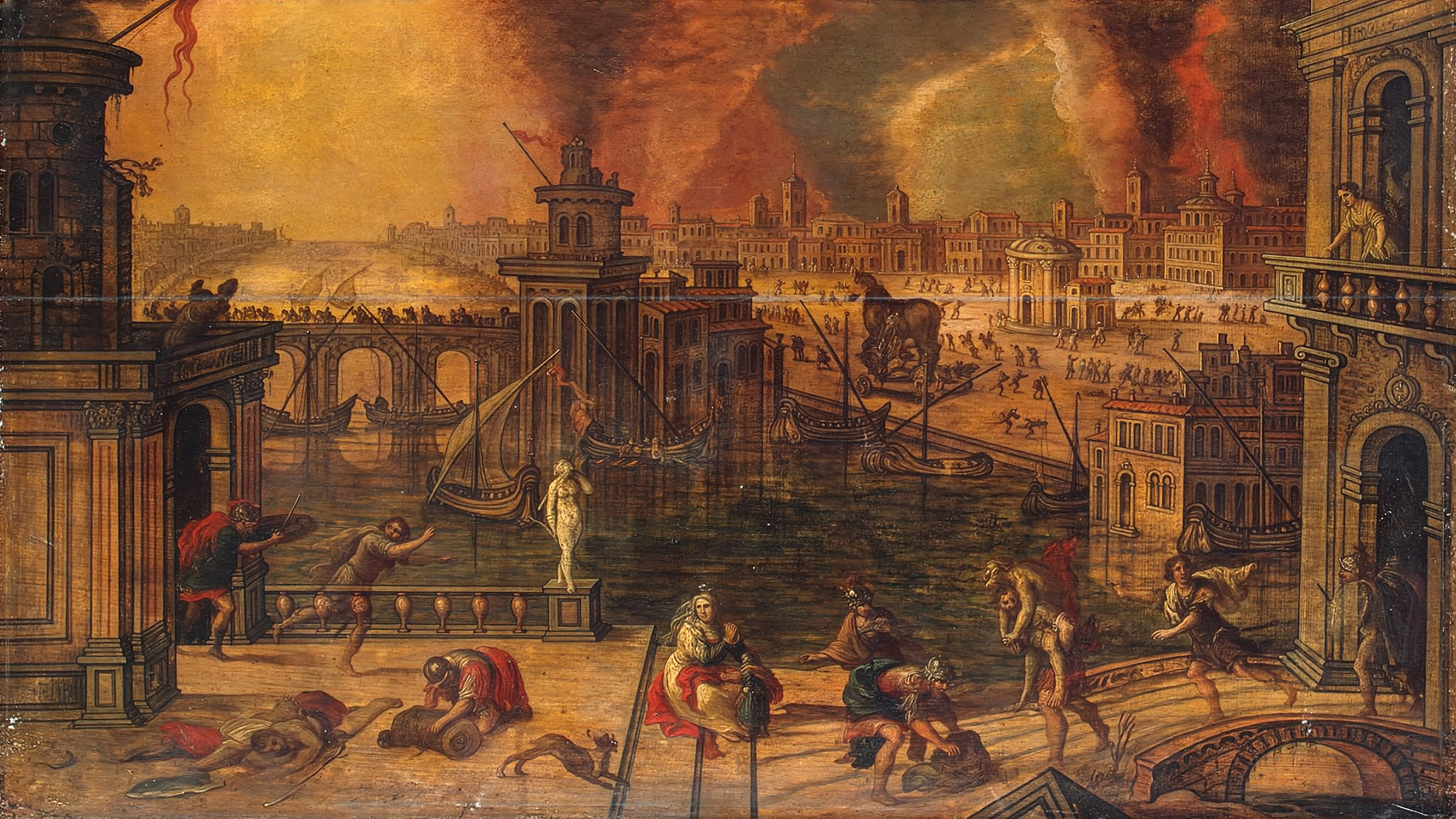
Homer’s late eighth‑century BC epic poems, the Iliad and the Odyssey, fixed powerful images in western cultural memory: heroes clashing, a wooden horse dragged through city gates, flames licking the night sky. Yet this dramatic ending hides a far longer, far more remarkable story: centuries of cooperation embedded in everyday social organisation. A story we might call the Trojan peace.
This selective memory is not unique to Troy. Across history, spectacular collapses dominate how we imagine the past: Rome burning in AD64, Carthage razed in 146BC and the Aztec capital Tenochtitlán falling in AD1521. Sudden catastrophe is vivid and memorable. The slow, fragile work of maintaining stability is easier to overlook.
The Trojan peace was not the absence of tension or inequality. It was the everyday ability to manage them without society breaking apart, the capacity to absorb pressure through routine cooperation rather than dramatic intervention.
When catastrophe outshines stability
Archaeology often speaks loudest when something goes catastrophically wrong. Fires preserve. Ruins cling to the soil like charcoal fingerprints. Peace, by contrast, leaves no single dramatic moment to anchor it.
Its traces survive in the ordinary: footpaths worn smooth by generations of feet; jars repaired, reused and handled for decades, some still bearing the drilled holes of ancient mending. These humble remnants form the true architecture of long‑term stability.
Troy is a textbook example. Archaeologists have identified nine major layers at the site, some of which are associated with substantial architectural reorganisation. But that isn’t evidence of destruction. Rather it simply reflects the everyday reality of a settlement’s history: building, use, maintenance or levelling, rebuilding and repetition.
Instead, I argue that Troy’s archaeological record reveals centuries of architectural continuity, stable coastal occupation and trade networks stretching from Mesopotamia to the Aegean and the Balkans – a geography of connection rather than conflict.
The only evidence for truly massive destruction that can be identified dates to around 2350BC. Against the broader archaeological backdrop, this stands out as a rare, fiery rupture – one dramatic episode within a much longer pattern of recovery and continuity.
Whether sparked by conflict, social unrest or an accident, it interrupted only briefly the long continuity of daily life – more than a thousand years before the events portrayed by the poet Homer in his tale of the Trojan war were supposed to have taken place.
But what actually held Troy together for so long? During the third and second millennia BC, Troy was a modest but highly connected coastal hub, thriving through exchange, craft specialisation, shared material traditions and the steady movement of ideas and goods.
The real drivers of Troy’s development were households, traders and craftspeople. Their lives depended on coordination and reciprocity: managing water and farmland, organising production, securing vital resources such as bronze and negotiating movement along the coast. In modern terms, peace was work, negotiated daily, maintained collectively and never guaranteed.
When crises arose, the community adapted. Labour was reorganised, resources redistributed, routines adjusted. Stability was restored not through force, but through collective problem solving embedded in everyday practice.
This was not a utopia. Troy’s stability was constrained by environmental limits, population pressure and finite resources. A successful trading season could bring prosperity; a failed harvest could strain systems quickly. Peace was never about eliminating conflict, but about absorbing pressure without collapse.
Archaeologically, this long-term balance appears as persistence: settlement layouts maintained across generations, skills refined and passed down, and gradual expansion from the citadel into what would later become the lower town. These developments depended on negotiation and cooperation, not conquest, revealing practical mechanisms of peace in the bronze age.
Why we remember the war
Stories favour rupture over routine. Homer’s Iliad was never a historical account of the bronze age, but a poetic reflection of heroism, morality, power and loss. The long, quiet centuries of cooperation before and after were too distant – and too subtle – to dramatise.
Modern archaeology has often followed the same gravitational pull. Excavations at Troy began with the explicit aim of locating the battlefield of the Trojan war. Even as scholarship moved on, the story of war continued to dominate the public imagination. War offers a clear narrative. Peace leaves behind complexity.
Reexamining Troy through the lens of peace shifts attention away from moments of destruction and towards centuries of continuity. Archaeology shows how communities without states, armies, or written law sustained stability through everyday practices of cooperation. What kept Troy going was not grand strategy, but the quiet work of living together, generation after generation.
The real miracle of Troy was not how it fell – but for how long it endured. Rethinking the cherished narrative of the Trojan war reminds us that lasting peace is built not in dramatic moments, but through the persistent, creative efforts of ordinary people.
