
Humanity’s relationship with fire is unique across all of evolutionary history. Learning to harness the power of flame is arguably our most monumental technological breakthrough as a species—one that allowed Homo sapiens to flourish across the planet.
But fire is not without its inherent dangers. A team of evolutionary biologists and medical experts now suggests its most painful consequences are so powerful that they actually reshaped our genetic makeup. In a study recently published in the journal BioEssays, researchers at Imperial College London argue that increased exposure to burns influenced our DNA enough to separate us from all other mammals and primates. While many of these adaptations help humans heal from many burns, they also make it harder to survive more serious encounters with fire.
“Burns are a uniquely human injury. No other species lives alongside high temperatures and the regular risk of burning in the way humans do,” study co-author Joshua Cuddihy of Imperial’s Department of Surgery and Cancer said in a statement.
Burns are classified as first, second, and third degree based on a wide range of severity. Lighter damage often heals easily on its own, but deeper burns destroy both surface and deeper tissues. Prolonged skin damage greatly increases risks of bacterial infections that can quickly turn lethal. According to the American Burn Association, there is an almost 18 percent mortality rate for hospital burn patients who require surgery and prolonged ventilation.
But while nearly every other animal on Earth works to avoid encountering fires, humans actively seek it out.
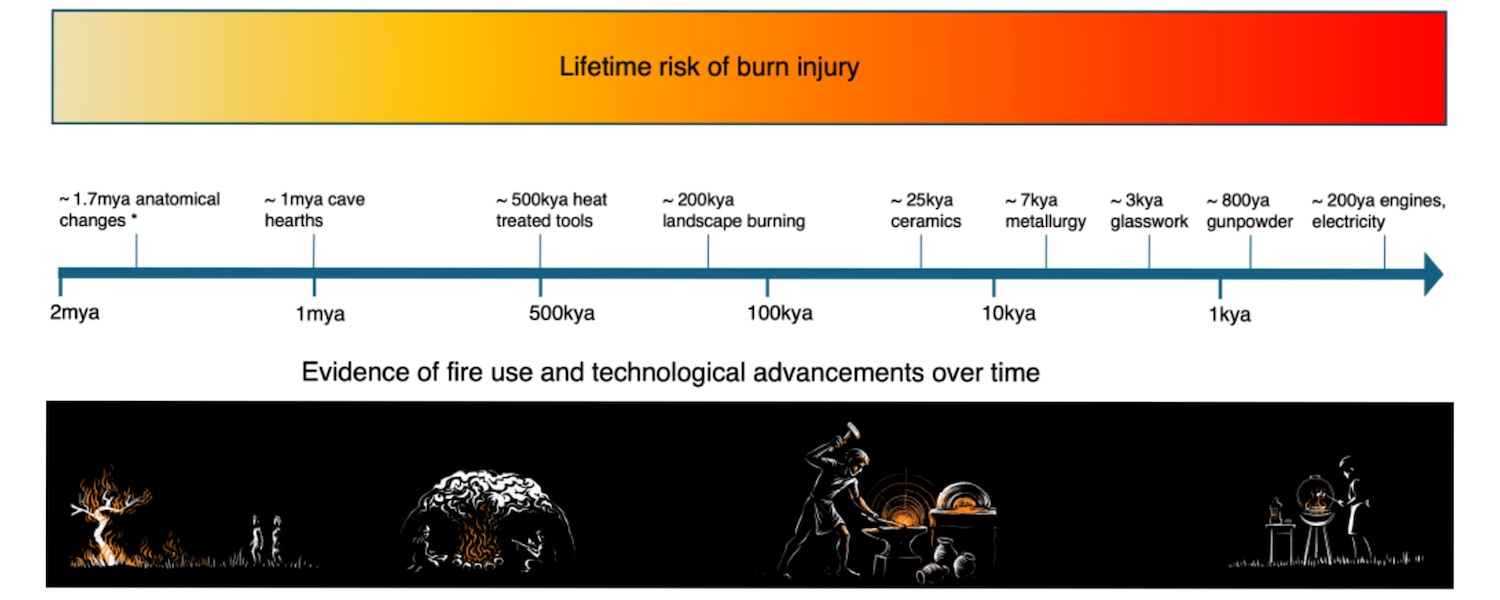
“The control of fire is deeply embedded in human life—from a preference for hot food and boiled liquids to the technologies that shape the modern world,” explained Cuddihy. “As a result, unlike any other species, most humans will burn themselves repeatedly over their lifetime, a pattern that likely extends back over a million years to our earliest use of fire.”
Cuddihy and his colleagues theorized that these regular encounters with fire—and their unwanted consequences—would inevitably have a profound effect on any species over tens of thousands of years. To investigate, the team compared genomic data across primates , and their findings appear to support their suspicions. Compared to our relatives, humans have genes that are linked to an enhanced evolution towards burn injury recovery. Specifically, these genes are tied to inflammation and immune system responses, as well as wound closure. These abilities would have been especially lifesaving prior to the development of antibiotics.
“Our research suggests that natural selection favoured traits that improved survival after smaller, more frequent burn injuries,” said Cuddihy.
At the same time, these developments offered certain trade-offs. The same healing processes that ensure recovery from lighter burns also can cause intense scarring, inflammation, and even organ failure in more severe cases. Cuddihy said this might explain why humans are still “particularly vulnerable” to worse burns.
Beyond a better understanding of humanity’s origins, the study could help direct our species’ future. Additional research may lead to new treatment approaches for burns as well as novel ways to deal with their complications. This evolutionary background may also explain why it has remained so difficult to translate burn studies involving animal models to humans.
“What makes this theory of burn selection so exciting to an evolutionary biologist is that it presents a new form of natural selection—one, moreover, that depends on culture,” added study co-author and evolutionary biologist Armand Leroi. “It is part of the story of what makes us human, and a part that we really did not have any inkling of before.”
