

In 1970, a single record would change history. It wasn’t the latest album from The Who or Rolling Stones, but the musical stylings of a pod of humpback whales (Megaptera novaeangliae). Songs of the Humpback Whale would go multi-platinum, whale songs were included on the Voyager Golden Record sent into space, and the Marine Mammal Protection Act was passed by 1972. However, listening in on the humpback whale goes back even further than the far out days of the 1970s.
While digitizing archives, a group of researchers and archivists at Woods Hole Oceanographic Institution (WHOI) in Massachusetts have now identified what may be the earliest preserved recording of a whale. The humpback song was captured on March 7, 1949, in the warm Atlantic waters near Bermuda. However, the team did not exactly know what they were hearing and the recording was never properly archived.
“Preserving data when it is created is an investment in the future of science,” Ashley Jester, Director of Research Data and Library Services at WHOI, said in a statement. “These recordings remind us why we collect data, even when we don’t immediately know what it means.”

Earliest preserved whale song discovered in the WHOI archives
Early eavesdropping
The recording was on a fragile yet well-preserved Gray Audograph. This device was first introduced in 1946 and was primarily used in offices to take dictation. It worked by etching audio onto thin plastic discs rather than magnetic tape.
When the etched recording was made, researchers aboard the R/V Atlantis were near Bermuda testing sonar systems, measuring explosive volumes, and conducting other acoustic experiments in partnership with the United States Office of Naval Research. Advances in audio technology were just beginning to allow recordings of underwater sound. The humpback sounds were likely recorded using the WHOI “suitcase,” an early experimental underwater acoustic recording system. Those soundscapes would prove how little we knew about what was making many of the ocean’s signature sounds.
At this time, WHOI scientist William Schevill and his mammalogist wife Barbara Lawrence, were laying the groundwork for the field of marine mammal bioacoustics. In 1949, they used an early hydrophone and a dictating machine to record beluga whales in eastern Canada’s Saguenay River. This beluga recording was the first that identified the sounds from a marine mammal in the wild. Many of these recordings from the late 1940s are poorly preserved and often inaccessible, as science could not reliably identify which ocean sounds were produced by marine mammals at the time.
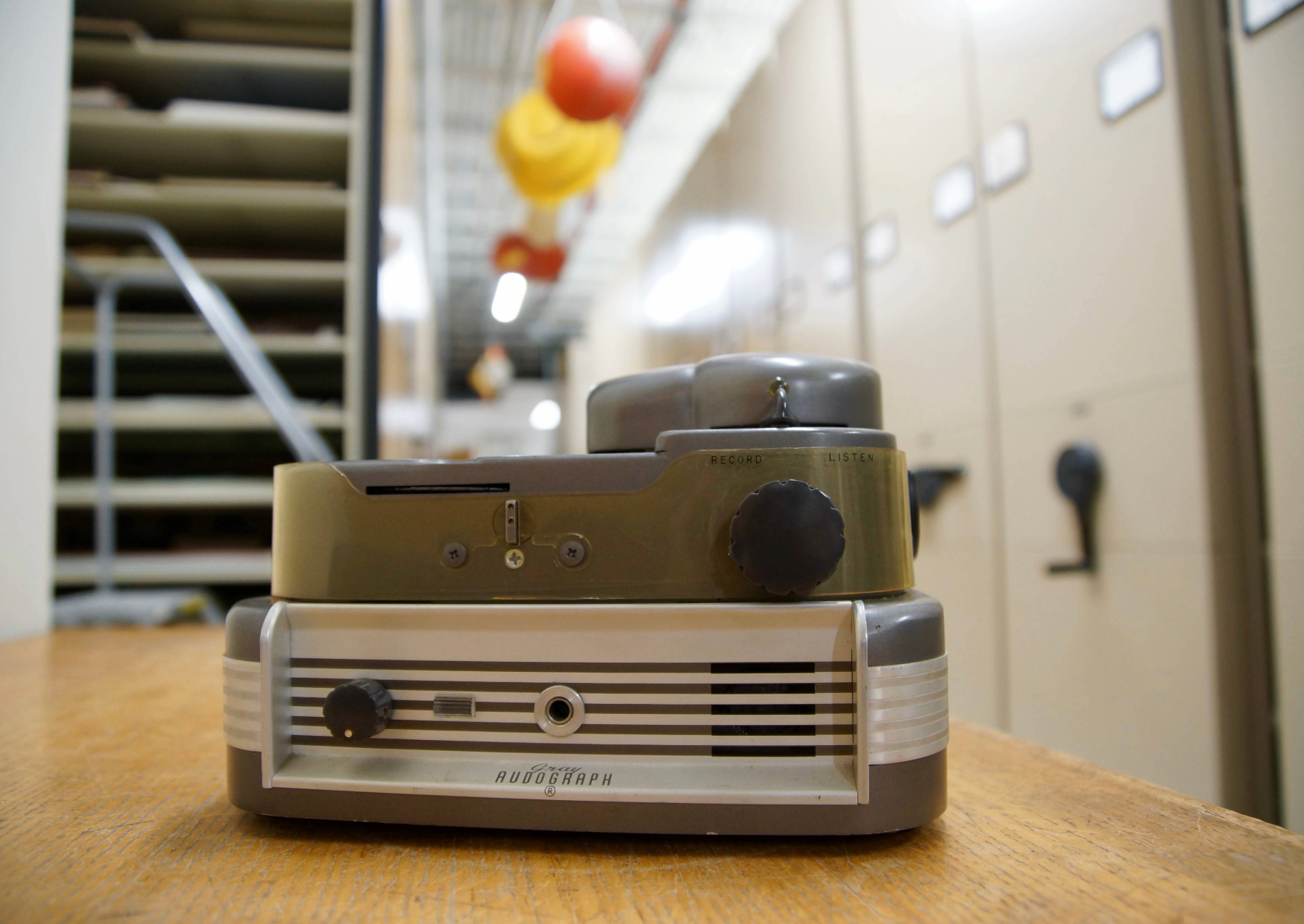
“Data from this time period simply don’t exist in most cases,” said Laela Sayigh, a marine bioacoustician and senior research specialist at WHOI. “The ocean is much louder now, with increases in both number and types of sound sources. This recording can provide insight into how humpback whale sounds have changed over time, as well as serving as a baseline for measuring how human activity shapes the ocean soundscape.”
Most of the recordings from this era have been lost as the tapes deteriorated. However, the surviving audograph discs show that the format may have been uniquely used for underwater sound. They are considered a rare and possibly singular example of preserved early ocean listening.
“These audograph discs survived because of their material and careful preservation,” said Jester. “WHOI’s audograph collection reflects a chain of close observation and curiosity—first by the scientists and engineers who recorded underwater sounds they couldn’t explain, and now by the librarians, archivists, and audio preservation experts who were determined to keep digging.”
From the audograph to robots
Unsurprisingly, a lot has changed in the almost 80 years since this recording was made. WHOI scientists now use passive acoustic buoys, sleek Slocum gliders, and autonomous hydrophones to monitor ocean acoustics. These technologies help acousticians gather datasets that are used to study marine life, track human impacts on the ocean, and understand long-term environmental changes.
Specifically, Robots4Whales program is focused on protecting marine mammals. It uses autonomous ocean robots equipped with the Digital Acoustic Monitoring Instrument (DMON), which can detect whales in real-time. DMONs carry a low-frequency detection and classification system that can identify various marine mammal calls by analyzing how the sound frequency changes over time. It then makes “pitch tracks” from spectrograms that allow the system to classify calls based on a known library of whale calls. The results are then sent back to shore via satellite in near-real time.
“Underwater sound recordings are a powerful tool for understanding and protecting vulnerable whale populations. By listening to the ocean, we can detect whales where they cannot easily be seen,” added Peter Tyack, a marine bioacoustician and emeritus research scholar at WHOI. “At the same time, these acoustic tools let us track how human activity, from shipping noise to industrial sounds, changes the ocean soundscape and affects the way whales communicate, navigate, and survive.”
