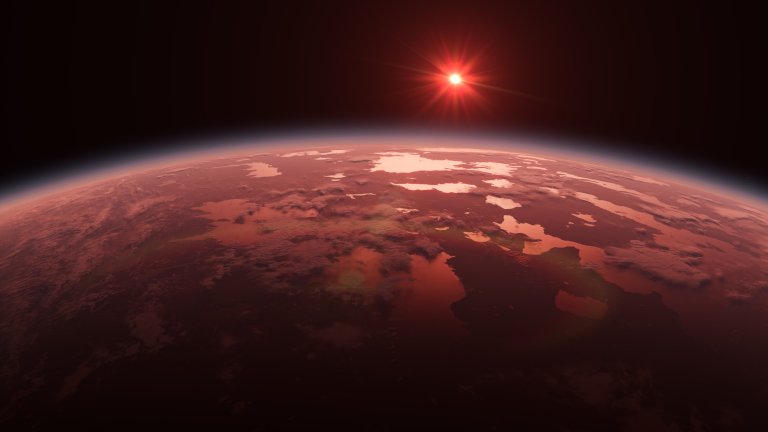
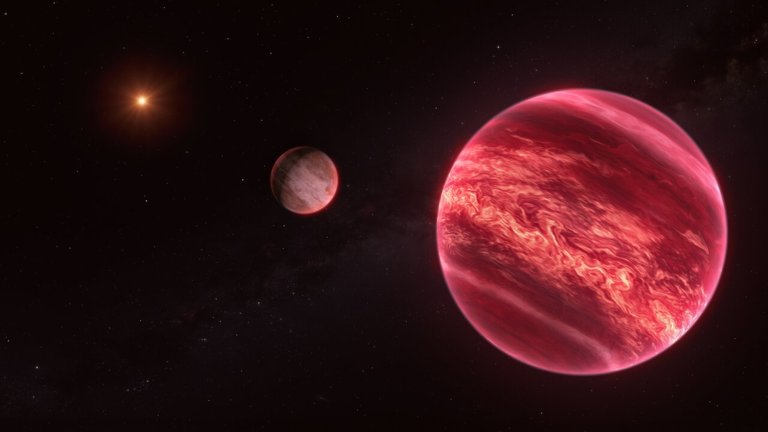
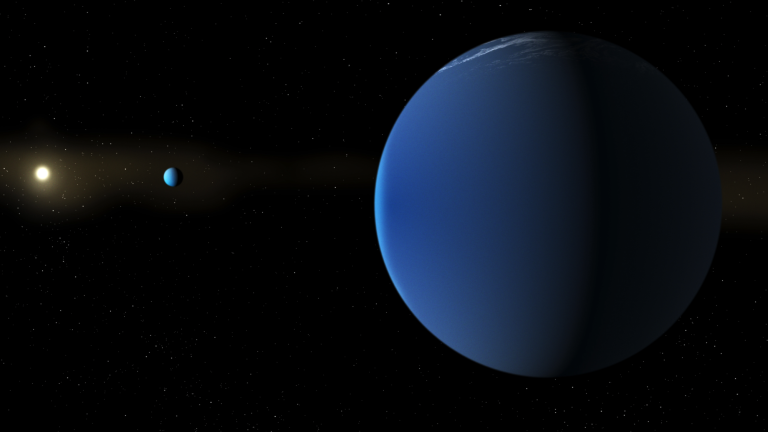
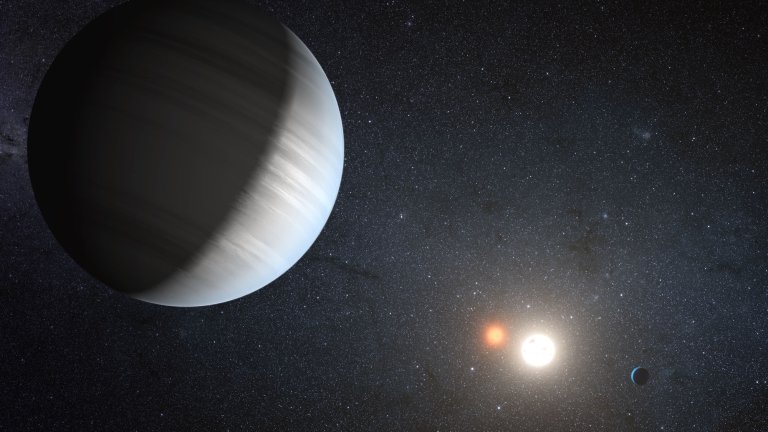
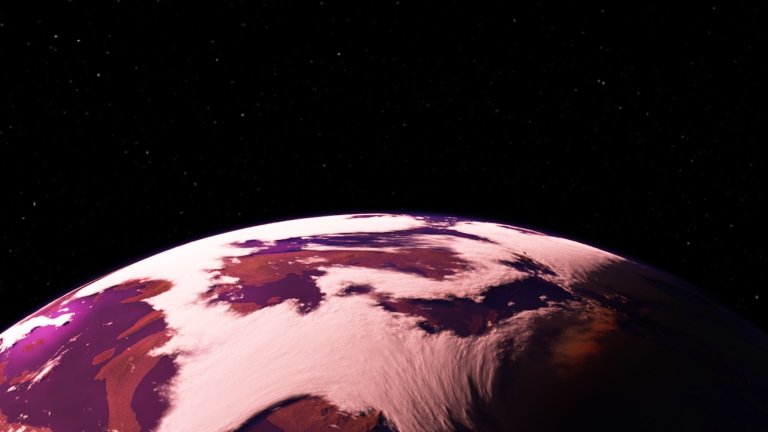
It’s lonely way out there in interplanetary space, lonelier still if you don’t have a star to call home. But this solitary life is all CFBDSIR2149 has ever known. Astronomers searching for the faint signatures of brown dwarf stars discovered this Jupiter-class giant hurtling through the cosmos with not star to orbit and nowhere in particular to be.
Discovered some 130 light-years from Earth, the planet is too dim to be viewed in the optical spectrum. But by analyzing its infrared emissions they were able to determine a few things about its chemical composition and its mass, which falls somewhere between four to seven times that of Jupiter. These kinds of starless planets aren’t unheard of, but they are relatively difficult to detect when they are out there on their own. Astronomers usually detect planets outside our solar system by either observing its transit of its star or measuring the wobble of the parent star caused by the orbiting planet’s gravitational pull.
Planets like lonely CFBDSIR2149 have no such star to draw observations from, and hence they are very difficult to spot--generally they either form far from their parent stars or are kicked out of their solar systems at a very young age. Which is a shame. A second analysis by the astronomers showed that CFBDSIR2149 has fallen in with a pack of young stars with which it is now traveling across the cosmos. No doubt that bunch is up to no good.
Five amazing, clean technologies that will set us free, in this month's energy-focused issue. Also: how to build a better bomb detector, the robotic toys that are raising your children, a human catapult, the world's smallest arcade, and much more.


Online Content Director: Suzanne LaBarre | Email
Senior Editor: Paul Adams | Email
Associate Editor: Dan Nosowitz | Email
Assistant Editor: Colin Lecher | Email
Assistant Editor: Rose Pastore | Email
Contributing Writers:
Kelsey D. Atherton | Email
Francie Diep | Email
Shaunacy Ferro | Email
this planet is very relatable.
Very interesting. I remember this Voyager episode where they landed on a rogue planet. Europe's astronomers and their ESO telescopes are surely making world headlines lately with all these discoveries. I also like their recent discovery of a planet at Alpha Centauri. This is something i have been reading about in science fiction stories for some time. And now the first planet is found there!:
http://www.nytimes.com/2012/10/17/science/space/new-planet-found-in-alpha-centauri.html?_r=0
And the first close (42 light years) super-earth found in the habitable zone of this nearby star. This could well be able to host life! And because it`s close enough future observations could analyze the atmosphere for existence of that potential life according to NASA. This is really setting new ground for planetary research and the search for alien life.
http://kepler.nasa.gov/news/nasakeplernews/index.cfm?fuseaction=ShowNews&NewsID=234
and at NASA;
http://kepler.nasa.gov/news/nasakeplernews/index.cfm?fuseaction=ShowNews&NewsID=234
And checking the ESO and ESA websites a lot of new instruments and a few new ground braking satellites will be launched/activated soon that will massively boost their search for planets further.
Upcoming `SPHERE` instrument: http://www.eso.org/sci/facilities/develop/instruments/sphere.html
Upcoming
Beyond HARPS: "New instruments are planned to further this search. These include a copy of HARPS to be installed on the Telescopio Nazionale Galileo in the Canary Islands, to survey stars in the northern sky. As well as a new and far more powerful planet-finder then HARPS called ESPRESSO, to be installed on ESO’s Very Large Telescope in 2016."
Remember HARPS is only installed on a 3.6 meter telescope so having a far more powerful instrument on a much larger telescope....
"Looking further into the future also the CODEX instrument on the European Extremely Large Telescope (E-ELT) will push this technique to a higher level."
Then we have ESO`s GAIA mission to be launched next year that will map 1 billion stars in our galaxy and which could reveal thousands of planets including planets around the closest stars. Quote: "hundreds of thousands of new celestial objects, such as extra-solar planets and failed stars called brown dwarfs can be found." "Within our own Solar System, Gaia should also observe hundreds of thousands of asteroids."
http://www.esa.int/esaSC/120377_index_0_m.html
Then we have more instruments and telescopes by ESO and also by ESA and NASA. Including James Webb and the E-ELT and other massive projects.
Planetary research is sure getting more interesting by the day. What a great time to be alive.
Oh sorry for the double NASA link. The article i was referring to is this:
http://www.spaceflightnow.com/news/n1211/08superearth/#.UKQZ4GfhVf1
The question is : Is this Nibiru heading towards us ?
Interesting, be chaos if one of them came barreling through our solar system. Another thing to note, I wounder if that planet is cold? I know Jupiter can create some of its own heat, this one would be more closer to a star then Jup. Or is it like a snow ball earth? One day we become a snow ball again, forget about co2.
PS: "No doubt that bunch is up to no good." lol
Velikovsky stock went up 5 points in after hours trading.
obi-wan: That's no planet Luke
I agree with Teotwawki...this is obviously the work of the Empire. If they can build Death Stars the size of gas giants now, then we're in trouble.
Zonoma Sekot
Freezing subtraction of energy. Pulling all I have away from me. Negative nothing from the warmth we see. Speeding steadily across the void. Dragging unrealized matter along with me. My only warmth comes from within. Tidal flexing donating friction for the kindred. Illogical sentience with bio-carbon radio communicating with no regard to spectrum using intensity and variation in frequency as it's device.
Melancholia