A fetus lives in a world of bubbles. In its earliest days, it’s shaped like one. Later, it floats in one—the squishy, enveloping amniotic sac. And eventually, if all goes well, the fetus releases one bubble of fluid, then another and another, like smoke signals, as it puckers and swallows and floats in the womb. It
was the bubbles that first convinced Hung-Ching Liu two years ago that a baby might actually be grown outside its mother’s uterus. Liu, the director of the Reproductive Endocrine Laboratory at Cornell University’s Center for Reproductive Medicine and Infertility in Manhattan, has become, almost accidentally, the nation’s premier womb-maker.
Beginning in 2001, her lab started growing sheets of human tissue composed of cells from
the endometrium, the lining of the uterus. This engineered tissue, which used starter cells donated by infertile patients, was meant to bolster the clinic’s in-vitro fertilization success. A layer of endometrial cells is, after all, the ideal platform on which to nurture an embryo, a medium almost as good as mom would have made.
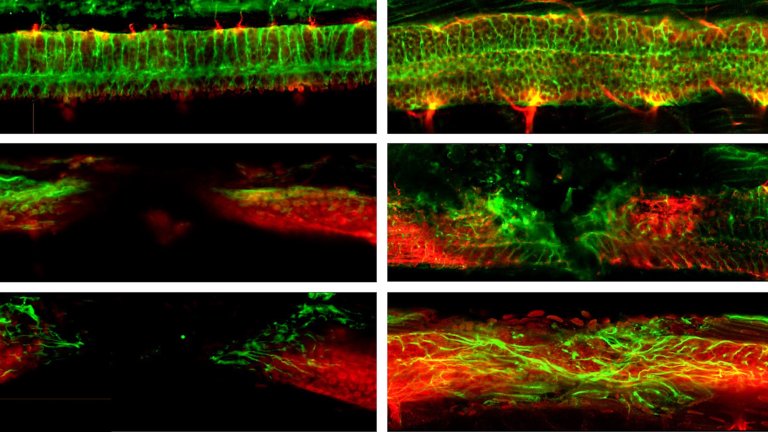
But the tissue, a single layer of cells stretched across a cell culture within a plastic petri dish, was gossamer-thin. “We’d hoped the embryos would implant on this tissue,” Liu says, “so we could learn more about the mechanisms of implantation. But they could not.” The growing embryos would break through the tissue, smack against the petri dish and, like a tree whose roots hit rock, die.
So Liu added layers, tissue atop tissue, until she had a three-dimensional model, essentially a freestanding uterus. Embryos could attach to this engineered tissue. They could burrow in, sending out shoots of blood vessel. They could take in nutrition and give out waste. They could divide, differentiate, and thrive.
Which led at last to the bubbles. In 2003, in an experiment that hasn’t received as much attention as one might expect—perhaps because Liu hasn’t published her results, due to her qualms about how those results will be received by politicians, activists and desperate would-be parents—a mouse embryo grew almost to full term in one of Liu’s artificial wombs. It moved. It breathed. It bubbled. “And not just one bubble,” Liu says. “We saw bubble, bubble, bubble.”
She may also have glimpsed, in that moment, the far-out future of human reproduction, vitreous and shifting. Thanks to her research and others’, man-made mouse wombs could be a reality within a decade—and a stepping stone to artificial human wombs. Eventually, these baby incubators could supplant natural ones. Conception could be clinical, and birth bloodless. Gestation could be detached from motherhood, and a fetus could be viable from the instant that sperm and egg fused.
Or not. Days after cheerfully percolating, Liu’s rodent fetus died, deformed and contorted, more seahorse than mouse, a developmental freak. The same thing happened to the next fetus she implanted, and the one after that. “Making babies is more complicated than we imagined,” Liu says. “And we knew going into this that making babies is very, very complicated.”
Stay up to date on the latest news of the future of science and technology from your iPhone with full articles, images and offline viewing
Featuring every article from the magazine and website, plus links from around the Web. Also see our PopSci DIY feed
Share links with friends, comment on stories and more
In our December issue, Popular Science names the 100 best innovations of the year: bombproof wallpaper, self-parking cars, the fastest helicopter, and 97 more. Plus inventor profiles and videos.
Check out the best of what's new here.
For years I had trouble conceiving a child. Finally put on fertility drugs, I was pregnant! Twice I lost my babies at 51/2 months. No reason was ever found. If I could have only transferred them to an artificial womb.....
I often thought about this at that time. You would think that with our technology today, it would already be in use. Instead, we use our technology for wars and eliminating the human race rather than creating life.
I finally conceived and had one son, with a miscarriage again after that. I always wanted at least a few children and thought that I would be a great mom and although it is not easy, Iam at least grateful to have had one.
My son is twenty now and has left home. I often long to have had more children as I now feel most useless as I wanted motherhood to be my chosen profession.
I do know that the development of an artificial womb would benefit many childless couples yearning to be parents....................I would like to see this developed in my lifetime.
This Technology is not meant to be used for humans. Not to offend anyone but this is risky not to mention unnatural and can lead to some very bad things. Just think what will start to happen when a teenager gets pregnant and abandons the baby in a womb. Also you should consider how this will psychologically affect your "baby" adoted kids often have problems imagine a child learning there machine born.
This technology is quite incredible. Although I hope it's never used main stream, it would be sweet for preventing stretch marks from forming during pregnancy!
- Amanda
http://www.stretch-marks.me/