The world's most powerful X-ray machines are a byproduct of high-energy physics. Synchrotron particle accelerators are helping shed light on some of the world's rarest fossils.
Last spring, a synchrotron helped scientists create a 3-D image of a 300 million year-old brain.
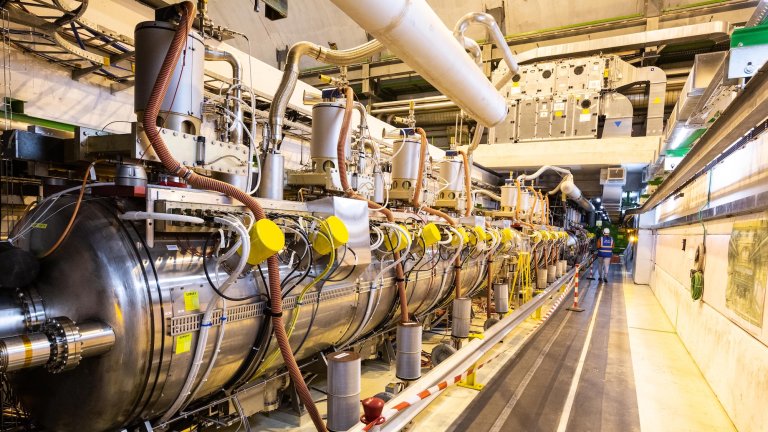
Synchrotrons use magnetic and electric fields to send electrons careening along a circular path; the process radiates X-rays that can be used to illuminate structures as small as atoms.
In March 2009, scientists from France and the U.S. announced they had X-rayed remnants of a brain inside an Iniopterygian fossil from Kansas. Iniopterygians are extinct relatives of modern ratfishes, also known as "ghost sharks" or chimaeras. Chimaeras are related to sharks and rays.
Like some of the best discoveries, it happened by accident. The team was using the synchrotron at the European Synchrotron Radiation Facility in Grenoble, France, to study the rare 3-D fossil (most are squashed flat), and the researchers noticed part of the fish's head was denser than normal. Using X-ray holotomography -- holographic mapping, basically -- they realized they were looking at fossilized brain tissue.
Along with studying fossils, accelerators can be used to search for priceless works of art. Some art historians believe Leonardo da Vinci's greatest painting is hidden inside a wall in Florence's city hall. Last fall, the New York Times reported on an Italian scientist's plans to beam neutrons through the wall in hopes of finding the lost painting.
I like the alchemy picture. Just hope that the never manage to turn anything into gold. It will demolish the already fragile economic structure.
| Written by Dimitri from Eat Healthier Foods |
Regarding the Fossils, how can the computer justify that what data it has decoded out is perfect and is viewable in good shape as it was at the past time.