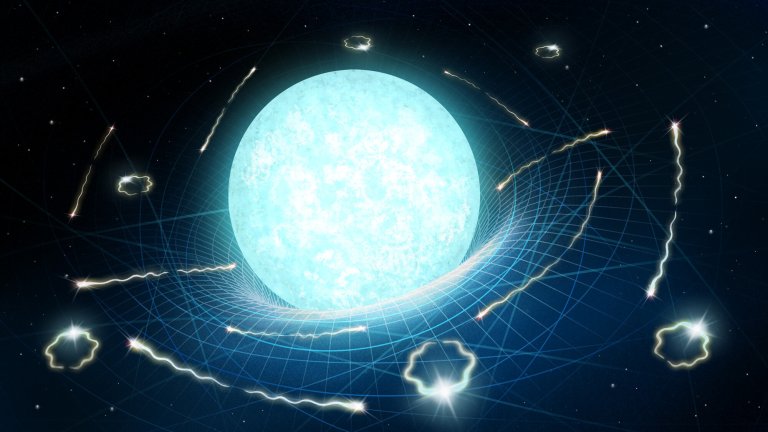
More than 30 years after Stephen Hawking predicted the existence of radiation emitted by black holes, physicists say they’ve finally observed the phenomenon for themselves, not in the heavens, but down here on Earth.
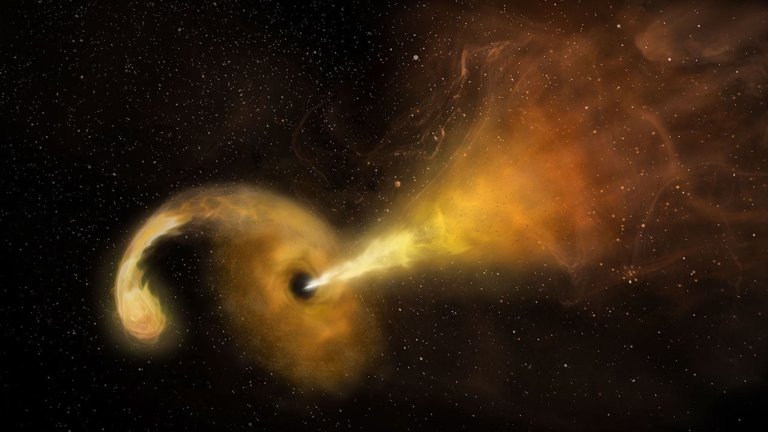
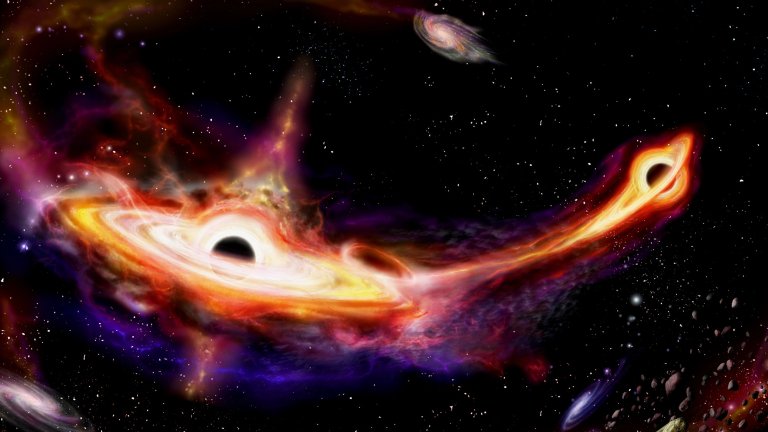
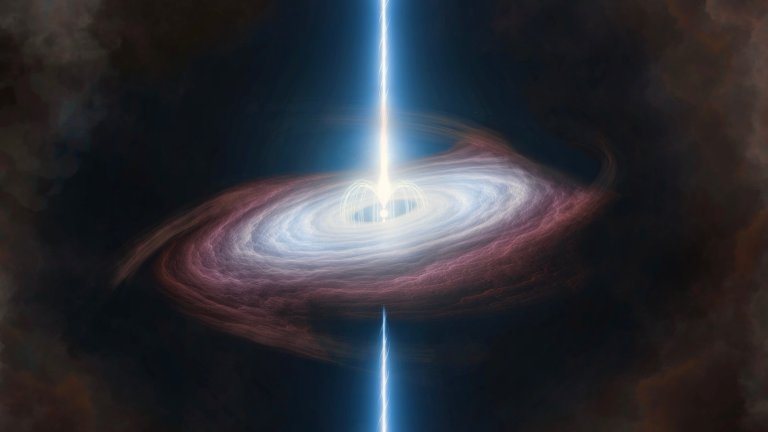
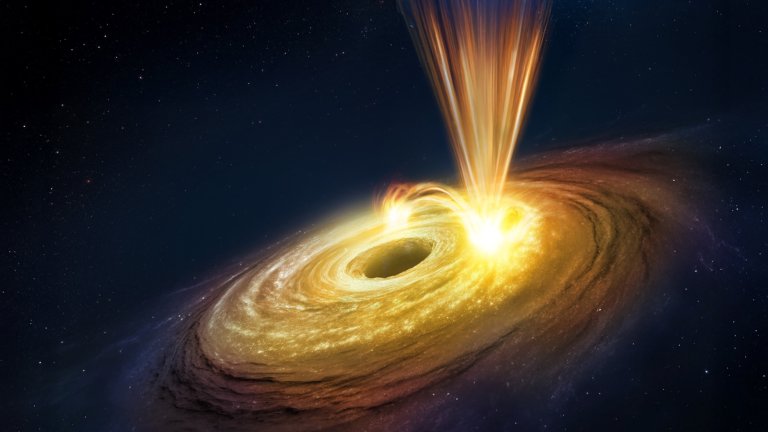
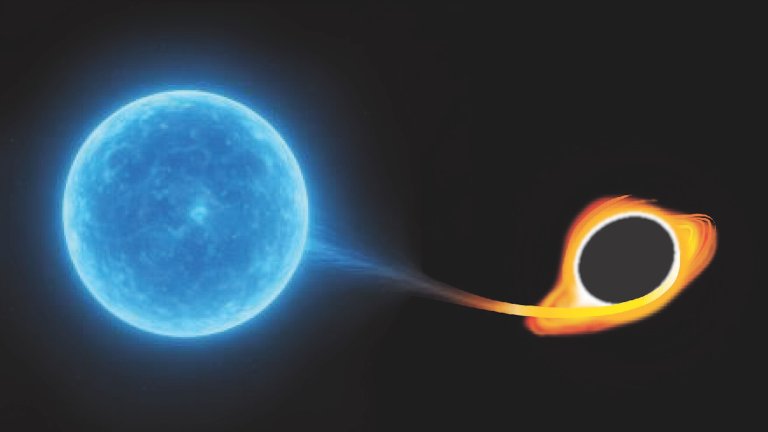
The universe is filled with particle/antiparticle pairs that form and almost immediately mutually annihilate, releasing their energy. Hawking radiation, as it’s known, occurs when these pairs form near the edge of a black hole. As the pair of particles crosses the black hole's event horizon, one member is sucked in, while the other is set free -- before they are able to annihilate each other. The observed effect is that the black hole is radiating particles, and actually losing mass.
Researchers at the University of Milan claim to have observed Hawking radiation in their lab by creating the inverse of a black hole – the aptly named white hole. Rather than all light being sucked inside, as happens with a black hole, in a white hole, light waves come to a complete halt, creating a different sort of event horizon.
Having formed this event horizon by sending an infrared laser pulse through fused silica, the researchers say they were able to rule out other phenomena and conclude that what they had observed was, in fact, Hawking radiation.
If this is true, the discovery could have huge implications for cosmology and many other fields. The only known way for black holes to evaporate is through Hawking radiation, so its effects on the eventual end of the universe could be huge.
Five amazing, clean technologies that will set us free, in this month's energy-focused issue. Also: how to build a better bomb detector, the robotic toys that are raising your children, a human catapult, the world's smallest arcade, and much more.


Online Content Director: Suzanne LaBarre | Email
Senior Editor: Paul Adams | Email
Associate Editor: Dan Nosowitz | Email
Assistant Editor: Colin Lecher | Email
Assistant Editor: Rose Pastore | Email
Contributing Writers:
Kelsey D. Atherton | Email
Francie Diep | Email
Shaunacy Ferro | Email
So we can see black holes now?
*Feels relieved.*
So its the opposite of a black hole....so it pushes light and everything OUT? so it reverses the push of gravity? Wouldn't this have some other crazy awesome applications like say hovercrafts? I am probably a complete retard but wouldn't the opposite effects of a black hole mainly a black hole being suck everything in without mercy being this thing pushing everything out with out mercy be kind awesomely applicable to alot of things.
Sadly, a white hole is not really the opposite of a black hole. No hovercraft for you! hehe
wat.
someone explain in terms applicable to a CPA sitting in his office.
Boooooo!!! I was promised hovercraft back in the '80s!!!! I WANT MY HOVER CRAFTS AND FLYING CARS!!!!
@Delkomatic it would be breaking news all over the world if they created the exact polar opposite of a black whole, they only simulated the opposite effects that a black hole has on light.
What's next? Back hole, While hole, B**T hole..?
Interesting indeed.
what they did in thier lab is a simulation, it is not a black hole singularity, it is not a white hole singularity, it is not any kind of singularity.
I would not consider a computer simulation of me to be me, nor would I consider this to be anyting more then an interesting phenominon most likely to have no relation to singularities.
for that matter so far every experiment I have seen that claims to have brought a photon to a standstill looks more like the optical effect of a strobe light on falling water makeing he water seem to stop and foat in mid air, are the photons really stopped motionless? or is it some kind or scientific illusion
When this story went from the lab to the popular press, a lot must have been lost in translation. "...light waves come to a complete halt, creating a different sort of event horizon..." -- they stop at the event horizon or inside the white hole? How would particle pairs be separated here? How do things get drawn in, or pushed out? . . . ???
@wsulek, I think what they mean is that like the stories they broke about slowing down and even stopping light with certain setup of supercooled atoms. Photon/anti photon pairs are created by quantum mechanics, in the split instant between creation and annihilation one moves into the mass and stops moving the other moves away. This mimics the idea of hawking radiation.
What I'm not clear on is why the mass would be lost from a black hole and not gained? Unless the energy of creation is being solely derived from the black hole and not outside the event horizen. If some does come from outside the event horizen the total energy/mass would be gained by the black hole.
you get interesting stuff if u google white hole
@Mycellium
I'm also slightly confused at why the black hole would lose mass. I understand that the 2 mirror particles that are created are matter and anti-matter. So if they are created on the event horizon and the antimatter particle falls into the black hole, it will destroy 1 particle and therefore lower the mass. But similarly, if the antimatter flies out and the normal matter particle falls into the black hole, the black hole should gain mass. So if both of these are happening, the mass of the black hole should remain the same. Maybe there is something in the physics that causes more antimatter particles to fall into the black hole than normal matter particles?
@ Chillspace
A black hole would gain or lose mass depending on which type of particle would fall into the black hole more often. As of yet, I assume the pattern for matter/antimatter particle formation is random.
EDIT: But the radiation we see from a black hole is matter, because the antimatter would quickly annihilate with another particle of matter. So, I assume that the denser the radiation is, the more antimatter fell into the black hole, because if equal numbers of both matter and antimatter particles fell into the black hole, it should be a zero-sum scenario, because there would also be equal number of both outside the black hole, which, I think (in theory), should completely annihilate each other, leaving no radiation. Thus, I see it as safe to propose that black holes lose mass due to Hawking radiation.
It is not matter and anti-matter pairs, which are both positive in mass & energy, just opposite in polarity.
it is Positive (anti)matter and negative matter / energy pairs. Particles with a mass/energy value of LESS than zero.
Presumable, the math shows the negative particles are more likely to be drawn in.
Anti matter would still increase the size of the black hole because even after annihilating with a matter partical, the mass value of the energy of both is left behind.
Side note: Negative mass is one of the potential requirements for FTL & time travel, via worm holes.
What it means is that the theory of "something can escape from a black hole" is true, not everything that goes near a black hole inevitably goes into it, Hawking Radiation is that; something escaping from a black hole. This means adjustments can be made to equations considering the life span, structure and "end" of the universe. OK?