
We may earn revenue from the products available on this page and participate in affiliate programs. Learn more ›
President Obama’s 2012 budget request specifically focuses on exascale computing, the first time the word has appeared in the federal books.
Under Obama’s budget request, the Department of Energy would get $126 million for exascale development, with about $91 million going to DOE’s Office of Science and $36 million for the National Nuclear Security Administration, according to a breakdown by Computerworld. In 2011, the DOE had budgeted about $24 million for “extreme scale” computing, as opposed to exascale.
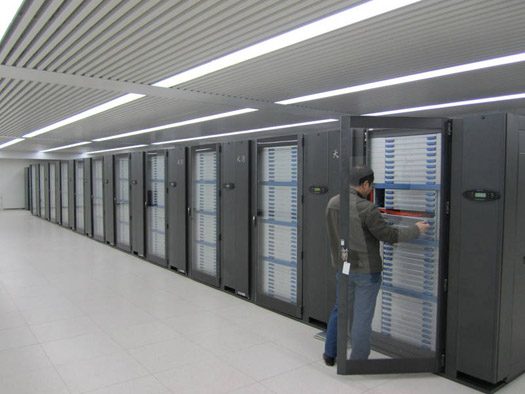
Today, the world’s fastest computer is China’s Tianhe-1A, pictured above, which performs 2.5 petaflops via 7,168 GPUs and 14,336 CPUs. A petaflop is one thousand trillion (one quadrillion) operations per second.
Not to be outdone, DOE is getting a new 10-petaflop system called Mira, which will be be twice as fast as today’s fastest supercomputer. IBM said Mira is a stepping stone toward exascale computing. An exaflop is 1,000 times faster than a petaflop, and equates to quintillion operations per second, or a million trillion calculations.
An exascale system is estimated to happen in the 2018-2020 time frame, solving questions that have remained beyond our reach, like understanding regional climate change and designing safe nuclear reactors.
