
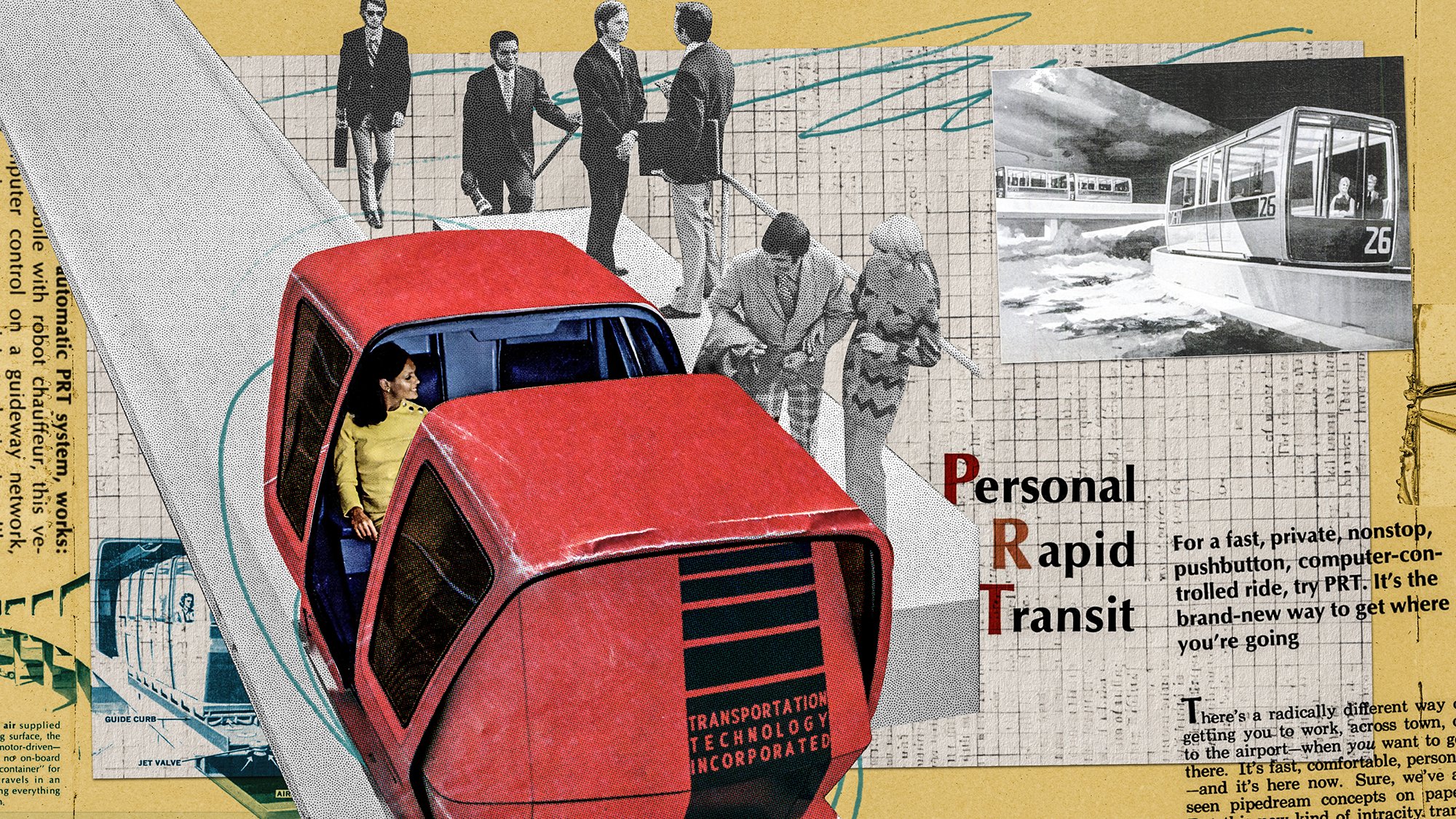
In 1953, Donn Fichter, a graduate student at Northwestern University in Chicago, had a simple transportation idea: What if you tipped an elevator on its side, enabling it to run horizontally, and set it loose in a city? Unlike conventional urban mass transit, elevators are responsive to individuals, callable with the push of a button, and not subject to schedules.
After completing his dissertation in 1958, “Automated Urban Circulation,” Fichter spent years turning that idea into a complete transit system design he called Veyar. At its core, Veyar would offer small automated cars running on lightweight guideways. The electric cars would be available at any hour and travel directly from origin to destination without stops, schedules, or drivers. “Personalized transit,” he called it, in which each car “is a self-operating vehicle which can go unattended.” To keep infrastructure construction costs low, he explained, “they have to utilize existing public right of way: the streets.” Fichter self-published the design in 1964, calling it “Individualized Automatic Transit and the City.”
For 60 years, personalized transit systems like Veyar gained support from generation after generation of transportation engineers, but none were ever built. That’s because personal rapid transit systems demanded infrastructure cities couldn’t afford and automation technology that didn’t yet exist. What finally solved both problems wasn’t a transit agency or a federal program, but rather the autonomous vehicle industry. Companies like Zoox and Waymo built Fichter’s system more practically, starting with the automation and letting existing streets serve as the guideways.
The origins of personal rapid transit
Donn Fichter was born in Minneapolis in 1926. After serving in the Army during World War II, he earned engineering degrees from Brown and Northwestern. He was the first serious advocate of what urban planners would eventually call personal rapid transit, or PRT—a vision of on-demand, automated, point-to-point city travel.
Fichter conceived Veyar at a time when traffic choked American cities. Cars gave riders individual freedom at the expense of gridlock. Buses, subways, and elevated rails offered more efficiency but subjected riders to fixed schedules and routes.
What no one had yet built, Fichter argued, was a third system that combined the automobile’s spontaneity and the subway’s separation from traffic, available to anyone at any hour without a driver, a schedule, or a transfer. Gridlock notwithstanding, the environmental stakes, he believed, made the solution urgent.
Even before the first Earth Day was celebrated in 1970, Fichter foresaw the “ecological imperative” to reduce our dependence on private automobiles. He made this case explicitly in a 1968 PRT planning paper, “Small Car Automatic Transit.” Fichter claimed that small, electrically-propelled, autonomous cars running on guideways would mean cleaner air, quieter streets, and cities less congested with the machinery of driving and parking.
Personal rapid transit systems catch on in the 1970s
“Your car is waiting,” wrote journalist Paul Wahl in a 1971 Popular Science feature on personal rapid transit systems. “On entering the car, you push a button to select your destination, then take a seat. The cabin is roomy, automobile-like in accommodations.”
Wahl went on to describe how a PRT trip might unfold: “The automatic vehicle moves away on the station spur, accelerating until it enters the stream of traffic on the guideway.” The car would then switch off the guideway at its destination spur, “with a central computer doing the driving.”
The experience Wahl described was precisely what Fichter’s Veyar system proposed. Small electric cars—sized for just a few riders—would run on slender elevated tramways threaded along existing streets. Stations every few blocks would keep cars queued and ready. Just like an elevator, a rider would board, close the door, press a button, and go. The car would merge into mainline traffic automatically, travel nonstop to the destination, and pull itself into the arrival station without further instruction. Then it would wait, callable for whoever needed it next. A computer would control the entire network. What the elevator had done for the skyscraper, Veyar would do for the city.
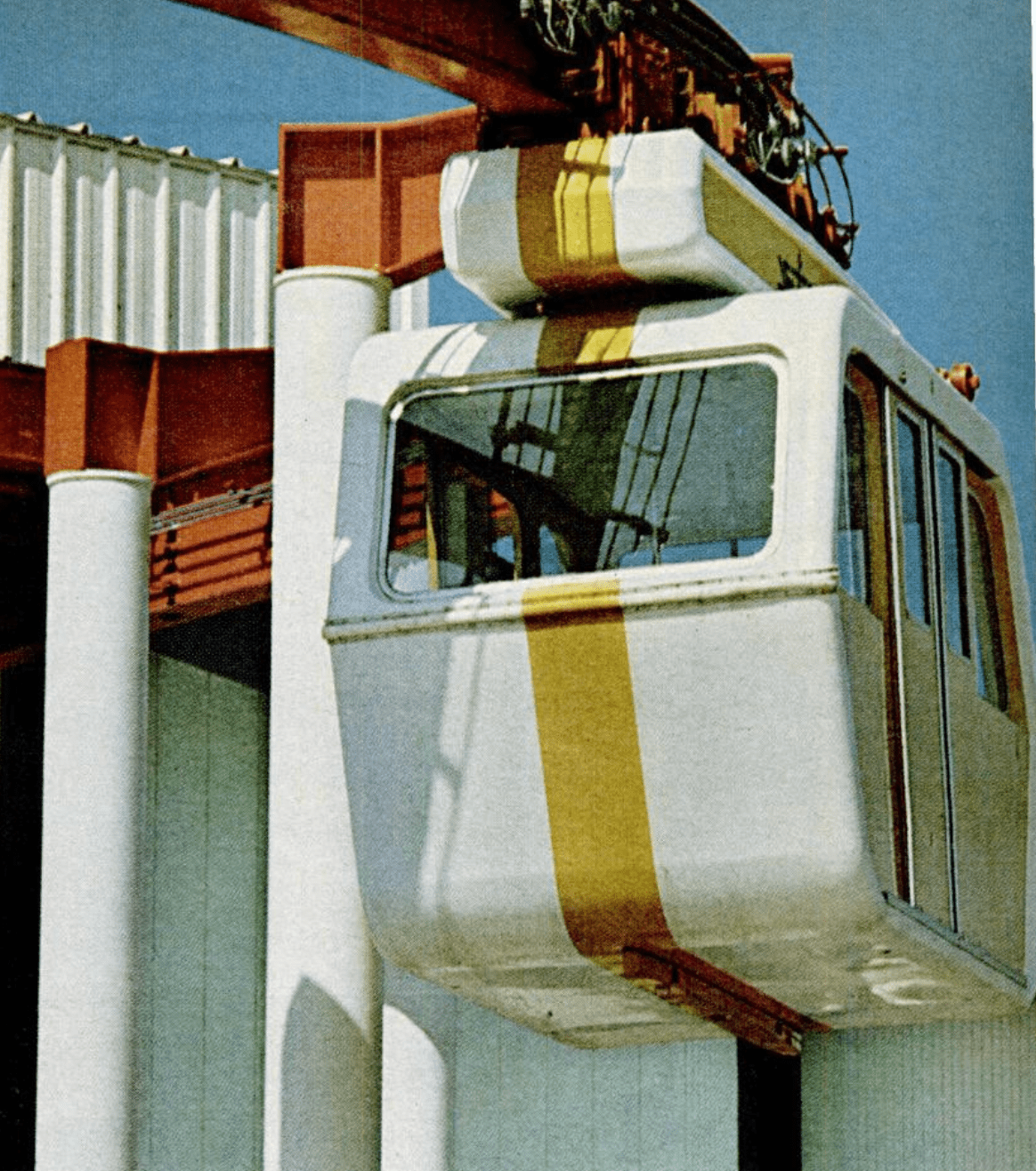
passenger cars, traveling at 15 mph, cover the three quarter mile distance between the satellite parking lot and the Braniff boarding area in under four minutes. Image: Popular Science, November 1971 issue
The federal bet on personal rapid transit begins with the Nixon administration
By the early 1970s, the idea attracted serious attention. As Wahl wrote, experts were “banking on it to relieve our metropolitan areas from the twin stranglehold of pollution and congestion.” The federal government committed $6 million to build and demonstrate four competing PRT systems at Transpo72, an international transportation exposition held at Washington, D.C.’s Dulles International Airport in 1972. One of those prototypes was destined for a small college town in West Virginia, where West Virginia University needed a better way to move students between its multiple campuses and downtown Morgantown, West Virginia.
At the same time, planners in Minnesota began drawing up blueprints for a city to be built from scratch on 50,000 acres of rural land—a place called the Minnesota Experimental City, or MXC. The new city was the brainchild of Athelstan Spilhaus, a polymath University of Minnesota dean who had already helped design the 1962 Seattle World’s Fair and co-invented submarine warfare instruments. Spilhaus wanted MXC to be a living laboratory, not a utopia, and personal rapid transit was to be its arteries.
The federal commitment to PRT in the early 1970s produced a brief but remarkable flurry of competing designs. Engineers at aerospace firms, university labs, and automotive companies developed more than two dozen distinct guideway systems—Monocab, TTI, Dashaveyor, Cabinentaxi, Aramis, staRRcar, and others—each with its own switching designs, propulsion method, and structural approach. No two were compatible. The proliferation reflected a significant engineering problem—no one had cracked the code on the automated control systems required to make PRT work. Wahl called this control system the “super-robot trainmaster.”
“The heart of any personal rapid transit system,” Wahl wrote, “is the central computer facility that runs things efficiently and economically, making it practical.” He described a fully autonomous system that not only controls all the cars, “but also handles vehicle distribution and scheduling.” In fact, the central computer would manage just about everything, he explained, leaving little to human operators who are prone to make mistakes. Unfortunately, at the time, such sophisticated automation technology did not exist.
Besides lacking the necessary automation, PRT systems demanded infrastructure cities couldn’t afford to build at scale, even with available federal funding. A network of lightweight guideways would need to be built above city streets, with stations every few blocks, for PRT to deliver on its promise. By the mid-1970s, federal funding had dried up, Transpo72 had come and gone without producing a single municipal contract, the Minnesota Experimental City project had been canceled, and PRT’s moment of official enthusiasm had passed—with one notable exception.
America’s first and only personal rapid transit system
The West Virginia University Personal Rapid Transit system, which opened in Morgantown in 1975, became the closest thing to a guideway-based automated transit system ever built for regular urban use in the United States. It connects the university’s three campuses and the downtown central business district via 8.7 miles of dedicated guideway and five stations, carrying riders in small electric vehicles on demand, without stops between origin and destination. And most importantly: The system works.
Since its debut in 1975 WVU’s personal rapid transit system has logged more than 100 million trips, using electric vehicles that carry roughly 12,000 passengers a day during the school year. Despite its impressive track record, Morgantown also illustrated the trap at the heart of every PRT proposal. The project ran wildly over budget—partly because engineers rushed to meet a politically mandated deadline tied to the Nixon administration—and the cost per rider was never remotely competitive with conventional mass transit.

More fundamentally, Morgantown succeeded because it was built for a specific, constrained geography: a university town with four fixed nodes and a captive ridership. That configuration bears almost no resemblance to the open-city, go-anywhere network with stops every few blocks that Fichter had imagined, and it offers no blueprint for replication in a traditional urban setting. For a major city to build what Fichter described, it would have had to retrofit onto automobile-centric city streets dozens or even hundreds of miles of elevated guideway. It’s something no city has ever tried.
Driverless cars: PRT without the tracks?
And yet, six decades after Donn Fichter sketched his first Veyar pods, you can summon one of their descendants with your phone. Today, Waymo operates driverless electric vehicles across six major American cities, completing nearly half a million rides per week in 2025.
Amazon’s Zoox has deployed a uniquely designed robotaxi—no steering wheel, no pedals, carriage seating for four, bidirectional so it never needs to turn around—on the streets of San Francisco and Las Vegas. Between them and a growing field of competitors, the age of individualized automated transit has arrived—just not as anyone planned.
But do robotaxis really fit Fichter’s vision? A car can be summoned with the push of a button. It travels straight from origin to destination without stops. It is “a self-operating vehicle which can go unattended” as Fichter described Veyar in 1964.
Related 'A Century in Motion' Stories
In 1934, Chrysler bet big on teardrop-shaped cars
In 1871, cities almost got moving sidewalks. Why are we still waiting?
During WWI, a daredevil pilot helped invent the first ‘drones’
In 1916, hybrid cars could’ve changed history. But Ford wouldn’t allow it.
A century ago, suspended monorails were serious mass-transit contenders
Fichter would recognize robotaxis instantly as personalized transit. What’s missing is the “rapid” promise of a PRT system. Driverless taxis are subject to the same traffic-choked congestion that has plagued American cities for nearly a century.
In his 1964 specifications, Fichter worried that driverless vehicles “could not expect to share the streets with other motor vehicles,” which is why he proposed elevated guideways. Today, his concern seems prescient.
Waymo has faced recalls for vehicles driving into flooded roadways, investigations into repeated failures to yield to school buses, incidents where robotaxis blocked emergency responders at active crime scenes, and acted as getaway cars. A citywide power outage in San Francisco in 2025 triggered a wave of vehicles simultaneously requesting remote confirmation checks, snarling traffic for hours. The riding experience remains geofenced to specific neighborhoods in specific cities.
When issues arise, the system relies on remote human operators—Waymo employs about 70, half of them based in the Philippines—to step in. But these are engineering problems being worked through, not evidence the concept is broken. Arguably, city streets become the guideways when they are filled almost exclusively with robocars, which would complete Fichter’s vision in spirit, if not in intent.
But robotaxis were built as a for-profit product, not as civic infrastructure. They are privately owned, unevenly distributed in cities, expensive on a per-ride basis, and poorly regulated across most of the United States.
What Fichter envisioned was a public system woven into the city—the way elevators are woven into buildings—affordable to everyone, and available at the push of a button. Waymo, Zoox, and their competitors have built something remarkable. But whether it someday resembles the civic infrastructure Fichter had in mind, or remains just another profit-based enterprise siphoning riders and revenue from transit agencies, is ultimately a policy question—one that cities and regulators have so far shown little urgency to answer.
In A Century in Motion, Popular Science revisits fascinating transportation stories from our archives, from hybrid cars to moving sidewalks, and explores how these inventions are re-emerging today in surprising ways.
