North Korea has basically zero chance of hitting anyone but themselves with a nuke. But if they did manage to launch a missile, what technology do we have to stop it?
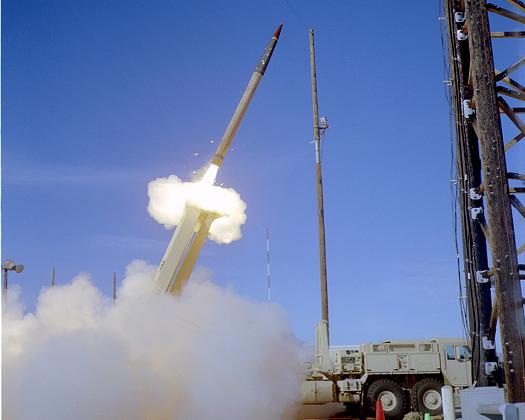
THAAD interceptor missile
THAAD interceptor missile U.S. Missile Defense Agency

In response to questions about North Korea's latest threats to nuke the U.S., White House Press Secretary Jay Carney said yesterday: "I can tell you that the United States is fully capable of defending against any North Korean ballistic missile attack."

This is the most definitive statement of U.S. missile defense capability in recent memory. Earlier claims have included vague statements, promises of capability, and, at most, guesses in the 90 percent range. Missile defense is the most controversial part of nuclear strategy, and the one most dependent on successful technology.

What anti-missile technology do we have?

1. Aegis Ballistic Missile Defense

Currently only carried by naval vessels, Aegis is a missile that intercepts enemy missiles at short and medium range, or 650 to 3,100 miles. (There's a land-based version in development.) Ideally, the U.S. has 16 ships equipped with Aegis deployed in the Pacific at all times, but recent budget cuts mean that currently might not be the case.

Caveats: While Aegis has done well in some tests, its systems have yet to be challenged by a missile than can release decoys. The Bulletin of Atomic Scientists warns that without successful decoy testing, the system should not be treated as effective in the real world.

2. Ground Based Interceptor

The Ground Based Interceptor is designed to blow up an enemy missile outside the atmosphere by slamming into it. These are currently kept in silos in California and Alaska.

Caveats: GBI is highly dependent on precise targeting information; if the interceptor doesn't hit the warhead exactly, and instead passes through the rocket part of the missile, it's likely that the warhead could still continue along its original trajectory. Also, counter-measures to defeat GBIs have already been demonstrated by both Iran and North Korea.

3. PATRIOT Advanced Capability Missiles

Used primarily for taking out aircraft and cruise missiles, PAC-3 missiles are designed to intercept an enemy attack in the last stage of its flight.

Caveats: As reported in the Japan Times, "The PAC-3 missiles... will be ineffective unless an object flies directly within their 20-km range and in a straight trajectory." PAC-3 Missiles also have a history of failures in testing.

4. Terminal High Altitude Area Defense

Mounted on what looks like a souped-up flatbed truck, THAAD fires several missiles designed to slam into enemy missiles at high altitude. Works best against "asymmetric ballistic missile threats," which is military speak for poorly made or improvised rockets and missiles.

Caveats: After a long and troubled history during the 1990s, the THAAD program seems to be one of the more competent parts of U.S. missile defense. While not primarily designed to target intercontinental ballistic missiles, it is not inherently useless against them.

Will any of this technology actually stop a U.S.-bound missile?

First, most missile defense testing is still ongoing, and none of the weapons above are yet in ideal condition. Many definitions of a successful test don't include countermeasures. GBIs have been tested as recently as January, suggesting that the full capabilities promised have yet to be realized.

Second, these components are only part of the U.S. missile defense system. I detailed the actual things we shoot at missiles here, because those are the exciting part, but they're all part of a broader system of electronic communication and sensors designed to provide a more comprehensive defense than any one interceptor missile alone. The system is greater than the sum of it's flawed parts. What isn't known is if the whole system can accommodate the limitations of imperfect parts.

Finally, it's worth understanding the threat. North Korea doesn't have a great record with missile launches, and while their technology has improved, it's unrealistic to assume it has improved enough to carry the extremely heavy atomic bomb they've built. (North Korea right now cannot make a nuclear weapon small enough to fit onto a missile.) Also, North Korea has an almost sixty year history of provocations that haven't resulted in renewed war. (Fun technicality: the Korean war, though halted with an armistice in 1953, has yet to formally end. This matters quite a bit.)

Failing all of the above, The Daily Show's Wyatt Cenac has a novel suggestion: Deploy 1992-93 Chicago Bulls in major cities so that Kim Jong-Un won't attack them.

31 Comments

Let's not forget the military satellites we have in orbit that can shoot down missiles. Of course, no one will ever admit to owning one though.

We have way more ways than just 5 to shoot down a nuke!
Even if they did launch nukes they would not live to see the aftermath, South Korea has already said they will send up nukes if North Korea launches them at anyone!
So either way they see it North Korea will not have any chance of doing anything, but killing their own people.

Have fun, Have Nukes

I can haz nuclear bomb in LA pl0x.

Kelsey - You have a lot of technical geeks that peruse Pop-Sci. Some of them even worked on the systems you mention above. Having said that you might want to consider doing a little more homework on your next article as we WILL call you out on misinformation. AEGIS is a combat system NOT a missile. AEGIS uses the RIM-161 also known as the SM-3 (Standard Missile 3) in the BMD role.

Strange, no mention of HAARP.

@johncos: It's hard to get any actual information when you're just pumping out filler articles about something you don't understand. Wikipedia only provides a certain level of accurate information...

"North Korea has basically zero chance of hitting anyone but themselves with a nuke" Sounds like famous last words. I'd rather we take every threat seriously, thank you very much.

And of course the anti missile defense 0bama administration's comment is laughable.

Obama's defense would be to just point a finger at it.

maybe that's what this guy is for?

www.popsci.com/category/tags/x-37b

Just to let you know N. Korea:

en.wikipedia.org/wiki/Missile_defense

en.wikipedia.org/wiki/Anti-ballistic_missile

I would imagine a moderately intense rainstorm would be sufficient to drench its paper wings, thereby rendering it incapable of flight.

But seriously, who wouldn't make these comments even if they had no way to back it up.

"Johnny, if you don't give me my football back I'm gonna punch you!"
"Oh yeah, well, well...I have a magic force field around me. Try anything and not only will your fist be absorbed, but I'm gonna turn right around and beat you up till you're eating your mama's cookin' through a straw!"

I find it insightful to always view international politics as though it were so many children on a grade school playground.

USA can easily stop north korean missile. They don't even need any missile technology because any missile fired by North Korea will land on their own country

So basically, youre saying that Korea is gonna drop a nuke on itself, and were gonna shoot five different types of missile interceptors that should land scattered in Nebraska.

Ok. PopSci, you know full well that we have about 100 different interceptors with either kinetic, explosive, or EMP payload in use right now; probably more. Everyone knows we've been on this missile defense thing for a long time now.

I don't know who told you that an 'asymmetrical ballistic missile threat is an improvised rocket', but that is not what it is. Asymmetrical, in warfare, means just that. Not symmetrically defending against a symmetrical missile attack of short, medium, and long range systems of varying type. In other words, not full spectrum. For most of those who would attack the U.S., their attack will be considered by us to be asymmetrical. Even First World nations.

what you never mention is the x band radar, which is supposed to solve the decoy problem, and one is being deployed in Japan, is the problem that it hasn't been tested?

Put it this way. We are engaged in asymmetrical combat operations in the Middle East, but their use of IED's has nothing to do with that. It would still be asymmetrical if they only used AK-47's of a non-improvised nature and had never heard of an IED.

Just curious where the confidence comes from.

They had reports of hijackings and many high speed aircraft capable of getting to the planes, yet still had terrorists able to go through with an attack on their country...

Yet America is seemingly able to stop any missile launched by North Korea?

Not to be a fear monger but I'm skeptical of all the hoohaw of American might when it comes to these things. Though I suppose if we can eliminate the human element it would work a lot better than herp derps being in charge.

Just deploy a couple hundred clones of Rodman to each major city and Kim won't attack them.

Don't forget Lockheed Martin's MKV (Multiple Kill Vehicle) Link for the lazy. www.youtube.com/watch?v=KBMU6l6GsdM

If we can destroy a nuclear missile if it ever came from North Korea, why are we conditioned to be scared of nuclear weaponry being launched from the petrodollar-rich Middle Eastern countries like Iraq and Iran? Does a two hundred mile margin really make a difference if this technology is so intelligent?

SocialAnomoly,

I think the threat with Iran, at least, is that they could use the nukes on their neighbors. The fear isn't that they are going to bomb the U.S., but that they are going to wipe Israel off the map. I have no background in our missile defense system, but I have to believe it would be much harder for the U.S. to stop a nuke that is only going a few hundred miles.

This assumes, of course, that they would use a missile to deliver a nuke, rather than moving it across land and sea in a shipping container. With that in mind, everyone have a great day!

I actually don't think they would try to hit US soil with a nuke anyhow; instead, they would hit South Korea in an area the US military prevalent.

I know this is more BS saber rattling from NK, but seriously, where the hell is China on this? If one of our allies was acting this belligerent we would be taking so much heat to get involved. China needs to step in and send their drunk friend home in a cab and let them sleep it off before they talk too much trash and get their cap twisted back.

if they put the missile in a plane then drop it or fly the plane into something how will they stop that?

North Korea BIG MOUTH!

You don't need a missile or plane to deliver a nuke.

in order to thank everyone, characteristic, novel style, varieties, low price and good quality, and the low sale price. Thank everyone

http://al.ly/3JF

http://al.ly/3JF

http://al.ly/3JF

http://al.ly/3JF

│\_╭╭╭╭╭_/│  
 │         │\|/  
 │ ●     ● │—☆—  
 │○ ╰┬┬┬╯ ○│/|\  
 │   ╰—╯   /  
 ╰—┬○————┬○╯  
  ╭│     │╮  
  ╰┴—————┴╯ sdgwegsdgwegwe

We have effectively demonstrated in the past that we can stop relatively slow moving missiles with 100 story and 5 sided buldings.

Let's ask our government to stop being the world's enemy.

my buddy's mother makes $84/hour on the computer. She has been fired from work for 7 months but last month her payment was $12814 just working on the computer for a few hours. Go to this web site and read more http://www.jump14.com

"North Korea has basically zero chance of hitting anyone but themselves with a nuke"

U.S. to bolster missile defenses in Alaska over North Korean threat - Published Friday, Mar. 15 2013 .
U.S. Defense Secretary Chuck Hagel announced plans on Friday to bolster U.S. missile defenses in response to a growing nuclear threat from North Korea, adding 14 interceptors to a missile defense site in Alaska by 2017 and deploying a radar tracking system in Japan.

What the hell Hagel? Kelsey D. Atherton says there is NOTHING to worry about, you idiot! Listen to her!!


June 2013: American Energy Independence

Five amazing, clean technologies that will set us free, in this month's energy-focused issue. Also: how to build a better bomb detector, the robotic toys that are raising your children, a human catapult, the world's smallest arcade, and much more.


Online Content Director: Suzanne LaBarre | Email
Senior Editor: Paul Adams | Email
Associate Editor: Dan Nosowitz | Email
Assistant Editor: Colin Lecher | Email
Assistant Editor: Rose Pastore | Email

Contributing Writers:
Rebecca Boyle | Email
Kelsey D. Atherton | Email
Francie Diep | Email
Shaunacy Ferro | Email

circ-top-header.gif
circ-cover.gif
bmxmag-ps