What a modest rocket flight tells us about the future of space tourism
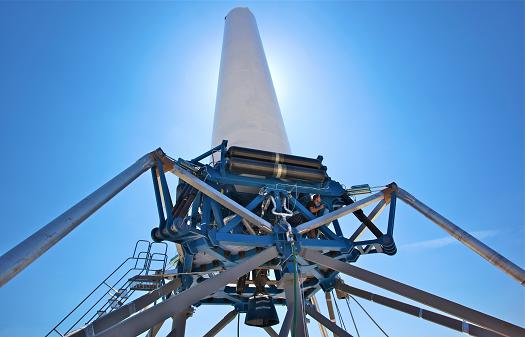
SpaceX Grasshopper
SpaceX Grasshopper Steve Jurvetson, via Wikimedia Commons

On Thursday, March 7, SpaceX's Grasshopper rocket launched 263 feet into the air, hovered for 34 seconds, and then under its own power landed back where it took off. It was a record-breaking moment for the Grasshoper--in December, the rocket reached an altitude about half as high--but plenty of rockets have catapulted to even greater heights. So why was the science press really, really excited about the whole thing?

Because the rocket actually landed in the same spot where it took off. This is called a vertical landing, it doesn't happen very often, and it bodes well for the future of space tourism:

Rocketry, since its inception, has been primarily concerned with breaking free from the constraints of Earth's gravity. It has been less concerned with the return trip. More often than not, rockets are designed to crash upon return. (Of course, scientists make calculations to ensure that they crash as safely as possible, ie. aiming for the 70 percent of Earth’s surface not covered by land, deploying parachutes, deploying recovery ships to pick up the rocket, and so forth.)

That's not to suggest that Vertical Take-Off and Landing (VTOL), as it's called, hasn't been highly sought-after. In fact, it's something people have wanted flying machines to do since pretty much the dawn of flying machines. If you can land where you take off, you can develop rocket-launching pads pretty much anywhere. And the more launch pads you have, the easier it is to explore space--and the more viable the business model for space tourism.

Vertical-landing rocketry was explored conceptually in the 1960s, realized in NASA’s Apollo lunar landing module, and, inevitably, immortalized in video-game form.

The moon lander only had to navigate and then escape from the moon's gravity, though. Earth's gravity proves more difficult. In the 1990s, NASA worked on the DC-X, which was designed to take off from, and return to, Earth, but the project ultimately failed. The past decade has seen several new attempts, including NASA’s Mighty Eagle lander prototype, Project Morpheus, GENIE rocket, and attracted private attempts with 2009’s Lunar X Prize.

But SpaceX's Grasshopper is the only one that has repeatedly and successfully demonstrated accurate landings back on the launchpad from which it launched, with this fourth and latest test achieving a precise landing from twice as high as the previous attempt.

22 Comments

Oh yeah... I definitely want to go through an extremely hot and violent atmospheric re-entry with enough rocket fuel still on board to slow me down to a stop later. What could possibly go wrong?

@marcoreid - It re-enters unmanned.

in order to thank everyone, characteristic, novel style, varieties, low price and good quality, and the low sale price. Thank everyone

http://al.ly/3JF

http://al.ly/3JF

http://al.ly/3JF

http://al.ly/3JF

│\_╭╭╭╭╭_/│  
 │         │\|/  
 │ ●     ● │—☆—  
 │○ ╰┬┬┬╯ ○│/|\  
 │   ╰—╯   /  
 ╰—┬○————┬○╯  
  ╭│     │╮  
  ╰┴—————┴╯ sdgwegsdfgwegwe

Is this really a science website? I think the excitement is about reusability to reduce the cost of going to space. Landing in the same spot allows you to put a pad anywhere? Really? I don't think that pad location has anything to do with it.

@cak0252: The idea behind the launchpad comments is that if you can come back to where you started every time, you can refuel and get ready to fly again in hours, rather than the days it would take to go out into the ocean, find the stage, ship it back, and clean it up.

".....So why was the science press really, really excited about the whole thing?....."

That's a great question. Similar feats have been achieved before, including some by private companies.

It would seem that the most likely reason the "science press" is so excited by this particular effort by SpaceX has more to do with the fact that SpaceX/Elon Musk/Tesla are media darlings.

As anyone that has ever worked in the launch vehicle business would tell you, there is no way any known type of reusable launcher can ever come close to competing with expendable launchers on a cost basis. This would include Mr. Musk's Grasshopper.

you can already see in comments who wants and who does not want to go to space ^^

---
No facts, No response...

I want to go to SPACE!

Hello N. Korea, pay attention please.
This is how rockets go up and down nicely!

@robot aka b.gump aka anyIcon

stop changing names and take the responsibility of your actions...

---
No facts, No response...

vt007,
Mr. "No Facts, No response."

You are not the owner of people. Get over yourself.

Science exists for the people and people have a voice and right in how it affects their own lives.

https://yourlogicalfallacyis.com/strawman

---
No facts, No response...

I think they got it all wrong. If you want to maximize the cargo and minimize the fuel, having a launcher that gives the device a running start would make alot of sense. There is no need for the rockets to start from a standstill. A ground based launcher, similar to a aircraft carrier steam catapult can add a great deal of velocity to the vehicle, with power generated on the ground (as compared to power generated on-board the vehicle). Thus, with a ground-based launcher, rockets could carry more with less fuel.

But the real money is with a space elevator. Rockets aren't needed at all for a smooth ride up a space cable.

I am not a rocket scientist, nor am I any kind of rocket expert, though I am a hobbyist. I have also seen many videos of failed rocket launches where the rocket starts to go up, slows down, sort of tips over a little, and then crashes and blows up. I'm thinking it's sort of a balancing act after the propulsion kicks in until the rocket is moving fast enough for aerodynamics take over. Try putting a pencil on the end of your finger and pushing it up into the air balancing it on your finger, see what I mean? I think this is a big deal because not only did the rocket stop and hover without tipping over, they managed to reduce the thrust just enough to set it down slowly without crashing or otherwise damaging it (at least that we know of), and on top of that, they managed to land it right where it took off from. I'm just a lay person, but it seems like a big deal to me.

my classmate's ex-wife makes $74 every hour on the laptop. She has been laid off for 10 months but last month her check was $18681 just working on the laptop for a few hours. Go to this web site and read more http://www.jump14.com

this looks like the least efficient way to handle space travel. Slowing and landing from a slow ascent and descent is nothing like doing it from the very high speed re-entry from space. This method has to waste tremendous amounts of fuel.
I like the concept where they launch from a plane high in the atmosphere. I would think they could rely on parachutes and just add some guidance rockets to steer it to a smaller landing zone.

"this particular effort by SpaceX has more to do with the fact that SpaceX/Elon Musk/Tesla are media darlings."

Elon Musk's enterprises are media darlings because, unlike a lot of talk by others, he has actually accomplished what he set out to do. Talk is cheap, actions speak volumes. Who else has sent and returned space craft? Who else has built an Electric Car that is really comparable to a gasoline powered one? Artist renderings and sub-scale prototypes don't get it.

Of course the lift off it great, but the landing of this rocket is an engineering fantastic technical accomplishment!

WELL DONE!
KUDOS!

Check out Masten Space Systems, www.masten-space.com. Been doing precision vtol for years. Granted, on a smaller scale, but hundreds of flights.

Oh, and the "GENIE rocket" is actually a payload on Masten's Xombie rocket that let's third party GNC's fly the rocket under Masten supervision.

Unfortunately, most commenters fail to appreciate this fundamental issue with launching commercial payloads into orbit: The practical payload mass fraction is only about 5% of the gross vehicle launch weight. The added mass of the landing gear system, additional fuel needed for landing, re-entry thermal protection system, and additional structural reinforcements, would be far more than the mass allocation of the payload itself.

dukane24, in my opinion, is right on target,,,
I do concur, well spoken.

I don't see this as any substantial step forward. It's still just fighting gravity with brute force, which has to be the least economical way to reach orbit. What's worse, is that without multiple stages, even orbit is tough to reach. What I would like to see is a TAV development program that doesn't get cut the first time somebody slips through the back door and greases a few congressional palms in order to get funding for a new cafeteria for their college or similar.

Why do I get the feeling that if Werner were still around we'd already be to Alpha Cebtauri?


June 2013: American Energy Independence

Five amazing, clean technologies that will set us free, in this month's energy-focused issue. Also: how to build a better bomb detector, the robotic toys that are raising your children, a human catapult, the world's smallest arcade, and much more.


Online Content Director: Suzanne LaBarre | Email
Senior Editor: Paul Adams | Email
Associate Editor: Dan Nosowitz | Email
Assistant Editor: Colin Lecher | Email
Assistant Editor: Rose Pastore | Email

Contributing Writers:
Rebecca Boyle | Email
Kelsey D. Atherton | Email
Francie Diep | Email
Shaunacy Ferro | Email

circ-top-header.gif
circ-cover.gif
bmxmag-ps