A company in Spain has developed a fabric that hardens like plastic when applied to a vacuum.
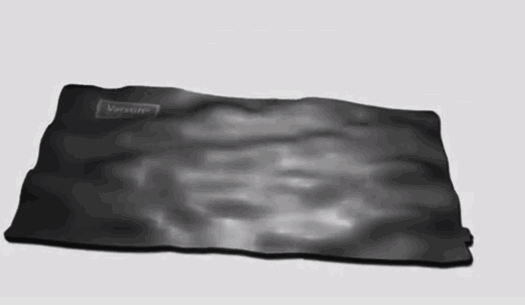
Insta-cast Smart Fabric Tecnalia

Paramedics may soon have a new instrument for their emergency first aid kits--a smart fabric that, when exposed to a vacuum, stiffens to create a plastic-like mold. The fabric could act as a kind of insta-cast, allowing emergency workers to quickly immobilize parts of a victim's body that may be vulnerable to permanent damage, like the neck and back.

According to a press release provided by Tecnalia, the Spanish company behind the new material, the insta-cast could be ready for market by early next year. The release doesn't provide any specific details about how the material--which they're calling VarStiff--works, but a Spanish-language promotional video suggests that the insta-cast will look like a super-slim, flexible mat with an attached air-pressure valve. Inside, a layer of VarStiff is surrounded by a plastic, air-filled sac. When the operator switches on the pressure valve, the air is sucked out of the sac, and the fabric hardens.

Varstiff

Tecnalia has also announced vague plans for other products down the road. Again, the details are scant, but it's easy to imagine that a light, flexible fabric that hardens to pretty much any rigid shape in a matter of seconds could be used for all kinds of cool stuff, from pop-up furniture to self-customizing orthopedics.

[Via PhysOrg]

4 Comments

This sounds like great emergency stuff to have around, should a small pebble dings it way through the ISS or space capsule.

Reminds me of the robot grasping appendage that uses coffee grounds and it hardens around what it is holding when the air is sucked out.

http://www.popsci.com/node/49360/

This is what I wrote to accompany my facebook re-share of the PopSci fb post:

"YES. Oh, the things you could do with this! Now, what I'm curious about is the length of time this application would last and how to remove/denature it. I'm assuming that if you put it through a vacuum to suck out all of the air, then it makes sense that the molecules all pack very tightly together. However, I wonder how porous the fabric itself actually is, and how susceptible it would be to molecules transversing the membrane. If exposed to extreme cold or extreme heat, how would the rigid structure now react, and would it even be able to keep its structure that was formed in ideal conditions (in a vacuum)? So if it was formed in low pressure, would a cast made of this still be as effective while traveling from an area of lower pressure to an area of higher pressure, and vice versa? Or transporting someone a colder climate to a warmer climate? And then, of course, depending on the tensile strength and ability to retain shape, it could be used for applications like structures that need to be temporary and mobile, furniture?, safety gear?, in conjunction with awesomely-printed 3D clothing and accessories?, efficient traveling/packing/emergency kits?, etc. And, lastly (but not leastly!), what would the cost for a meter of this fabric be, who would manufacture it and control its accessibility, how can you control what shape it would take (being able to cut it like regular fabric?) or synchronize it with regular patterns and textiles, and what would it cost to produce (cost to buy and cost to produce are different, as is accessibility)?

Yeah...this is really what is going on in my head right now. I am typing stream-of-consciousness style."

Hahaha.

facebook.com/sojackyso
twitter.com/jackypostgrad
www.jackyso.wordpress.com

Sounds like a good material to keep in a first aid kit along with a mini vacuum.


July 2013: The Future Of Flight

The incredible innovations, like drone swarms and perpetual flight, bringing aviation into the world of tomorrow. Plus: today's greatest sci-fi writers predict the future, the science behind the summer's biggest blockbusters, a Doctor Who-themed DIY 'bot, the organs you can do without, and much more.


Online Content Director: Suzanne LaBarre | Email
Senior Editor: Paul Adams | Email
Associate Editor: Dan Nosowitz | Email
Assistant Editor: Colin Lecher | Email
Assistant Editor: Rose Pastore | Email

Contributing Writers:

Kelsey D. Atherton | Email
Francie Diep | Email
Shaunacy Ferro | Email

circ-top-header.gif
circ-cover.gif