They hope to create 3-D tissues and organs using stem cells as the "ink."
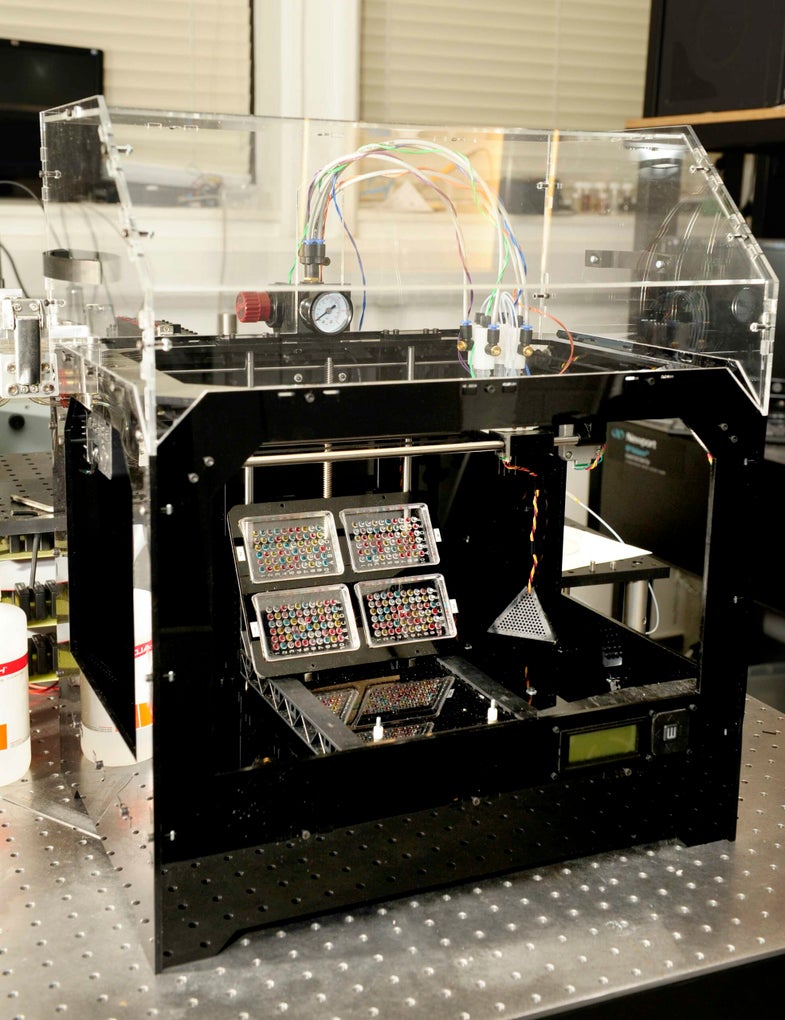
Stem Cell Printer
Stem Cell Printer Human embryonic stem cells can be printed out with a valve-based printing technique, tailored to account for the cells' delicate properties. The cells were loaded into two separate reservoirs in the printer and were then deposited onto a plate in a pre-programmed, uniformed pattern. Colin Hattersley

3-D printers can produce gun parts, aircraft wings, food and a lot more, but this new 3-D printed product may be the craziest thing yet: human embryonic stem cells.

Using stem cells as the “ink” in a 3-D printer, researchers in Scotland hope to eventually build 3-D printed organs and tissues. A team at Heriot-Watt University used a specially designed valve-based technique to deposit whole, live cells onto a surface in a specific pattern.

The cells were floating in a “bio-ink,” to use the terminology of the researchers who developed this technique. They were able to squeeze out tiny droplets, containing five cells or fewer per droplet, in a variety of shapes and sizes. To produce clumps of cells, the team printed out cells first and then overlaid those with cell-free bio-ink, resulting in larger droplets or spheroids of cells. The cells would group together inside these spheroids. Spheroid size is key, because stem cells need certain conditions to work properly. This is why very precisely controlled 3-D printing could be so valuable for stem cell research.

After being squeezed out of a thin valve, the cells were still alive and viable, and able to transform into any other cell in the body, the researchers say. It’s the first time anyone has printed human embyronic stem cells, said lead researcher Will Wenmiao Shu, a professor at Heriot-Watt. But ... why?

Eventually, they could be used to print out new tissues, or as filler inside existing organs, which would be regenerated. It could even serve to limit animal testing for new drug compounds, allowing them to be tested on actual human tissue, said Jason King, business development manager at Roslin Cellab, one of the research partners. “In the longer term, [it could] provide organs for transplant on demand, without the need for donation and without the problems of immune suppression and potential organ rejection,” he said in a statement.

The team took stem cells from an embryonic kidney and from a well-studied embryonic cell line, and grew them in culture. They had to build a custom reservoir--let’s call it an inkwell--to safely house the delicate cells, and then they added some large-diameter nozzles. A pressurized air supply pumps the cells from the inkwell into the valves, which contain pressurized nozzles on the end. The team could control the amount of cells dispensed by changing any of the factors, including the pneumatic pressure, nozzle diameter or length of time the nozzle stayed open.

University Logo
University Logo: The logo of Heriot-Watt University shows how stem cells can be printed with great precision.  Will Shu/Biofabrication

At first the researchers printed droplets, but ultimately, they were so precise that they made cell spheroids in a variety of shapes and sizes, like the university logo above. One interesting wrinkle: The cells also formed spheroids in the inkwells. More work needs to be done to explain that.

The researchers also took several steps to make sure the cells survived the printing process. Examining the results of several experiments, they found 99 percent of the cells were still viable after running through the valve-based printer. “This confirms that this printing process did not appear to damage the cells or affect the viability of the vast majority of dispensed cells,” they write in their paper, which is being published in the IOP regenerative medicine journal Biofabrication.

Stem cells are powerful because they can develop into any cell in the body. Embryonic stem cells, which are taken from human embryos in the earliest stages of development, can be developed into stem cell lines that can be grown indefinitely. This is kind of controversial, especially in this country. But medical researchers think they could be hugely promising for a whole host of human ailments--stem cells could differentiate into neurons, potentially replacing the ones lost in degenerative diseases like Alzheimer’s; or they could differentiate into pancreatic cells, curing diabetes; and so on.

Using a 3-D printer to produce gun parts has been pretty controversial, especially during the ongoing post-Connecticut-shooting gun debate. But that may be nothing compared to this.
3-D Printed Stem Cells
3-D Printed Stem Cells:  Will Shu/Biofabrication

6 Comments

Stem cell research has proven that using embryonic stem cells are not necessary to grow and replicate stem cells, so I doubt this will be controversial.

Most likely, it will be revolutionary for thrusting medical science forward.

In fact it seems like it should be less than controversial since all relevant data indicates that adult stem cells are more useful to resist rejection and that amniotic, placental, and chord blood stem cells all do just about the same thing as embryonic stem cells. The bonus is that these are easier to get and in higher quantities and most are simply thrown away after birth.

Research in induced pluripotence is also going very well. All said there seems to be absolutely no reason for this to be controversial. The only reason that I can figure that embryonic stem cells would still be argued and debated for by anyone is that it relates to other ideological grounds. Ex: If it's not okay to kill embryos for stem cells maybe other reasons to kill embryos are wrong?

Moral issues aside, it seems like the controversy is easily avoidable since embryonic stem cells are much less effective than every other source of stem cells.

This is great!!! Stem cell research is the key to eliminating all of these painful, crippling, debilatating diseases. People shouldn't have to suffer with these diseases. Using embryonic stem cells is not wrong by any means. Cells that are merely a few days old are not fetuses by any definition. I believe that if God is all powerful and omnipotent like he claims to be, then it would seem that by us killing a cell that's a few days old would hardly put a dent in his master plan. Let's just say this cell was considered a human in God's eyes with a unique soul that had been sent from Heaven by God to grow and live on Earth. I think that if we were to prevent that being from entering the Earth by killing it, then God would find some other means of sending that individual to the world, probably by putting that embryo into another woman where he would then use his powers to cause that embryo to be the one to be birthed. By us using an embryo, we're not stopping God's plan. We're not even making a bump in the path.

It would be different if it were a grown, actual human. His/her death would cause many reactions that could be seen and felt here on Earth that God would frown upon. However, this is much different than a cell that's only a few days old. Also, the Bible is not very clear on its stance against the use of embryonic stem cells. Actually, the few remarks it does make regarding stem cells do not say anything about how we shouldn't use stem cells or that it would be bad to use them.

nebulation
02/05/13 at 1:30 pm : "Using embryonic stem cells is not wrong by any means. Cells that are merely a few days old are not fetuses by any definition."

By your definition the "cells" as you wrote are not fetuses. By my definition and by the definition of those who can actually use logic the "cells" ARE an embryo. They are called 'Embryonic Stem Cells'. The adjective 'embryonic' indicates that cells are either an 'embryo' if all cells are used for an experiment or part of an embryo if some of them are used. They are not called 'tree' or 'frog' cells but 'embryonic'. The experiments on tree or frog cells are not a criminal undertaking but experiments on cells of an embryo are because a human in an embryo stage of life is given the status and value of a frog and then used and killed. If somebody did experiments on the stem cells of your arm or leg and to do so had to cut off your limbs and told you : 'it is all right, I am doing experiments only on the stem cells of your arm or leg but not on you', what would have been your answer ?
A human being during his or her existence goes through the stages of life, pre-born and post-born. A pre-born stage of life is an embryonic stage. It might come as a shock to you but you also went through this stage of life and you had the same right to live then as you do now. You became a unique human life, you, when your mother's and your father's genetic codes/material combined in ONE cell to become the unique genetic 'book' of you, the process of your life started right then. You as one cell started to divide and grow immediately. If a 'scientist' then and there decided to make an experiment on embryonic you and at the end of it splashed what was left of you down a toilet, you see this as acceptable ? Was the Auschwitz doctor Mengele a criminal or not ? He did not do experiments on the humans, he did experiments on the subhumans who in his darwinian science book were on the level of the frogs because they were not persons. And they were not persons because they were not fully human, and they were not fully human because many people said so. You see how exciting the science is ? If you want to do experiments on a human life just twist a word or two, redesignate, rename, say "it" is not fully human, it is a blob of cells, a "blob", and then do your experiments. Utter magic, the reality changes with the changing of few words and a human being becomes disposable trash.
You and your like are the prime example and proof of why the domain of the human life cannot be interfered with, decided about and experimented on by the democratic mob, the 'scientists' included. You are too easily swayed and bewitched by the words and actions of the conjurors of science whose truly satanic philosophy is 'The curiosity and the knowledge are above the morality.' Only the Church, the one that refuses to compromise with the 'science', has the exclusive right to judge on the questions relating to human life.

All this moralizing is beside the point and belongs in another forum. These inexorable innovations are taking place outside the US, all this hand-wringing notwithstanding. Only when we release science from the schackles of religion and short-sighted budget restraints will we recover the initiative in technology and create a 21st-Century economic renaissance.


June 2013: American Energy Independence

Five amazing, clean technologies that will set us free, in this month's energy-focused issue. Also: how to build a better bomb detector, the robotic toys that are raising your children, a human catapult, the world's smallest arcade, and much more.


Online Content Director: Suzanne LaBarre | Email
Senior Editor: Paul Adams | Email
Associate Editor: Dan Nosowitz | Email
Assistant Editor: Colin Lecher | Email
Assistant Editor: Rose Pastore | Email

Contributing Writers:
Rebecca Boyle | Email
Kelsey D. Atherton | Email
Francie Diep | Email
Shaunacy Ferro | Email

circ-top-header.gif
circ-cover.gif