Weather Balloon Breaks World Record For Longest Flight
Super-TIGER, a heavy-lift balloon, collected so much data in its flight above Antarctica that it will take scientists two years to sort it all out.
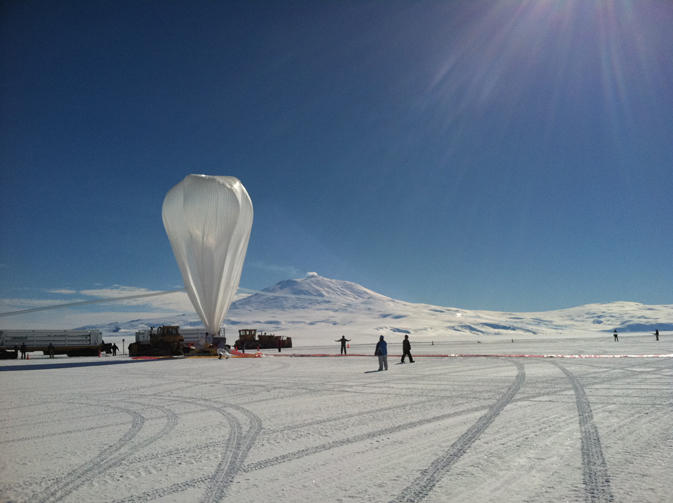
Floating 127,000 feet above frozen Antarctica, a weather balloon spent a record 55 days being bombarded with cosmic rays before heading home over the weekend. Called Super-TIGER, it has traveled longer than any comparable balloon yet, and it will help astronomers understand more about the heavy particles that are constantly pummeling our planet.
The balloon might look delicate, but it’s big enough to hold 200 Goodyear blimps, and it can carry 6,000 pounds of scientific cargo. That’s about the size of a large sports utility vehicle, as NASA points out–not a light load for something that’s just full of helium. Many balloon-borne experiments in Antarctica fall to Earth in the first few weeks, but Super-TIGER had more stamina.
Super-TIGER stands for Trans-Iron Galactic Element Recorder, and it was looking for rare, heavier-than-iron elements coming toward Earth. The planet is subject to a constant flux of high-energy cosmic rays from around the galaxy, and they can be harmful to astronauts and life on Earth. Scientists want to know where these cosmic rays are coming from and how they achieve such high energies, but they are difficult to study because Earth’s atmosphere mostly blocks them. They might come from distant exploding stars, or maybe other cosmic sources. Super-TIGER, which detected at least 50 million cosmic rays, will help scientists figure this out.
Researchers on the mission kept a blog about their experiment, and explained in a weekend post how the balloon comes down. First helium is vented, and then a specially designed tool slashes the balloon so it rips. The payload starts to fall, and then a parachute deploys to land it safely. After it hits the ground, the chute detaches, and the instrument is left on the ground for possible later recovery. Super-TIGER landed at 5:17 p.m. Eastern time on Friday, but recovery is pretty unlikely this year.
It had launched Dec. 8 from the Long Duration Balloon site near McMurdo Station. It was able to stay aloft so long because of the weird atmospheric behavior at the south pole. Prevailing wind patterns move the opposite way they do elsewhere on Earth–from east to west, instead of west to east. The launch site takes advantage of these anticyclonic winds, and air circulation makes it possible for the balloon to stay aloft above 100,000 feet. For perspective, Super-TIGER’s altitude took it about four times higher than the cruising altitude of a commercial airliner.
The science team will need about two years to fully analyze all of its data.
Super-TIGER Balloon