Poison, dye, and GPS chips. Poachers, you've been warned: these are not the horns you want.
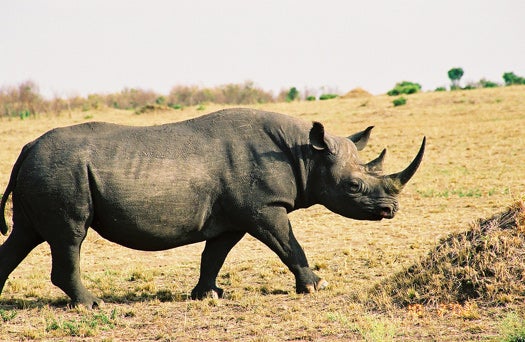
Rhinos' Horns Provide More Protection Than Ever, Thanks To GPS spbutterworth on Flickr

In South Africa, conservationists have had to come up with new and more innovative ways to prevent poachers from killing the local rhinoceros for their horns. Enter the Rhino Rescue Project.

The trade in rhino horns is immensely profitable; rhinos are huge but not particularly hard to kill, since they need a lot of water and can be reliably found at watering holes. The horns are powdered and used in traditional Chinese medicine, prescribed for fevers and convulsions (not as an aphrodisiac, as is sometimes thought). So the Rhino Rescue Project began investigating something unorthodox: why not make the horns unusable as medicine?

There's a multi-pronged method here. Materials are not exactly injected but rather, as the Rhino Rescue Project says, "infused into the horn using a patented high-pressure device." No more detail is given about how that works. But the device uses a dye which turns the horn brightly and irrevocably pink, kind of like the dye used in ink packs to secure money at a bank. That makes it useless as a prize or ornament, and even if the horn is ground to a fine powder, it'll still show up in an airport security scanner. Three separate GPS chips are implanted into the horn, kind of like this older project--it's worth mentioning here that a rhino's horn is made of keratin, just like your fingernails, and the animal feels no pain during any of this. And the dye has no adverse health effects on the rhino.

In the future, the project even plans to add poison--ectoparasiticides, to be exact, which are damaging to neither the rhino nor any animal in the rhino's ecosystem, like ox-pecker birds. But for humans, it's pretty toxic, causing extreme nausea, vomiting, convulsions, and more. So: make it non-desirable to poach (by making it pink), make it hard to move (because it's pink, also because of the GPS trackers and the dye's visibility in scanners), and then make it useless for medicine (because it'll make you sick).

The project is still in the testing phase, but it's very promising stuff.

[via PSFK]

8 Comments

I don't think pink is a good idea. Now women will want it! haha

Rhino horns can get to be about 3 feet long. It takes about 10 years to get to that size... A smart purveyor of rhino horn would encourage their health and reproduction, tranq them to harvest the horn. Harvest them in a staggered manner so every year you have a constant supply... each Rhino can provide up to 5 horns in its lifetime instead of one (since they grow at about 3-4 inches a year)

This plan seems crazy, but I actually see no flaws with it. As long as the rhinos don't mind and horn harvesters are properly warned... this is actually a really good idea.

Wonder if it works for elephant tusks?

Can they do this with elephants too?

As long as none of this hurts the animal I think it is a great idea. Exploiting and killing an animal just to harvest a part of their body for their perceived medical properties is wrong especially with such an endangered species.

@koala,
no, it does not work with ivory. Tusks are a tooth, while horns are like fingernails.

@ppardee,
This is not done, because the authorities are afraid that it will lead to an escalation of poaching, and allow poached horn to be hidden among legally harvested horn. So the blanket approach has been adopted of no legal trade in Rhino horn at all. South African game park authorities are holding considerable stocks of rhino horn which is not marketed. Kenia has been burning huge piles of ivory on occasion over the years so it would not fuel the industry of ivory smugglers, traders, and carvers. Vietnam and China are the major market for the horn, where the smugglers have spread the rumor that it also cures cancer.

ppardee
, the problem is not the harvesting of horns, it's that the porchers are doing it because they can make a quick buck and they're DIRT POOR, tranqs cost money but bullets don't.. bullets cost almost nothing and neither do rifles. further, tranq guns, are practiclly paintball markers, they need compressed air and compressors that can reach 3000+psi aren't cheap or common even in developed nations. along with this you need air tanks, regulators, regular maintenance, oil, cleaning, the darts, yo uneed to track and follow an angry animal until it takes effect, you'll want reverser if you want the animal to live (the whole point of doing all of that in the first place) so the animal doesn't burn up in the heat, suffocate under it's own weight.. etc etc, injecting the reverser isn't easy (ear vein) and needs clean needles and training along with more money to buy.

then on top of ALL that, you'll need the government permits to import all of this into the country in an ongoing basis, which can be tracked, you'll need a legitimate vetrenarian for all of that who'll need to work at a sancuary or rescue already.. and the sancuary's and rescue centres ALREADY HARVEST THE HORNS AND ELEPHANT TUCKS to prevent poaching.

from what i hear, most of the time it is burned and rightly so.

so, why would a smart horn poacher tranq the animals again???

answer: He wouldn't .. he just plain wouldn't . because it's a). impossible and b). not feasible/smart at all


June 2013: American Energy Independence

Five amazing, clean technologies that will set us free, in this month's energy-focused issue. Also: how to build a better bomb detector, the robotic toys that are raising your children, a human catapult, the world's smallest arcade, and much more.


Online Content Director: Suzanne LaBarre | Email
Senior Editor: Paul Adams | Email
Associate Editor: Dan Nosowitz | Email
Assistant Editor: Colin Lecher | Email
Assistant Editor: Rose Pastore | Email

Contributing Writers:

Kelsey D. Atherton | Email
Francie Diep | Email
Shaunacy Ferro | Email

circ-top-header.gif
circ-cover.gif