‘We Wanted To Make A Robot That Could Squeeze Through Holes And Change Its Shape’
The muscled Meshworm prototype mimics annelid locomotion.
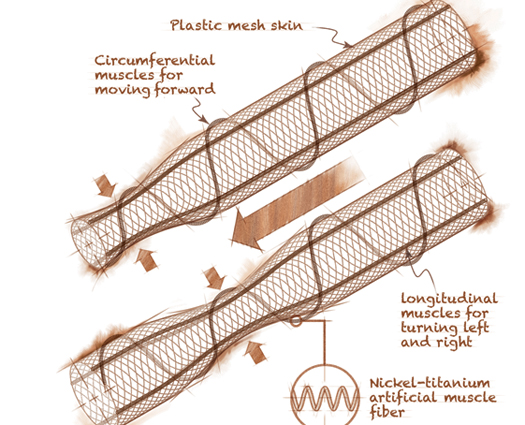
“If you don’t have legs, you can propel yourself by deforming your body. Earthworms do this through peristaltic locomotion: The muscles in one body segment contract while others relax, which creates a traveling wave that moves them forward. Our robot, Meshworm, moves this way, using wires for muscles. To make a muscle segment, we twist the wire into a long, narrow spring, and then wrap the spring into a tube shape. After that, we link up several segments and cover them with plastic braided mesh, like the screen on your window.
We use a nickel-titanium alloy for muscles because it changes its molecular structure at 160°F, which shortens the wire, tightens the spring’s coil, and squeezes that body segment. Our prototype—it’s about five inches long and one inch in diameter—has four segments, each controlled by the robot’s microprocessor.
A small battery inside provides an electrical current that travels through the wire; the wire’s resistance makes it get hotter. We also add a wire tendon that runs from head to tail and keeps the worm’s overall length fixed. As a result, when a segment contracts, the one behind it stretches out, and the robot inches forward. The tendon also has muscles attached so the robot can turn left or right.
Meshworm can move only a few millimeters per second, but it’s very light—just a few grams. And the muscles’ strength-to-weight ratio is unmatchable. A few grams of wire a couple centimeters long can lift 10 kilograms. Because the robot is soft and could be scaled down, we think it could be used as a medical endoscope. Or a swarm of them could monitor small places like the human intestine. Meshworm’s muscles are heat-sensitive, so the robot probably wouldn’t be good for entering a burning building. But it doesn’t have any fragile components. We banged our prototype with a hammer and a 200-pound guy stepped on it, and it crawled away.”
—Sangbae Kim, assistant professor of mechanical engineering at MIT.
