The solar-powered rover is a contender for the $30 million Google Lunar X Prize.
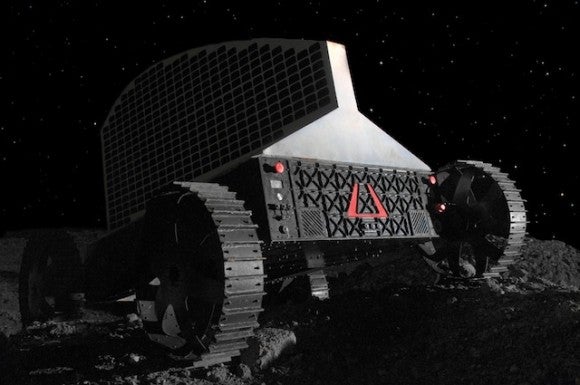
Polaris Prospecting Bot Polaris has three vertical solar panels to generate up to 250 watts of power, along with 3-D cameras and lasers to help it navigate. Astrobotic

A first-of-its-kind solar-powered lunar rover can drill 3 feet into the lunar surface, hoisting a vertical triple solar array to capture sunlight from super low on the moon’s horizon. Roboticists at a company called Astrobotic, a spinoff from Carnegie Mellon University, built a working prototype and plan to test it in the next few months.

Astrobotic and CMU hope to nab the $30 million Google Lunar X Prize for the first privately funded team to send a robot to the moon. Polaris is designed to seek out water ice trapped in the cold craters and regolith at the moon’s poles. It has 3-D cameras and laser guidance systems for navigation, and it will communicate directly with Earth using an S-band antenna.

A lunar day lasts about two Earth weeks, and about 10 of those days would have enough sunlight for drilling at the moon’s poles. Polaris would drill up to 100 holes in those 10 days as it searches for water ice deposits. If it survives the lunar night, it could recharge again as soon as the sun comes up, and continue drilling for ice as long as its drill bit lasts.

Some vitals:

  • Body: 5 1/2 feet tall, 7 feet wide and almost 8 feet long
  • Wheels: 2-foot diameter composite material
  • Speed: One foot per second
  • Weight: 330 lbs.
  • Payload: 150 pounds for drill and science instruments.

Polaris would launch on a SpaceX Falcon 9 rocket and land near the moon’s north pole, according to CMU. You can follow its progress here.

[via ScienceDaily]

5 Comments

Interesting, this robot has the unusual similarity to something TONKA would make, who knew?!

Fantastic! Advancements are more important when done outside of a government.

A privately built robot being launched on a rocket from a private company to the moon…I like this advancement. I hope that this will reach a regularly in the way shipping companies move containers over the ocean.

^
Just wait until one of our cargo transports discovers an alien planet, and brings something back with them. Then we're all in trouble! Lol

Well,

Thank you Google for the incentive to these private sector areas to push forward on global technology. For this I will have to take a second look at Google products (minus chrome I still don't like it)

As for this ice bot, good idea, we as a species just may start mining the moon and constructing lunar cities to further our expansion into the realm of the unknown. Sure this may take another hundred years but, baby steps.


June 2013: American Energy Independence

Five amazing, clean technologies that will set us free, in this month's energy-focused issue. Also: how to build a better bomb detector, the robotic toys that are raising your children, a human catapult, the world's smallest arcade, and much more.


Online Content Director: Suzanne LaBarre | Email
Senior Editor: Paul Adams | Email
Associate Editor: Dan Nosowitz | Email
Assistant Editor: Colin Lecher | Email
Assistant Editor: Rose Pastore | Email

Contributing Writers:

Kelsey D. Atherton | Email
Francie Diep | Email
Shaunacy Ferro | Email

circ-top-header.gif
circ-cover.gif