Tomorrow, NASA’s Twin Radiation Belt Probes Launch for the Most Hostile Regions in Nearby Space
In the wake of Curiosity’s landing on Mars, a return to regular science missions in Earth orbit may seem a...
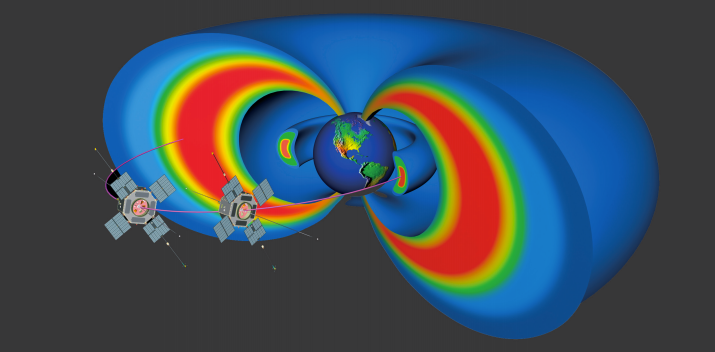
In the wake of Curiosity’s landing on Mars, a return to regular science missions in Earth orbit may seem a bit pedestrian. But tomorrow morning just after 4 a.m. EDT, an Atlas V rocket is launching from Cape Canaveral carrying a unique mission aimed at doing some pretty critical science much closer to home. The twin Radiation Belt Storm Probes are bound straight for the Van Allen radiation belts that ring Earth, mysterious and hazardous regions of nearby space that we’ve known about for decades without truly understanding them.
The Van Allen belts–named for their discoverer, U. of Iowa professor James A. Van Allen, who identified them in the late 1950s–are two donut like rings of intense radiation circling our planet. We know these regions of intense radiation occur around other bodies elsewhere in the solar system and the universe. And we know they are influenced by the sun, whose behavior can influence these radiation ring, bending them inward toward Earth and accelerating them, causing damage to power grids, disrupting satellites, and dosing airline passengers with higher-than-normal degrees of radiation.
In other words, the RBSP mission seeks answers to both fundamental physics questions as well as solutions to practical space weather problems. The inner belt stretches from the top of the atmosphere to about 4,000 miles up, while the outer belt begins at about 8,000 miles altitude and extends out to about 26,000 miles. These are huge swaths of space where high-energy particles can damage spacecraft bound for deeper space, yet we possess very little understanding of how these belts form, how they are influenced, and how they behave.
The twin RBSP spacecraft will travel straight into both belts over the course of their two-year mission, entering these regions of space where other spacecraft would be quickly rendered useless to collect the first real data set on the Van Allen regions. Flying in nearly identical orbits at slightly different speeds (both will have roughly nine-hour orbits), one spacecraft will lap the other every 75 days or so. This dual-spacecraft arrangement means that researchers will be able to take measurements from the same place in space at different times and compare the two.
Doing so will shed light on the structure of the belts and whether/how their intensities fluctuate over time. Researchers will learn how events like coronal mass ejections (CMEs) from the sun affect the belts, informing future spacecraft and mission design. And in terms of fundamental physics, the twin RBSP spacecraft will provide the first real data set on how these bands of radiation–observed elsewhere in the universe–get there in the first place.
Not bad for $686 million. If you’re near Cape Canaveral and want to see this Atlas V ripping skyward, the launch window opens at 4:08 a.m. and closes at 4:28 a.m.