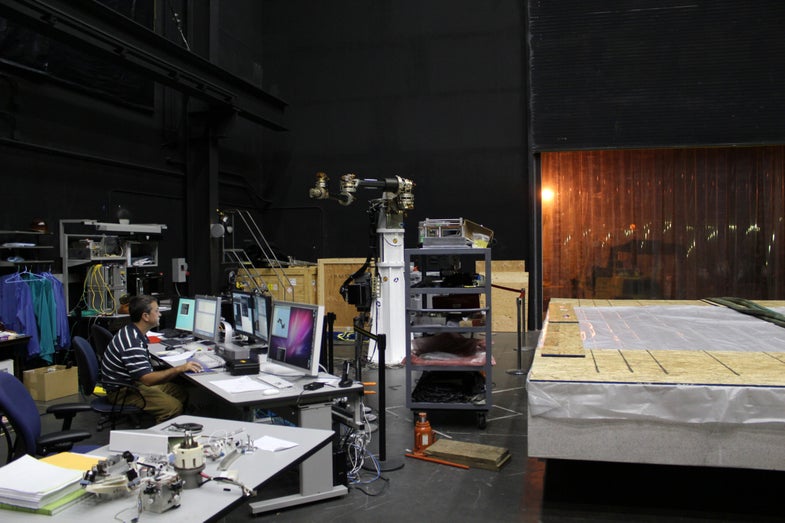
Granite Slab This may look like a slab of rock sitting in a room. But it's actually an ultra-precise microgravity laboratory, honed for the U.S. Navy. It will be used to emulate the inertia of space in the lab, testing things like the Front-End Robotic Enabling Near-Term Demonstration (FREND) arm, seen here with the slab. U.S. Naval Research Laboratory

Testing how objects act in microgravity is not limited to astronauts on the space station. On Earth, you could do it with the world’s largest air hockey table, made from a gigantic slab of rock.

The Navy just got a new 75,000-pound slab of granite, honed to near perfection at just plus or minus 0.0018 inches of irregularity across its entire 300-square-foot surface. The slab, quarried in California, is thought to be the world’s largest single-slab granite table.

It will help scientists emulate the motion of objects in space, which they’ll do by floating objects on air above its frictionless surface — similar to how an air hockey table works. “Based on the inertia of the 'floating' system, a realistic spacecraft response can be measured when testing thrusters, attitude control algorithms, and responses to contact with other objects,” explains Dr. Gregory P. Scott, space robotics scientist at the U.S. Naval Research Laboratory. Without a system like this, engineers would have no way to test the classical mechanics of objects in space — not without going to space itself.

One goal is to figure out how to capture and dock with free-floating spacecraft. Satellites and other spacecraft that are meant to be captured and retrieved — like the Hubble Space Telescope, for instance — have specific docking and capture systems, but most satellites don’t. But it is cheaper (and better for the burgeoning space junk problem) to capture and service an ailing satellite rather than launching a replacement. This new slab will help NRL study ways to do that, with better precision than any other space robotics facility.

[U.S. Naval Research Lab]

4 Comments

When modern technology gets all goosebumps and gee-wizzy about exact polish precise granite slabs, I still find it most interesting to refer to the past by comparison.

www.atlanteanconspiracy.com/2008/06/great-pyramid-mystery.html

Robot, that's the first thing I thought of from the headline. But I don't know of anyone that's conjured an explanation that the Archaeology/Egyptology gurus will accept.

They already have one of these in Huntsville, AL... My friends did research projects there for spacecraft docking, using air cylinders to hover above the ground in near frictionlessness. Weighs a few thousand pounds and you can just nudge it along. Pretty cool, real loud. Strange they would go to so much trouble/expense to duplicate it.

@Robot

"goosebumps and gee-wizzy"? The article just states a fact.

Let's put this in perspective. This slab of granite was a line item on a government purchase order that was fulfilled by a 17-person company in California. It was polished until it met the federal "AAA" specification and then it was shipped. We're not talking about a wonder of the world that took decades and untold millions of Egyptians to construct. I'd say we're doing pretty good.

If you want an example of how far fabrication/polishing techniques have come, just look at the specs of the Gravity Probe B gyroscopes, polished to within 40 atoms of a perfect sphere, or the Avogadro project spheres, polished to obtain a surface roughness of an atom or two.


June 2013: American Energy Independence

Five amazing, clean technologies that will set us free, in this month's energy-focused issue. Also: how to build a better bomb detector, the robotic toys that are raising your children, a human catapult, the world's smallest arcade, and much more.


Online Content Director: Suzanne LaBarre | Email
Senior Editor: Paul Adams | Email
Associate Editor: Dan Nosowitz | Email
Assistant Editor: Colin Lecher | Email
Assistant Editor: Rose Pastore | Email

Contributing Writers:
Rebecca Boyle | Email
Kelsey D. Atherton | Email
Francie Diep | Email
Shaunacy Ferro | Email

circ-top-header.gif
circ-cover.gif