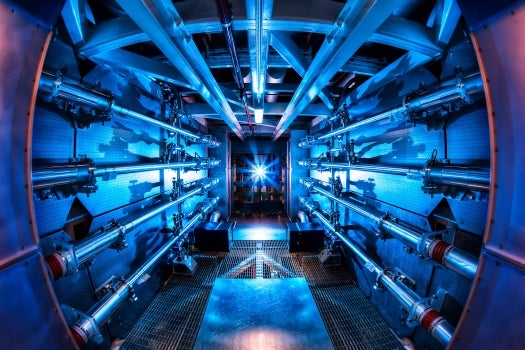
In California, at the ultra-powerful fusion laboratory of the National Ignition Facility, 192 laser beams have fired simultaneously, blasting their target -- a circle 2 millimeters in diameter -- with 500 trillion watts. That's 1,000 times more than the entire rest of the United States was using at the time. It is the highest-energy laser shot ever fired in real life, although some fictional lasers have exceeded the record.
The NIF's ultimate goal is to induce nuclear fusion in a highly compressed pellet of hydrogen, which will be held at the target point of the laser beams. The fusion reaction will generate energy, so we'll earn back our 500 terawatts with interest.
Five amazing, clean technologies that will set us free, in this month's energy-focused issue. Also: how to build a better bomb detector, the robotic toys that are raising your children, a human catapult, the world's smallest arcade, and much more.


Online Content Director: Suzanne LaBarre | Email
Senior Editor: Paul Adams | Email
Associate Editor: Dan Nosowitz | Email
Assistant Editor: Colin Lecher | Email
Assistant Editor: Rose Pastore | Email
Contributing Writers:
Rebecca Boyle | Email
Kelsey D. Atherton | Email
Francie Diep | Email
Shaunacy Ferro | Email
Just curious, how much is 500 trillion watts worth in tax payer monies?
How was this laser powered?
On average, I would say that utility companies carry a reserve of 30% capacity for electricity usage in the middle of the day.
Are there 200 nukes sitting below Lawrence Livermore Labs that we should know about?
@Robot "Just curious, how much is 500 trillion watts worth in tax payer monies?"
"Because the laser is on for the merest fraction of a second, it costs little to operate -- between $5 and $20 per blast" - Lynda Seaver, Lawrence Livermore National Laboratory
You can find a more through article on Fox News.
Read more: http://www.foxnews.com/scitech/2012/07/12/worlds-most-powerful-laser-fires-most-powerful-laser-blast-ever/#ixzz20RgyKcdz
Watts are just units of power; ie: energy/time.
Actual energy costs for this thing could be modest. Technically speaking, you could power the laser pulse with the energy from a single AA battery. It's just a question of how quickly you liberate it.
In this case, they took a sizable amount of energy. Likely in the 100-1000 MegaJoule range, and liberated it over a millionth of a second or so.
500e6 / 1e-9 = 5e17 or 500 Trillion J/s = 500 Trillion Watts.
"The fusion reaction will generate energy, so we'll earn back our 500 terawatts with interest."
Has fusion reached the "break even" point yet? I think they are still operating on a net-energy loss, so i don't expect any (financial) interest back on this test just yet.
@Brian,
Duh. Thanks for the explanation. I guess I had a brain fart for a minute there. Well, a brain fart for a fraction of a second, so it was multiplied in strength!
You can't "liberate" 500 trillion watts out of a AA battery. Total nonsense.
Robot, good question. It doesn't cost much in electricity to power the lasers for each shot. But it did take $4 billion to build those 192 lasers. It's a really, really expensive research experiment with no guarantee of reaching break-even fusion energy, just like its predecessor experiment didn't reach break-even even though project scientists predicted that it would. If it does achieve break-even energies it will still probably be decades before practical nuclear fusion plants based on inertial (laser) confinement fusion come online. Lots of new laser technology is coming out of the research though.
There are other roads to potentially achieving self-sustaining nuclear fusion. Just like laser confinement fusion, their viability is yet to be determined.
Look up "Bussard Polywell" or "inertial electrostatic confinement" fusion and "dense plasma focus" fusion or simply "focus fusion." If either of these works, it would be much simpler to get usable electricity from the fusion reaction than from laser or magnetic (tokamak) confinement reactors.
You know, if you consume 500 trillion watts over a long time or even 1 second or less, you still consume 500 trillion watts of power, of what somebody had to provide and yes pay for. I ask the same question?
Let me put it this way, if you read you electrical bill and for the month you consume 500 trillion watts, how much would it cost you. I bet it’s not equal to a triple A battery, that is just goofy.
500 trillion watts of energy exist in a triple A battery….. ROFL..
Well, we may not be very close to sustainable fusion reactors, at least we're going to have some really cool laser cannons in the near future.
Regarding the AA battery..
It looks like an alkaline AA battery has a capacity of around 2000mAH. So..
2000mAH = 2 Amp hours (Can sustain a drain of 2 amps for 1 hour)
AA's are 1.5V cells
Watts = Voltage*Current, so with 500 Trillion watts, thats:
500,000,000,000,000 Watts / 1.5V = 333333333333333.33 Amps (at one instant)
Knowing this we can calculate how long the battery would be able to sustain this kind of load. (even though a real battery would never be able to do this, but we are talking about just the energy involved)
So, 2 Amp hours divided by 333333333333333.33 Amps = 6 *e-15
so it will last 6 fempto-hours...not very useful. Let's convert this into a unit in seconds.
So take 6 *e-15 and multiply it by 60 and then by 60 again (to convert into minutes, and then to seconds)
this gives us 21.6 Pico Seconds. According to wiki 1 picosecond = half-life of a bottom quark, So that should make this easily relateable for everyone ;)
If anyone spots gapping holes in my math, please point them out. I'm tired :/
AAA battery can store store about 5000 Joules of energy. It could theoretically deliver 500 trillion watts for a very short time. Power = Energy/Time, so therefore Time = Energy/Power. So (5000 joules)/(500 trillion watts) = 10 pico seconds. There is no way a real AAA battery could deliver enough current to deplete it's energy in 10 pico seconds due to the chemistry. It just theoretically has enough energy to light this laser for 10 pico seconds.
The best real life analogy is electrostatic discharge (esd) which is the shock you get when you touch a door nob. ESD has been measured to have voltages in the 10's kilovolts and have currents above 50 amps. Since Power = Voltage x Current then an ESD event could easily have a power of (25 kV) x (50 A) = 1.25 megawatts. Seems like a crazy amount of power but that power level is only present for a few nanoseconds. Say they much power is delivered for 10 nanoseconds, then because Energy= Power x Time, (1.25 Megajoules) x (10 nanoseconds) = 12.5 millijoules. Which is a very low amount of energy even though the power was high.
Well Lynda, I think you are a big fibber or too smart to count money.
"Because the laser is on for the merest fraction of a second, it costs little to operate -- between $5 and $20 per blast" - Lynda Seaver, Lawrence Livermore National Laboratory
To me the entire cost of electricity needs to be calculated. There is no way I believe this device only used $20. It might be some wild end result of power calculation like billion for a billionth of a second but the cost of the building for the last how many days or years is my way of counting money. No wonder the Government is so bad with money. Sheeze.
Before anybody asks...NO you may NOT do the Pink Floyd Dark Side of the Moon laser show on the Dark Side of the Moon. I'll be keeping my eye on you guys at the NIF next April 20th.
I'd suggest the author spend less time researching fictional lasers and focus on getting the units for power and energy straight. It's a 112-word article, and 11 of them are totally pointless. There's not even a link to a decent article. Thank god for the readers for actually providing some decent information.
laurenra7, having designed a built an inertial electrostatic confinement fusion device for use in neutron activation applications I can assure you that with current technology you will not get the necessary energy to break anywhere close to even from such a device. The excess energy generated by a 1kW fusor is on the order of 1-10 microwatts. The WB-6 polywell device produces less than a milliwatt of fusion power at a cost of more than 1 kilowatt. So even assuming you could recapture all the energy you put in the yield is absurdly low. In order to get reasonable yield you need to get out as much fusion power as you put in. These types of devices, particularly fusors, lend themselves well as portable neutron generators. Some possible applications of neutron generators of this are field neutron activation analysis or low budget university research/teaching tools. Fusors technically do not even create a full traditional plasma but more of a plasma sheath, which is saturated space charge. In fact the Child-Langmuir law used to describe the electron distribution in a fusor is a description of a plasma sheath.
I am not sure what the current goal NIF is, but as of the discussion I have heard recently. NIF is intended to study how to achieve a self-sustained fusion reaction as well as a better understanding of the physics and dynamics of fusion environments. Though the narrative coming out of NIF is not always clear through media and I have not yet had the opportunity to talk to representatives of NIF directly, only academic researchers who work in plasma physics. So I can make any definitive statements about what the researchers and directors at NIF are thinking about this project or the future of laser driven fusion. I will say however, that at this point I wouldn't hold your breath waiting for fusion with fission starting a transition to smaller designs. At this point by the time that fusion is able to build large plants, fission power will have evolve to a point where at least materials are commonly designed on an atomic level. This is not to say that somewhere down that road fusion will not find its way into the mix but there is always the issue of market competitiveness.
I'm surprised that no one said this... but the target, an autobot eyeball, things that make you go hmmmm.
Playing Devil's Advocate since 1978
"The only constant in the universe is change"
-Heraclitus of Ephesus 535 BC - 475 BC
Cool movie set:
http://www.mercurynews.com/movies-dvd/ci_20525780/filming-star-trek-sequel-at-lawrence-livermore-lab
Thanks,
-Tony
Interesting, almost half as powerful as Orion at AWE in the UK. This baby pumps out 1 Petawatt = 1000 Trillion watts.
I so much appreciate all those people that respond to my question and with much calculations. Thank you.
I suppose the point of my question, how much does this R&D National Ignition Facility cost the Tax Payer and is all this research creating postive fruit from the Tax payers investment? It this a money pit or is this light at the end of the tunnel?
While on PoPSci, there is another article talking much about the postive aspects of Thorium-Fueled Future for making energy, I also keep in mind that our current government officals have been bogged down for YEARS in not making decisions for our broken budget.
I just want and hope our Tax payer monies, be spent wisely on productive things. It seems we need real answers to real energy problems now and to gamble less currently with our Tax payer money.
1 terrawatt (/second - default if not mentioned) = 277777 kWh = 41,666 GBP (at 15p/kWh) = 64,786 USD.
500 TW.. you can google it.. "500 * (10^12 / 1000 / 3600 * 0.15) gbp in usd"
Obviously that laser didn't fire for a whole second and that energy didn't come straight from the grid. PopSci please go back to your source and find out how much energy, not debit, they used.
Fun Fact: This is enough energy to send 413 DeLoreans through time.
well, the other article says : 5 millionths of a second, so take your $64k divide it by 1 million, ten multiply by 5.... im thinking it will be in the 5-20 dollar range.... hmm where have i heard that figure before.... oh, that's right, the scientist describing the project told us that.... come to think of it, that's 6.4 million pennies, so , 6.4 cents times 5 equals around 32 cents, add in inefficiencies, and the power cost of the detectors, controls, etc, and 5-20 bucks sounds pretty reasonable... any reason why we have such a need to make this about wasted tax dollars? If so, do a bit of research, I am certain we can find much better things to pick on than high energy physics to portray as a waste of tax money. Oh, like making 33 'symbolic' votes in Congress while actually pressing matters are at hand... just sayin. Or a 5 million dollar witch hunt to find out if Mark McGuire used steroids? While we cut funding for medicine for needy kids whose only crime was having shitty parents?
Why is it that everyone is making this a political issue, this is not the place for that kind of bickering, this is pointed at you joshmon999 and Robot.
@alias007 Great Scott!
engineer238, apparently you are familiar with fusors, which are designed to generate neutrons, not produce electrical power; and which, I might add, high school students have built for science projects. It's an elegant concept that Philo T. Farnsworth (the inventor of television) developed back around 1964. Apparently you've also worked out that a modified fusor like the polywell will never achieve net energy output based on...what? Bussard was convinced that it could be done and "...calculated that a Polywell reactor with a radius of 1.5 meters would produce economically viable net power."
There is controversy about several aspects of this, but the initial research was promising and a lot of people take it seriously enough that the U.S. Navy has continued funding of research; ostensibly to develop fusion reactors, but (as you noted about NIF) it could also be for other reasons.
The bottom line is that funding for NIF, in the billions of dollars, has produced about the same probability for practical energy from nuclear fusion as the Bussard polywell concept which so far has only received a few millions of dollars of funding.
laurenra7, just because someone thinks an idea will work does not mean it will. When I started working with fusors I honestly thought they would be capable of producing enough neutrons to make a economically competitive source for produce certain commercial isotopes; however I soon discovered through more meticulous calculations and research that fusors only produced 1E8-1E9n/s at best, and that greater than 1E9n/s was needed to be at the edge of market competitiveness. The navy until recently funded rail guns despite the fact that it was proving impractical with modern materials. Maybe one day someone will have a spark of inspiration and think of a way to modify polywells to make them produce enough excess power to be viable; but for now, they seem to be simply a neat thought as far as electricity generation is concerned. That is not to say however that the navy cannot use them for other things including active interrogation in nuclear security and shipping crate security. The navy may also find use for them in materials research including determination of crystal structure. In fact the naval research lab has a very comprehensive database of crystal structures and space groups. There are plenty of reason other than electricity for the Navy to have a polywell all of which involve utilizing them as a neutron source that may be turned on and off at will. If you recall the navy is deeply involved in nuclear science and energy due to its use of nuclear power on naval vessels. So I would say the navy should not necessarily stop funding the polywell research but spending money to research it as an electricity generating device is a dead end for now. The evidence gathered so far supports this claim (see my previous post on excess energy generation). NIF might be a dead end as well but we will see. Fusion is at best decades away, and as I said before by the time it arrives the fission power industry will have moved onto miniaturizing its designs and focusing on advanced materials science so the fusion industry will have to compete against those advancements. There may be fusion in our future but the longer it takes and the more tritium used up the less likely that it will either be seen in our lifetimes or resemble any type of fusion concept known today.
"...although some fictional lasers have exceeded the record."
What the hell does that mean? It's like having an article on the speed of light and saying "according to the laws of physics, nothing can exceed the speed of light, although in some fictional television shows and movies scientists have managed to do so."