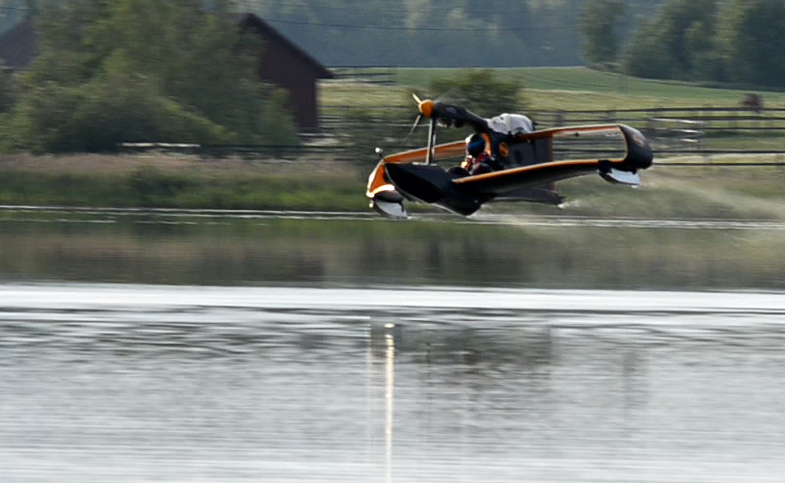
This Finnish-built flying boat made its maiden flight a few days ago, taking off from a lake and soaring into the air. The FlyNano, made by a startup by the same name, is a recreational vehicle with no wheels — and it looks like fun.
FlyNano seems pretty affordable at €32,000, or about $40,500 U.S. You’ll also want a storage trailer, which sells for around $6,600. The company wants to start production next year and deliver its first 35 planes, which have been pre-sold, by the end of 2013.
The plane can reach altitudes of 10,000 feet, but the company points out you’ll probably enjoy it more if you fly close to the surface. Its top speed is 87 mph and the pilot controls the throttle with a joystick, like a regular airplane. Pedals control the rudder. The 440-pound aircraft doesn’t come with a cockpit or windshield — the company says “our philosophy is ‘feel the wind’” — so you would need a helmet or at least goggles, and probably a wetsuit. An international patent is pending.
The FlyNano was originally presented at AERO-Expo in Friedrichshafen, Germany, last year, and was billed as a combustion-engine seacraft. But citing new advances in electric motors and batteries during the past year, FlyNano says it will now be an electric vehicle.
The company is mulling rental units for those who want to fly one but don’t want to shell out 40 large. But you’ll need a pilot’s license to operate it, unlike our other favorite flying-in-water contraption, the JetLev jetpack. You can learn more about the company here.

[via Infoniac]
Five amazing, clean technologies that will set us free, in this month's energy-focused issue. Also: how to build a better bomb detector, the robotic toys that are raising your children, a human catapult, the world's smallest arcade, and much more.


Online Content Director: Suzanne LaBarre | Email
Senior Editor: Paul Adams | Email
Associate Editor: Dan Nosowitz | Email
Assistant Editor: Colin Lecher | Email
Assistant Editor: Rose Pastore | Email
Contributing Writers:
Kelsey D. Atherton | Email
Francie Diep | Email
Shaunacy Ferro | Email
so let me get this straight.... the prop is in front of you, so if you crash or stop too hard and for some reason you come out of your seat you get a face full of propeller? no thanks... no thanks
AHHH HAHAHA well played! haha
I fly (42 years worth) and I can tell you that these "Wrap-around Wing" planes have awful Glide characteristics! The only reason for them is increased lift only when under power and less power is required. But no one in commercial aviation would ever accept this type of design. Have you ever seen one from Boeing, Lockheed, etc., even Hawker-Beechcraft or Cessna? No.
I'll also ditto the thought that this prop is in my face-(less?) if there is a mishap in take-offs, landings or a crash of any kind. Frankly Scandinavians should just stick with their Viking boats and leave the plane designing to Americans and Europeans. Name just one revolutionary plane design from any of the Scandinavian countries??
Ps - Where the hell are all those "flying commuter cars" you Tards at PopSci have been promising and showing us since the 1950s!! Huh?? I think this pub should change their name to PopSciFi.
websterphreaky,
Sniffing oven cleaner is not actually flying... ya know.;)
@websterphreaky
Flying 42 years makes you an expert on what has happened...not what is yet to come. Boeing, Lockheed, and others are indeed planning double-wing aircraft for commercial use.
@websterphreaky
Last time I checked the Saab JAS 39 Gripen is a very capable aircraft, and widely considered a match for the F-15D/E's. It was designed in the 80's and is still built by Saab AB, witch is still a Swedish company.
That propeller is awfully close to the pilots head. Seems very dangerous and a large risk for decapitation.
It looks like a fun kinda toy to have, but I think a pusher prop would have been nicer just so you don't sit behind a big 4*2 blocking your view.
To the editor, the fact it's an electric plane could have been pointed out earlier if not in the title. I only noticed this because I read the URL.
I see a lot of still shots of this plane, a lot of video not flying, a lot of video of the creator and builders and a lot of sales promotion.
I feel if they truly want to sell this plane, they need to provide a lot more video of the plane actually flying, taking off, landing, and maneuvering in the air.
What bothers me is not really the propeller but the 4 inchs pole in the middle of your field of vision ...
i agree w mrKTz, that would drive me crazier. no way id fly if i cant see in front of me without having to look around it. wouldnt an arch support be better?
I think the whole concept behind this aircraft is fool-proof take-off and landing which is a must if it is aimed at beginner pilots. The closed wing is less efficient than a monoplane wing with winglets but necessary to reduce the wingspan and increase the load that the plane can handle during landings. Obviously a flying boat means there is always a spacious landing strip available.
The puller propeller configuration means undisturbed air reaches the propeller increasing efficiency, meaning the aircraft can have a lighter engine, less fuel etc...
As for the "flying car" concept, we have the technology but we lack the services to support it. In theory a competent pilot could take off in a 50 kilogram nanolight from a long driveway, land at a public park near his place of work and fly back home again every day for years with only a low risk of an accident during take off and landing, it would probably be more efficient too since he would be travelling in a straight line at 50 mph with the equivalent of a motorcycle engine instead of zig zagging everywhere and starting and stopping due to traffic in a 2 ton car. The reason we don't do this on a large scale is because we would need expensive services to coordinate all the take-offs and landings, airspace transitions, along with all the training needed for pilots, gyrocopters which take off vertically are even harder to fly and more expensive to run, as we take on more pilots we would also start to take on less desirable candidates, people who may drink before flying, people with psychological problems or inadequate intelligence. I haven't even mentioned the weather yet. Accident rates would be too high.
The main engineering challenge is making the "flying car" fool-proof.
Is there not a prototype plane, w/ landing gear, that has the very same short double wing configuration, but w/ full enclosed cockpit and instruments that was in this mag or on the web?
So, how much solar energy have you used today?
@ mrKTz
In case of a mishap you knock yourself unconcious on that pole, so you won't be traumatized when the prop slices your head off. Looks like fun though.
Hi all, this is my first post so forgive me if I'm a bit late... Marzo, I like your comment, there are a number of designs in the wings (so to speak), and right now the Synergy Aircraft under development in Kalispell Montana has to be the most exciting. Watch this space for the Flying Prototype sometime in the new year... I believe it will smash the efficiency records for light aircraft!
A number of things to add, 1st, a prop coming loose will fly forward and away from someone behind, and 2, the vertical support would hardly be more noticeable than a centre support in an Aircraft windscreen (a la Piper Cherokee). The Nano's biggest problem is taking off from the water, when waves or chop pitch the aircraft forward on rotate. Caused a few problems in the early stages, resulting in a few under water excursions. I trust they now have the balance better sorted.