DARPA’s Satellite-Recycling Program is Looking For the Perfect Orbiting Sat to Dismantle
In late 2011, DARPA announced its intention to create an on-orbit capability to harvest dead satellites and recycle their parts...
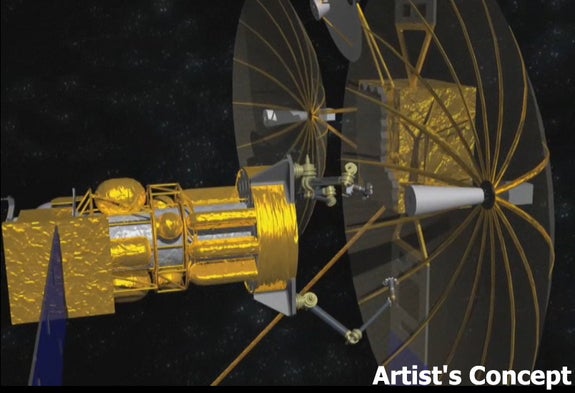
In late 2011, DARPA announced its intention to create an on-orbit capability to harvest dead satellites and recycle their parts into new orbiting communications outposts. In 2012, the research arm of the DoD is making good. Danger Room reports the agency has awarded its first contract ($2.5 million to a Northrop Grumman division for technology development), organized a summit on sustainable satellite servicing, and began seeking its first candidate satellite on which it hopes to demonstrate these technologies by 2015.
The program–called Phoenix–hopes to make use of all of the dead satellite hardware parked in geosynchronous “graveyard” orbits around Earth. While these satellites are largely out of propellant and loaded with old or obsolete technologies, some components–antennas are supposedly the primary target here–are still perfectly usable. DARPA envisions launching a largely autonomous servicing satellite armed with all kinds of robotic tools that is capable of rendezvousing with these dead satellites in space and stripping them of their useful parts.
But that’s only half the challenge. Assuming DARPA is able to build and launch such a robotic space salvager, it still needs a way to repurpose components on orbit. For that, the agency would also launch a bunch of “satlets”–small satellites stripped of all but the most necessary hardware–that would meet up with the larger service-sat in space. These satlets could then be fitted with antennas and other hardware and parked in their own orbits, after which they could be used by the Pentagon for bouncing communications across the globe or feeding data like drone footage to troops on the ground.
Such a system could drastically reduce the costs of the Pentagon’s space program, which spends millions keeping its space-based communications battle-ready. But nothing like this has ever been tried before. The servicing satellite alone would require a significant amount of robotic autonomy–it would need to know how best to dock with and dismantle a vast array of different satellite types–as well as a range of reusable robotic tools.
But as we noted when we first wrote about Phoenix in October of last year, if DARPA does pull this off it will end up with a suite of bleeding edge space and robotics technologies that could prove useful for a range of applications, both benign and decidedly military. So the DoD gets cheap communications satellites, but it also expands its on orbit capabilities. More over at Danger Room.
